A scalper averaging 30 trades per day on EUR/USD at a 0.1-pip cost differential gives up roughly $660 per month on a 1-standard-lot setup before commissions (30 trades times 0.1 pip times $10 per pip times 22 trading days). A 5-millisecond latency increase that consistently puts the trader on the wrong side of the spread on volatile ticks can convert a profitable strategy into a losing one inside a calendar quarter, without any change to the strategy itself. For scalping specifically, VPS choice is the infrastructure decision where the dollar consequences show up fastest. Generic forex VPS comparisons are about whether the trader’s setup runs reliably overnight. Scalping comparisons are about whether the tick that triggered the entry was the same tick the broker filled against.
Most scalping VPS comparisons do three things that quietly mislead readers. They rank the publisher’s own product at position 1 without acknowledging the conflict of interest, which is one of the patterns Google’s March 2026 spam and core updates penalised. They treat every “low-latency” claim as equivalent when retail VPS operating at 1 to 5 milliseconds and institutional FPGA HFT operating at 13.9 nanoseconds are categories separated by roughly five orders of magnitude. And they present vendor-published latency figures as if they had been independently audited, when no third party publishes audited tests for the retail forex VPS category. This guide takes the opposite approach on all three: the publisher appears at position 2 inside an explicit ordering rationale, the institutional-vs-retail gap is framed honestly with cited numbers, and every vendor-published performance figure is flagged as vendor-stated.
Eight providers are evaluated here, grouped by infrastructure tier with founding year as the tiebreaker within tiers. The framing is US-first because the largest concentration of retail forex broker infrastructure sits in Equinix NY4 and NY5 in Secaucus, New Jersey, with London’s LD4 in Slough as the European hub and CME Aurora as the futures-relevant alternative. VPSForexTrader is one of the eight evaluated providers and is the publisher of this guide. The methodology section below documents the data sources, verification dates, ordering rationale, and conflict of interest.
What this comparison found
BeeksFX is the institutional anchor in this comparison, publicly listed on the London Stock Exchange (Beeks Financial Cloud Group plc, ticker BKS) with retail VPS plans from £31 per month, broker white-label infrastructure powering FXCM, Pepperstone, Tickmill, and FxPro, and the only provider in this comparison with a documented FPGA NIC option (UberNic) for institutional deployments.
Among trading-focused retail specialists, VPSForexTrader is the only retail-specialist provider in this comparison with ECC RAM documented at the 4 GB entry tier paired with NVMe SSD storage, in the Smart plan at $25.59 per month on annual billing with a $0.99 three-day trial that runs in the exact Equinix NY2 and LD3 facilities where major brokers host their matching engines. ForexVPS.net (operated by ThinkHuge Ltd) holds the largest verified Trustpilot review base at 4.8 stars from 6,484 reviews and the broadest location footprint at 22 data centers. FXVM is operated by the same ThinkHuge Ltd entity as ForexVPS.net on shared infrastructure. TradingFXVPS markets AMD Ryzen 9 9950X processors with high single-core clock speeds and is the only provider in this comparison with a documented Chicago CME Aurora location.
AccuWeb Hosting describes its forex VPS in its own knowledgebase as “a specialized subset of Windows VPS hosting tailored specifically for forex trading,” which is the honest positioning for the price point (entry plans from $7.99 per month). Hostwinds offers general-purpose Windows VPS from $16.99 per month unmanaged with a 72-hour refund window, the shortest in this comparison. NextPointHost markets a premium reliability proposition with broad platform support including JForex for Dukascopy traders, but plan tiers and exact GBP pricing are not publicly published on indexable pages.
How this comparison was built
Pricing, plan specifications, trial terms, refund policies, and operational disclosures for every provider in this comparison were verified in June 2026 against each provider’s own checkout, pricing, and product documentation pages. Trustpilot ratings and review counts were verified directly on trustpilot.com at the same time. MetaTrader build numbers reflect current releases as documented in MetaQuotes’ release notes: MT4 build 1470 from March 12, 2026 and MT5 build 5830 from April 24, 2026. Broker colocation claims, where included, are sourced from each broker’s own infrastructure pages and not from VPS provider marketing.
Providers are ordered by infrastructure tier with founding year as the tiebreaker within tiers. Tier 1 contains providers with publicly documented institutional-grade infrastructure, defined here as listing on a public stock exchange, operating broker white-label infrastructure as a primary business line, or running Equinix colocation as the core product. Tier 2 contains trading-focused retail specialists with documented enterprise hardware, broker-hub locations, and published plan specifications. Tier 3 contains general-purpose Windows VPS providers and providers whose plan specifications or prices are not publicly documented.

Scalping-specific evaluation dimensions are weighted differently than for general forex VPS use. Broker-hub proximity (particularly to Equinix NY4 and LD4 for US-first relevance) weighs highest. Latency consistency (P99 tail latency and jitter) weighs above best-case latency. Hardware specifications oriented toward jitter reduction (ECC RAM, NVMe storage, dedicated CPU cores) weigh above raw resource count. Refund window length weighs more heavily because scalping requires validation across multiple market sessions.
VPSForexTrader is operated by HOSTLINE UAB (Lithuania) and is the publisher of this comparison. To address the conflict, the comparison places the publisher at position 2 inside the tier-based ordering rather than at position 1, documents the publisher’s limitations alongside its strengths in the per-provider section, and uses the same evaluation criteria for every provider. Latency claims published by any VPS provider in this comparison, including VPSForexTrader and every competitor listed, are commercially motivated and have not been independently replicated.
The 58.95 ms floor and the 13.9 nanosecond ceiling
Two physical constants set the boundaries of what a scalping VPS can and cannot do. Understanding both prevents the most expensive infrastructure decisions in the category.
The floor is the speed of light through fiber-optic cable. Light travels through silica fiber at approximately 203,000 kilometers per second, two-thirds of its speed in a vacuum. The transatlantic distance between New York and London is roughly 4,600 kilometers on the most direct undersea route. This produces a round-trip floor of just over 45 milliseconds in pure-physics terms, before any networking overhead is added.
In practice, the fastest documented round-trip latency between Equinix NY4 in Secaucus, New Jersey and Equinix LD4 in Slough, United Kingdom is sub-58.95 milliseconds, as published in Equinix’s press release dated November 3, 2015 announcing the connection of the Hibernia Express subsea cable system (now operated as EXA Express by EXA Infrastructure following the 2021 acquisition of GTT’s infrastructure assets). The cable uses Corning EX2000 pure-silica core fiber on its ultra-low latency fiber pair at 100 Gbps service, engineered specifically to shorten the New York to London route for financial markets traffic. The 58.95 ms figure represents the floor of what is physically possible on a transatlantic forex execution path. No VPS specification on any plan from any provider beats geography on this route.
The corollary is that same-facility colocation produces an entirely different latency regime. When a VPS sits inside the same Equinix building as the broker’s matching engine, the network path between them is one switch hop measured in meters of fiber rather than thousands of kilometers. This is the physical basis of the “sub-1 millisecond” latency marketing that dominates the forex VPS category. The geometry is real. The specific per-broker millisecond numbers published by individual providers are vendor-measured and not independently audited.
The ceiling is what “low latency” actually means at institutional scale. On June 27, 2024, AMD announced a STAC-T0 benchmark world record with Exegy at 13.9 nanoseconds actional latency, a 49 percent improvement on the prior 24.2 nanosecond record. STAC-T0 measures the time between transmission of simulated UDP market data and receipt of TCP orders from the system under test. The retail forex VPS category, including every provider in this comparison, operates at 1 to 5 milliseconds. Converted to a common unit, retail VPS runs at roughly 1,000,000 to 5,000,000 nanoseconds. The difference between retail VPS and institutional FPGA HFT is approximately 50,000-fold at the low end and 500,000-fold at the high end. The categories are not adjacent.
The Equinix Secaucus campus houses NY2, NY3, NY4, NY5, and NY6 as a single virtual campus connected by internal fiber cross-connects. NY4 specifically hosts over 1,115 companies and 115-plus network service providers per Equinix’s facility brochure, with direct interconnections to major financial exchanges, electronic trading platforms, and the Equinix Cloud Exchange documented on the IBX listing page. London’s LD4 in Slough is the corresponding European hub. CME Aurora in Illinois is the futures-relevant alternative. The practical reading instruction for the comparison table below is to treat the “locations” column as the most important specification on any provider’s plan page. A 2 GB VPS in Equinix NY4 will outperform a 16 GB VPS in a generic US-East data center 80 miles away for a scalper whose broker sits in NY4. RAM and CPU matter only after the location decision is correct.
Latency consistency, not best-case latency
Best-case ping numbers are advertising. Tail latency and jitter are what kill scalping strategies. This is the framework distinction most scalping VPS comparisons miss.
A VPS that runs 1.5 milliseconds round-trip consistently with sub-0.5 millisecond jitter beats a VPS that runs 0.3 milliseconds best-case but spikes to 12 milliseconds once per minute during volatility. The reason is straightforward: scalping strategies depend on the tick that triggered the entry being the same tick the broker fills against. A latency spike during the exact tick that triggered an entry order means the broker fills against the next tick, which on a 1-pip volatile move can convert a winning trade into a losing one. Best-case latency tells the trader what the path looks like when nothing is happening. P99 latency tells the trader what the path looks like during the ticks that matter most.
The contributors to jitter in a retail VPS environment include oversold CPU cores (when the hypervisor schedules multiple tenants onto the same physical cores and a noisy neighbor steals cycles during a burst), non-ECC RAM bit-flips (single-bit memory errors that cause silent corruption or platform stalls), SATA SSD I/O stalls during continuous tick logging, network buffer congestion on shared 1 Gbps uplinks, anti-virus or Windows Update interruptions running during market hours, and vendor maintenance windows that the trader was not notified about.
The hardware differentiation across this comparison that maps to jitter reduction:
- ECC RAM is documented across all plan tiers on VPSForexTrader’s public pricing pages. No other retail-specialist in this comparison documents ECC RAM as a public specification on their plan pages.
- NVMe storage is documented at the entry tier on VPSForexTrader and TradingFXVPS plan pages. ForexVPS.net runs SSD (not NVMe) at the entry tier. AccuWeb runs SSD. FXVM runs SSD on Lite VPS.
- Dedicated CPU cores are specified by VPSForexTrader (three AMD EPYC cores on Smart, six on Boost, eight on Max). FXVM’s Virtual Desktop tier is explicitly shared (shared AMD Ryzen 7950X3D).
- SolarFlare 10 GbE NIC documentation appears on TradingFXVPS plan pages but no other retail specialist in this comparison.
- BeeksFX offers UberNic, an FPGA-based NIC option, at institutional pricing tiers. No retail tier in this comparison documents FPGA NICs.
The validation method that works for scalping is a 48-hour test during volatility (London open, New York open, NFP release if available within the trial period), watching P99 latency and not minimum ping. The cheapest method for executing this validation in this comparison is VPSForexTrader’s $0.99 three-day trial. TradingFXVPS offers a $3.99 seven-day trial that covers a longer window. ForexVPS.net does not offer a paid trial but its 14-day money-back guarantee is the functional equivalent for traders willing to commit the full plan cost up front and refund if validation fails.
Single-core CPU clock, MT4 trade context, and the institutional-vs-retail gap
MetaTrader’s threading model dictates what scalpers actually need from a CPU. MT4 has one trade context per terminal: every OrderSend() call locks the trade thread until the server responds. A scalper running five Expert Advisors across five currency pairs in a single MT4 terminal can hit Error 146 “Trade Context Busy” during a tick burst because each EA’s order attempt is serialized through the single trade context. MT5 supports up to eight trade contexts, which makes it materially easier to scale multi-EA setups before saturation, but per-symbol execution is still single-threaded in most cases.
The implication for CPU selection is that one high-clock core beats many medium-clock cores for typical retail scalping. A 4.3 GHz core executing the trade-context lock release matters more than a 3.0 GHz core that has seven siblings available.
Provider hardware differentiation on single-core clock breaks down as follows. TradingFXVPS markets AMD Ryzen 9 9950X processors (4.3 GHz base, 5.0 GHz turbo) in its plan-related blog and marketing content. The 9950X model reference appears more prominently in TradingFXVPS’s marketing and comparison content than as an explicit specification on individual plan-page spec sheets, which is worth noting for scalpers verifying hardware before commitment. BeeksFX runs Intel Xeon processors, which deliver lower single-core clocks but more cores per socket at institutional densities. VPSForexTrader runs AMD EPYC processors (specific model not disclosed on public pricing pages); EPYC server processors generally trade single-core clock for core count, prioritizing parallel throughput. ForexVPS.net, FXVM, AccuWeb, Hostwinds, and NextPointHost do not document CPU model on their public plan pages.
The honest reading: TradingFXVPS positions itself around the single-core clock attribute that matches MT4’s threading model most directly, with the verification caveat. VPSForexTrader and BeeksFX optimize core count and ECC, which matches multi-terminal portfolio scalping and jitter reduction respectively.

The institutional contrast that protects credibility on this framework requires acknowledging where retail ends and institutional HFT begins. Retail forex VPS at $20 to $80 per month is not in the same category as institutional FPGA HFT operating at 13.9 nanoseconds. Per Virtu Financial’s most recent Q3 2025 earnings supplement, the firm’s adjusted Communications and Data Processing expense (covering data-center colocation, network lines, market-data fees, and microwave-network joint venture payments) ran $231 million for fiscal year 2023 and $236 million for fiscal year 2024, with $63 million in Q3 2025 alone and year-to-date 2025 spend of $184 million across the first three quarters. Virtu’s earlier 10-K filings disclose microwave-network joint venture payments specifically of $32.6 million, $27.7 million, and $25.3 million for fiscal years 2023, 2022, and 2021 respectively, which are payments to a joint venture that operates physical microwave towers between trading venues to shave microseconds off inter-exchange paths. CME Aurora colocation, where TradingFXVPS positions its CME-proximity offering, runs $12,000 per month per cabinet per third-party reporting, with CME’s own GLINK fee schedule confirming the 10 Gbps handoff component at $2,000 per month. Citadel Securities is privately held and files no 10-K, so no audited technology spend figure is public for that firm; Virtu serves as the citable institutional anchor.
The honest framing for retail traders is that a forex VPS removes the trader’s local internet connection as a bottleneck and shortens the network path to the broker. It does not produce institutional-scale execution advantages and should not be marketed as if it did. No third party publishes audited latency benchmarks for retail forex VPS because the economics do not exist: STAC Research’s clients pay for benchmarks that justify multi-million-dollar infrastructure decisions, and retail VPS at $20 to $80 per month does not generate that demand.
Broker scalping policy: who actually allows what
The infrastructure question is necessary but not sufficient. Broker policy on scalping varies across the ECN, STP, and market-maker brokers most likely to host the readers of this guide, and selecting a high-performance VPS for a broker that restricts scalping or caps message rates is a category of mistake worth surfacing before the per-provider sections.
The good news is that no major ECN or STP broker in the researched set restricts scalping outright in 2026. Restrictions are confined to two narrow cases: latency arbitrage, which Vantage explicitly prohibits, and message-rate caps on HFT-tier accounts that are not typically relevant for retail multi-EA setups. The broker policy table below covers the brokers whose execution servers sit in the Equinix facilities that dominate this comparison.
| Broker | Scalping policy | Execution model | Primary hosting |
| IC Markets | Explicitly allowed; no minimum hold, freeze level 0 | True ECN | Equinix NY4 (MT4, MT5), LD5 (cTrader) |
| Pepperstone | Allowed; Razor account ideal | STP / no dealing desk | BeeksFX-delivered VPS; LD4, NY4 |
| FP Markets | Allowed; Raw account ideal | ECN | NY4, LD4 |
| Vantage | Allowed; latency arbitrage prohibited | Hybrid ECN / STP | Equinix LD4, NY4 |
| Tickmill | Allowed explicitly across all accounts | Raw spreads from 0.0 pips | LD4 |
| ThinkMarkets | Allowed; no minimum hold | MT4, MT5, ThinkTrader | LD4, LD5 |
| Exness | Allowed; zero restrictions | Market execution | LD4, NY4, HK |
| RoboForex | Allowed; scalper-friendly | Hybrid STP / ECN | Multiple |
| OANDA | Allowed | Partners include BeeksFX, Liquidity Connect | NY4, LD4 |
| XM | Allowed | Market maker / STP | Multiple |
The implication for VPS selection: broker policy is a smaller differentiating factor than broker location. The single rule that constrains VPS selection on policy grounds is Vantage’s prohibition on latency arbitrage on its account types where that restriction is enforced. For every other broker in the table, the VPS selection decision is purely about location and infrastructure, not policy. Scalpers should confirm three things from the broker’s own documentation before selecting a VPS: which data center the broker’s matching engine sits in, whether the broker’s account-type policy supports scalping on the chosen account, and whether any message-rate caps apply at the trader’s volume.
Best Forex Vps For Scalping Providers
| Provider | Tier | Operator (founded) | Entry price (mo / yr) | CPU | RAM (entry) | ECC documented | Storage (entry) | Key locations | Trial / refund |
| BeeksFX | 1 | Beeks Financial Cloud Group plc (2010) | £31 / £310 yr | Intel Xeon | 2.56 GB | Not publicly specified | 30 GB (type not specified) | NY4, LD4, TY3, FRA, HK, CHI, Aurora | None / not publicly published |
| VPSForexTrader | 2 | HOSTLINE UAB (2011) | $31.99 / $25.59 | AMD EPYC (model not specified) | 4 GB | Yes, across all tiers | 120 GB NVMe | NY2, LD3, Amsterdam Serverius, HK4 | $0.99 / 3 days; 14-day refund |
| ForexVPS.net | 2 | ThinkHuge Ltd (2013) | ~$40 / ~$32 | Not publicly specified | 4 GB | Not publicly specified | 100 GB SSD | 22 locations incl. NY4, LD4, TY3 | None / 14-day refund |
| FXVM | 2 | ThinkHuge Ltd (2013) | $15 / Virtual Desktop full price (~$20 Lite VPS annual) | Customizable 1-4 cores (Lite: 2 cores) | 1.5-6 GB customizable (Lite: 1.5 GB) | Not publicly specified | 40-90 GB SSD (Lite: 60 GB SSD) | 15 locations | $0.99 / 7-day refund |
| TradingFXVPS | 2 | Next Era Pte Ltd (2014) | $25 / $17.50 | AMD Ryzen 9 9950X (marketing-stated) | 2 GB DDR5 | Not publicly specified | 30 GB NVMe | 8 locations incl. CME Aurora | $3.99 / 30-day refund |
| AccuWeb Hosting | 3 | AccuWeb Hosting (2003) | $7.99 / mo | Not publicly specified | 1.5 GB | Not publicly specified | 35 GB SSD | Denver, NY, LD, FRA | None / 7-day refund |
| Hostwinds | 3 | Hostwinds (2010) | $16.99 / mo | Intel Xeon | 1 GB | Not publicly specified | 30 GB SSD | Dallas, Seattle, Amsterdam | None / 72-hour refund |
| NextPointHost | 3 | Next Point Host LTD (2008) | Not publicly listed | Intel Xeon vCPU | 4 GB (one tier surfaced) | Not publicly specified | 40 GB SSD | LD, NY area, SG, FRA | Not publicly published |
All pricing, Trustpilot data, and operational disclosures verified June 2026. Latency figures published by every provider in this comparison are vendor-stated and have not been independently replicated.
BeeksFX
Source: beeksgroup.com
Beeks Financial Cloud is the only provider in this comparison that is publicly listed on a major stock exchange and the only one whose primary business is white-labeling trading infrastructure for retail brokers. The retail VPS catalogue at beeksfinancialcloud.com is the consumer-facing storefront of a broader institutional operation that supplies VPS, dedicated server, and cross-connect services to brokers including FXCM, Pepperstone, Tickmill, and FxPro. For scalpers, BeeksFX is the provider that operates closest to actual institutional trading infrastructure.
Infrastructure tier: Institutional, Equinix-colocated
Operator: Beeks Financial Cloud Group plc (LSE: BKS), Renfrew, Scotland, founded 2010
The retail catalogue lists three tiers. Bronze at £31 per month provides 1 vCPU, 2.56 GB of RAM, and 30 GB of storage, sized for two to four MT4 terminals per the catalogue page. Silver at £55 per month doubles resources to 2 vCPU, 4 GB RAM, and 50 GB storage. Gold at £97 per month provides 4 vCPU, 6.5 GB RAM, and 75 GB storage. Annual billing follows a 12-months-for-the-price-of-10 structure, placing Bronze at £310 per year.
Locations on the retail catalogue include London (Equinix LD4), New York (Equinix NY4), Tokyo (Equinix TY3), Hong Kong, Frankfurt, Chicago, and CME Aurora for institutional and futures-relevant deployments. Cross-connect latency is marketed at 0.3 milliseconds and up, which should be read with the vendor-stated latency caveat from the framework section above. The UberNic FPGA-based NIC option is available at institutional pricing tiers and represents the only documented FPGA NIC offering in this comparison, though it is not part of the £31 retail entry tier.
Operational caveats matter for scalpers. Storage type (NVMe or SSD) is not publicly specified on the retail catalogue. ECC RAM is not publicly specified either, which limits how confidently the entry tier can be evaluated for jitter resistance. GBP pricing creates foreign-exchange variability for US-first buyers, compounding month over month for traders paying in dollars.
Bottom line: institutional infrastructure with cross-connect availability and FPGA NIC at higher tiers; best suited to scalpers prioritizing the LSE-listed institutional pedigree over high-RAM entry-tier value.
Strengths: publicly listed institutional pedigree (LSE: BKS); operates broker white-label infrastructure for FXCM, Pepperstone, Tickmill, and FxPro; documented Equinix NY4 and LD4 presence; broad location footprint covering NY4, LD4, TY3, Frankfurt, Hong Kong, Chicago, and CME Aurora; UberNic FPGA NIC option available at institutional tiers.
Limitations: Bronze tier 2.56 GB RAM is below the practical multi-terminal floor for scalping setups; retail storage type not publicly specified; ECC RAM status not publicly specified on retail catalogue; GBP pricing creates foreign-exchange variability for US-first buyers; latency figures published are vendor-stated.
VPSForexTrader
Source: vpsforextrader.com
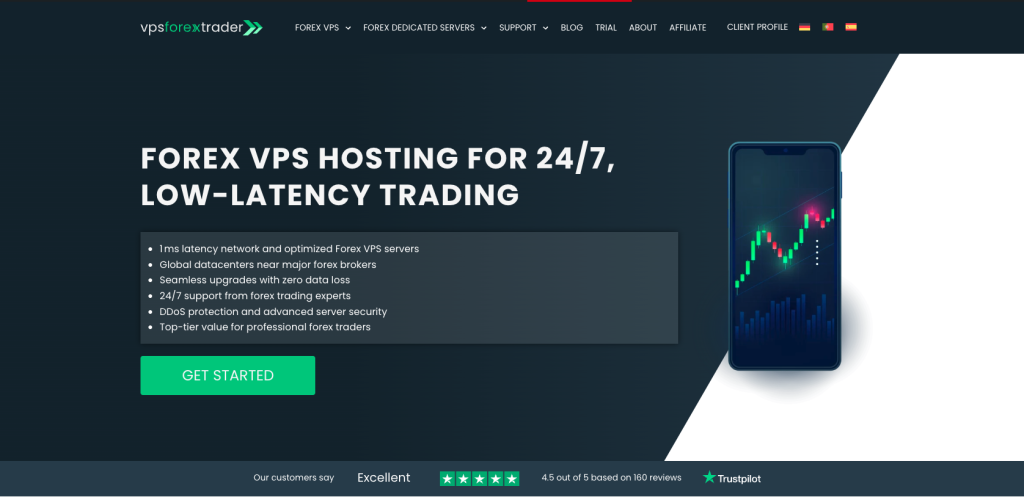
VPSForexTrader is the only retail-specialist provider in this comparison with ECC RAM documented at the 4 GB entry tier paired with NVMe SSD storage. The Smart plan at $25.59 per month on annual billing provides 4 GB of ECC RAM, three dedicated AMD EPYC cores, and 120 GB of NVMe storage, with a $0.99 three-day trial that runs in the exact Equinix NY2 and LD3 facilities where major brokers host their matching engines. Every other Tier-2 specialist’s entry plan in this comparison either runs less RAM (TradingFXVPS Standard 2 GB DDR5; FXVM Lite 1.5 GB), runs SSD rather than NVMe storage at the entry tier (ForexVPS.net Core 4 GB on SSD), or does not publicly document ECC RAM specification, making the Smart plan the lowest-priced option in this comparison that combines documented ECC RAM at the entry tier with same-facility colocation access for multi-EA scalping setups.
Infrastructure tier: Trading-focused retail specialist
Operator: HOSTLINE UAB, Lithuania, operating since 2011
The Smart plan at $31.99 per month on monthly billing or $25.59 per month on annual billing covers three dedicated AMD EPYC cores, 4 GB ECC RAM, and 120 GB NVMe SSD storage. The Boost plan at $54.99 monthly or $41.24 annual provides six dedicated cores, 6 GB ECC RAM, and 180 GB NVMe storage, sized for seven concurrent MetaTrader terminals per the provider’s plan page. The Max plan at $79.99 monthly or $59.99 annual provides eight dedicated cores, 8 GB ECC RAM, and 250 GB NVMe storage, sized for ten terminals. All three tiers run Windows Server 2022 standard. Linux is not offered. MetaTrader installation is manual via Remote Desktop Protocol.
The $0.99 trial covers three days at full Smart-plan specifications. The trial converts automatically to a standard $31.99 monthly subscription if the trader does not cancel before expiration, with an email reminder before conversion. The 14-day money-back guarantee applies to VPS plans for traders who proceed past the trial period. Backup policies are weekly on Smart and daily on Boost and Max, included at no additional charge. A documented operational policy commits to not terminating service for billing issues during active forex trading days.
The four-location list (Equinix NY2, LD3, Amsterdam Serverius, HK4) is narrower than ForexVPS.net’s 22-location footprint or FXVM’s 15-location footprint. Scalpers whose brokers are hosted in Tokyo TY3, Sydney, Frankfurt FR5 specifically, the CME Aurora futures facility, or Asia-Pacific markets outside Hong Kong should evaluate ForexVPS.net, FXVM, or TradingFXVPS for broader geographic coverage. The specific AMD EPYC processor model is not disclosed on the public pricing pages. No service-level agreement percentage is published on the official site.
The Trustpilot review base sits at over 160 reviews as of June 2026, with third-party listings citing aggregate ratings between 4.3 and 4.7 stars depending on the snapshot date and source; the trustpilot.com page itself displays 161 verified reviews on the most recent direct snapshot accessible in this research (deep-fetch was bot-blocked, so the exact rating should be re-verified at publication). The review base is smaller than ForexVPS.net’s 6,484 or FXVM’s 3,600 plus reviews, reflecting that VPSForexTrader is a more focused retail brand.
Bottom line: VPSForexTrader is the only retail-specialist in this comparison combining ECC RAM, NVMe storage, and dedicated AMD EPYC cores at the 4 GB entry tier with same-facility Equinix NY2 and LD3 access and a $0.99 trial; particularly well-positioned for US-first scalpers running multi-EA setups against brokers colocated in those exact facilities.
Strengths: ECC RAM, AMD EPYC processors, and NVMe SSD documented across every plan tier on public pricing pages (the only retail-specialist in this comparison with this combination); Equinix NY2, LD3, Amsterdam Serverius, and HK4 locations confirmed; $0.99 three-day trial is the cheapest real-broker validation method in this comparison; 14-day money-back guarantee; free backups across all tiers; documented operational policy around continuity during trading days for overdue payments.
Limitations: four locations only, without Tokyo TY3, Sydney, Frankfurt FR5, or CME Aurora coverage; specific AMD EPYC processor model not disclosed on public pricing pages, which limits single-core clock comparison; no SLA percentage published on the official site; no Linux option; manual MetaTrader installation required via RDP; Trustpilot review base is smaller than ForexVPS.net’s or FXVM’s; latency figures published by VPSForexTrader, like every provider in this comparison, are vendor-stated and have not been independently replicated.
ForexVPS.net

Source: forexvps.net
ForexVPS.net is the provider with the largest verified Trustpilot review base in this comparison and the broadest data center footprint at 22 global locations. Operated by ThinkHuge Ltd from Hong Kong since 2013, it covers more broker hubs than any other retail specialist in this comparison.
Infrastructure tier: Trading-focused retail specialist
Operator: ThinkHuge Ltd, Hong Kong, founded 2013
Public pricing places the Core plan at approximately $40 per month monthly or $32 per month annual, providing 2 CPU cores, 4 GB RAM, and 100 GB SSD storage, sized for one to three MetaTrader platforms. The Edge plan at approximately $49 per month provides 4 cores, 6 GB RAM, and 150 GB SSD. The Prime plan at approximately $67 per month provides 6 cores, 8 GB RAM, and 200 GB SSD. The refund window is 14 days on VPS plans.
The Trustpilot listing displays 4.8 stars from 6,484 reviews as of June 2026, the largest verified review base of any provider in this comparison. Recent reviews praise customer support and reliability.
The 22-location footprint includes Equinix NY4, LD4, TY3, Hong Kong, Singapore, Sydney, Amsterdam, Frankfurt, Zurich, and other hubs. Specific Equinix facility codes are confirmed for NY4, LD4, and TY3; other locations are named at the city level without explicit facility codes. RAM type is not publicly specified as ECC. Storage is described as SSD, with NVMe used on higher tiers but not consistently flagged on entry-tier specifications.
The disclosure that matters most here is the shared parent company with FXVM. ThinkHuge Ltd operates both brands, both share infrastructure, and both share a single status page. In August 2025, a fiber-related network failure took ForexVPS.net offline for approximately 24 hours. The same outage took FXVM offline simultaneously, because the two brands share the affected infrastructure. Scalpers considering running both brands for production redundancy should understand that this is effectively running one provider on two brand names.
Bottom line: largest verified Trustpilot review base and broadest location footprint in this comparison; the strongest match for scalpers prioritizing geographic flexibility across multiple broker locations, with the caveat that running FXVM alongside does not provide independent redundancy.
Strengths: largest verified Trustpilot review base in this comparison (6,484 reviews at 4.8 as of June 2026); 22-location footprint is the broadest in the comparison and includes confirmed Equinix NY4, LD4, and TY3; established operator with 13 years of trading history; 14-day money-back guarantee.
Limitations: RAM type not specified as ECC on public plan pages; storage is generally SSD rather than NVMe at the entry tier; shared infrastructure with FXVM under the same parent (ThinkHuge Ltd) limits the value of using both for redundancy; the August 2025 outage took both ThinkHuge brands offline simultaneously for approximately 24 hours; latency figures published are vendor-stated.
FXVM

Source: fxvm.net
FXVM is the second ThinkHuge Ltd brand in this comparison and the budget-oriented sibling of ForexVPS.net. The two brands share corporate ownership, share infrastructure, and share a single status page.
Infrastructure tier: Trading-focused retail specialist (budget tier of shared infrastructure)
Operator: ThinkHuge Ltd, Hong Kong, founded 2013
The Virtual Desktop tier is listed at $15 per month full price on fxvm.net (with a sitewide promotional discount of 15 percent under the FXVM4LIFE code bringing it to roughly $12.75 per month at the time of writing), with customizable resources documented at 1 to 4 CPU, 1.5 GB to 6 GB RAM, and 40 GB to 90 GB SSD. The tier is limited to one trading platform and does not support DLL-dependent EAs. The Lite VPS tier at approximately $20 per month annual provides 2 cores, 1.5 GB of RAM, and 60 GB of SSD storage. The 1.5 GB RAM specification is below the practical floor for multi-terminal scalping setups: after Windows Server overhead of 800 megabytes to 1.2 gigabytes, the remaining 300 to 700 megabytes of usable RAM cannot reliably hold a single MetaTrader terminal running multiple EAs with charts and indicators loaded.
The Basic VPS at approximately $30 per month annual provides 2 cores, 2.5 GB RAM, and 80 GB SSD. The Advanced VPS at approximately $42 per month annual provides 2 cores, 4 GB RAM, and 90 GB SSD, which crosses the multi-terminal threshold. The trial is $0.99 with a 7-day money-back guarantee.
The 15-location footprint includes New York, Washington DC, Chicago, Miami, London, Manchester, Amsterdam, Zurich, Frankfurt, Singapore, Tokyo, Mumbai, Sydney, and Hong Kong. Specific Equinix facility codes are not consistently published. The Trustpilot rating is 4.8 out of 5 from over 3,600 reviews as of June 2026, the second-largest verified review base in this comparison.
The shared-infrastructure disclosure is load-bearing for FXVM. The August 2025 outage demonstrated that ForexVPS.net and FXVM are not independent providers from an operational risk perspective.
Bottom line: lowest entry-tier prices in the trading-focused specialist group but with a 1.5 GB Lite tier that does not meet the practical RAM floor for multi-EA scalping; appropriate for budget-conscious single-platform scalpers, not for redundancy planning alongside ForexVPS.net.
Strengths: large verified Trustpilot review base (3,600+ reviews at 4.8); 15-location footprint; ISO 27001 certification disclosed; competitive entry pricing including a Virtual Desktop tier below the $15 per month threshold.
Limitations: Lite VPS tier at 1.5 GB RAM is below the practical floor for multi-EA scalping setups after Windows overhead; shared infrastructure with ForexVPS.net under the same parent (ThinkHuge Ltd) means running both for redundancy provides limited benefit; the August 2025 outage took both brands offline simultaneously for approximately 24 hours; backup policy is not consistently documented across FXVM’s public pages; Virtual Desktop tier is limited to one trading platform and does not support DLL-dependent EAs.
TradingFXVPS
Source: tradingfxvps.com
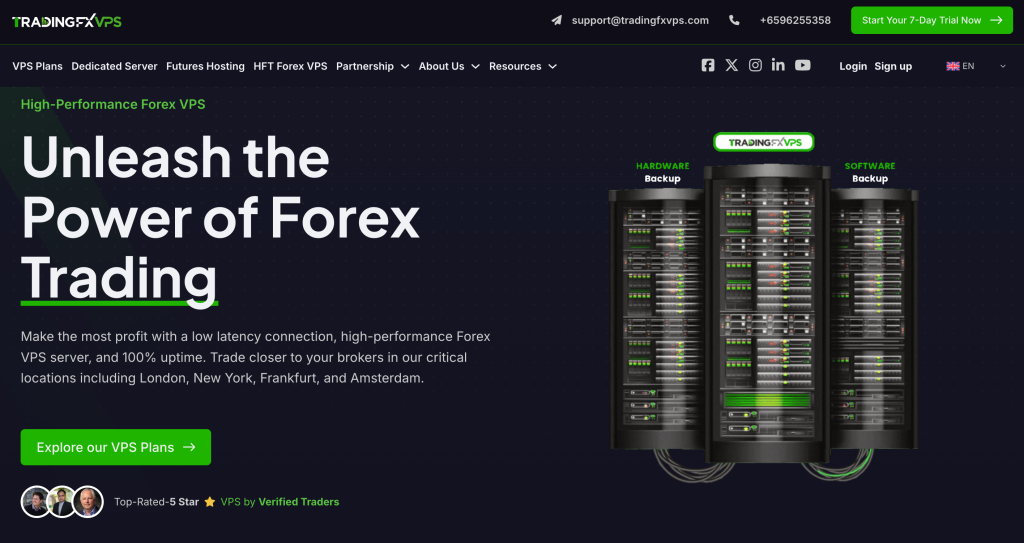
TradingFXVPS is the Singapore-incorporated specialist that positions itself around high single-core clock speeds for latency-sensitive workloads, and the only provider in this comparison with a documented CME Aurora location.
Infrastructure tier: Trading-focused retail specialist
Operator: Next Era Pte Ltd (also listed as High Frequency Trading Network Pte Ltd), Singapore, founded 2014
The Standard plan at $25 per month monthly or $17.50 per month annual provides 1 core, 2 GB DDR5 RAM, and 30 GB NVMe RAID storage. The Standard+ tier at approximately $22.11 per month annual provides 2 cores and 2.5 GB RAM. The Advanced tier at approximately $33.75 per month annual provides 2 cores and 4 GB RAM. The Expert tier at approximately $63.75 per month annual provides 4 cores and 8 GB RAM. Specialized HFT VPS plans start at $75 per month and Futures VPS plans at $40 per month.
The 8-location footprint includes New York, London, Frankfurt, Amsterdam, Chicago at the CME Aurora facility, Singapore, Tokyo, and Hong Kong. The CME Aurora location is the only such documentation in this comparison and is the operative differentiation for futures scalpers running CME products. The provider markets per-broker latency figures of 0.28 to 0.33 milliseconds to ICM Capital, Pepperstone, and Vantage, which should be read with the vendor-stated latency caveat. SolarFlare 10 GbE network cards are documented on plan pages.
The Trustpilot rating sits at approximately 4.6 from 300 plus reviews. The trial is $3.99 for 7 days and the money-back guarantee is 30 days, the longest refund window in this comparison and a meaningful validation advantage for scalpers who want time to test across multiple market sessions.
The AMD Ryzen 9 9950X processors (4.3 GHz base, 5.0 GHz turbo) appear more prominently in TradingFXVPS’s plan-related blog content and comparison materials than as explicit specifications on individual plan-page spec sheets. Entry-tier plans default to Windows Server 2016, which exits Microsoft extended support on January 12, 2027 per Microsoft’s lifecycle documentation. The platform also sells forex signals and a third-party Expert Advisor product, which is unusual among VPS-focused providers and worth noting for scalpers who prefer a hosting provider that does not also sell trading products.
Bottom line: the only provider in this comparison with documented CME Aurora location and the longest refund window (30 days); the obvious choice for futures scalpers needing CME proximity, with the caveat that the entry tier defaults to Windows Server 2016 and the 9950X model reference is marketing-located rather than plan-page-located.
Strengths: AMD Ryzen 9 9950X processors with high single-core clock speed documented in plan-related content; DDR5 RAM and NVMe RAID storage at the entry tier; only provider in this comparison with documented CME Aurora location; 30-day money-back guarantee is the longest in this comparison; SolarFlare 10 GbE network cards documented; 8-location footprint covers major hubs.
Limitations: entry tier defaults to Windows Server 2016 which exits Microsoft extended support on January 12, 2027; Standard plan 2 GB RAM is close to the practical floor for multi-terminal scalping setups; RAM type not specified as ECC on public plan pages; provider also sells forex signals and a third-party EA product; AMD Ryzen 9 9950X model reference appears mainly in blog and comparison content rather than on plan-page spec sheets; latency figures published are vendor-stated.
AccuWeb Hosting
Source: accuwebhosting.com
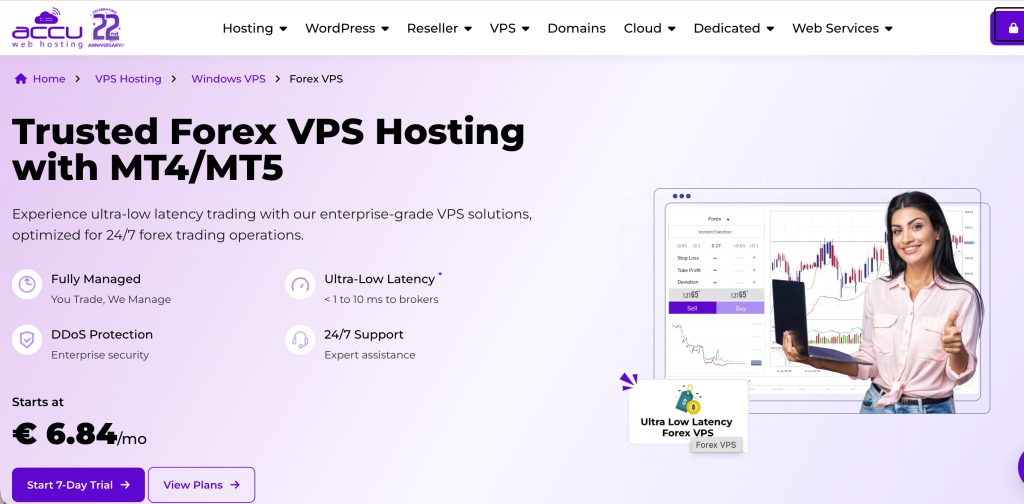
AccuWeb Hosting describes its Forex VPS offering in its own knowledgebase as “a specialized subset of Windows VPS hosting tailored specifically for forex trading.” This is the honest positioning for a general-purpose Windows VPS provider that markets a trading-relevant tier.
Infrastructure tier: General-purpose Windows VPS with forex marketing
Operator: AccuWeb Hosting, US-based, founded 2003
Forex VPS plans start at $7.99 per month for Forex VPS 1, climbing through Forex VPS 2, 3, and 4 (4 vCPU, 8 GB RAM, 50 GB SSD at the top tier). The provider runs SSD storage rather than NVMe and markets a 99.99 percent uptime guarantee. The refund window is 7 days.
Available locations include Denver, New York, Hyderabad, London, and Frankfurt, with weekly complimentary backups in London, Denver, and New York facilities. Windows Server 2019 is the baseline operating system; Windows Server 2022 is available in Denver, Hyderabad, and London; Windows Server 2025 is available in Denver and London on plans with 3 GB or more RAM. The provider does not claim broker-hub colocation or specialized network paths to liquidity providers.
For scalpers whose use case is a single MetaTrader terminal running a simple EA with broker proximity as a secondary consideration, AccuWeb’s pricing makes the trade-off reasonable. For scalpers whose execution depends on broker-hub colocation or tick-level jitter management, the trading-focused specialists in Tier 2 are better fits.
Bottom line: honest budget positioning as a “specialized subset of Windows VPS hosting” (the provider’s own words) at $7.99 entry; a reasonable choice for single-terminal scalpers running simple EAs for whom broker-hub proximity is secondary, not for tick-level jitter-sensitive setups.
Strengths: competitive entry pricing from $7.99 per month; established hosting provider with over 20 years of operating history; multiple Windows Server versions available; weekly complimentary backups in London, Denver, and New York; 24/7 multi-channel support; honest self-positioning as a Windows VPS subset.
Limitations: SSD storage rather than NVMe at entry tiers; ECC RAM not publicly specified; not specialized trading infrastructure and no documented broker-hub colocation; entry-tier RAM (1.5 GB) is below the practical multi-terminal floor; 7-day refund window is shorter than ForexVPS.net’s or VPSForexTrader’s.
Hostwinds

Source: hostwinds.com
Hostwinds is a general-purpose Windows VPS provider rather than a forex specialist. For scalping, it is viable only for traders comfortable configuring a Windows VPS themselves who do not require broker-hub optimization.
Infrastructure tier: General-purpose Windows VPS
Operator: Hostwinds, US-based, founded 2010
Unmanaged Windows VPS plans start at $16.99 per month, scaling to 16 CPU cores, 96 GB RAM, and 750 GB of storage at the top tier. The hardware uses Intel processors with SSD storage and 1 Gbps networking. The provider markets a 99.9999 percent uptime guarantee, which should be read as marketing rather than as an audited SLA.
Operating system options include Windows Server 2012, 2016, and 2019. Nightly backups, snapshots, and cloud firewall are paid add-ons rather than included by default. The refund window is 72 hours, the shortest in this comparison and a procurement constraint for scalpers who plan to test across both London open and New York open trading sessions over a weekend.
The location footprint is limited to US (Seattle and Dallas) and Amsterdam (EU). The provider does not market broker-hub colocation, does not document specific Equinix facility codes, and does not optimize network paths for trading workloads. A Hostwinds VPS in Seattle routing to a broker hosted in Equinix NY4 will incur cross-continental latency that no specification on the VPS can compensate for, which makes Hostwinds a structural mismatch for scalping setups against NY4-hosted brokers regardless of plan tier.
Bottom line: mainstream hosting brand running general-purpose Windows VPS that is not optimized for trading; viable for technically comfortable scalpers blending non-trading workloads with one MetaTrader instance on a familiar hosting platform, not for execution-sensitive scalping setups.
Strengths: mainstream hosting brand with broad product range; scalable plan tiers up to 16 cores and 96 GB RAM; flexible OS choices including legacy Windows Server versions; managed and unmanaged options.
Limitations: 72-hour refund window is the shortest in this comparison; not optimized for forex execution and no documented broker-hub colocation; only US (Seattle, Dallas) and Amsterdam locations, none at named Equinix facilities; backup, monitoring, and DDoS protection are paid add-ons; broker proximity requires manual planning by the trader.
NextPointHost

Source: nextpointhost.com
NextPointHost markets a premium reliability proposition with broad platform support including JForex for Dukascopy traders, but plan tiers and exact GBP pricing are not publicly published on indexable pages.
Infrastructure tier: Premium-positioning with opaque pricing
Operator: Next Point Host LTD, founded 2008
One specification block surfaced during research describes a tier with 2 Intel Xeon vCPUs, 4 GB of guaranteed RAM, 40 GB of SSD storage, unlimited bandwidth, 10 Gbps networking, dedicated IP, and capacity for up to 10 trading accounts. Locations include London, New York, Singapore, and Frankfurt. Specific Equinix facility codes are not named on NextPointHost’s own pages. The UK address is at Slough Trading Estate and the US address is at 755 Secaucus Road, which is the Equinix NY4 building, suggesting a presence at LD4 and NY4 though the codes are not explicitly stated.
Platform support is broad, including MT4, MT5, cTrader, JForex (Dukascopy), NinjaTrader, TradeStation, and MultiCharts, which is wider than most competitors in this comparison. JForex support is the operative differentiator for Dukascopy scalpers specifically.
The Trustpilot rating is 2.3 out of 5 from 8 reviews as of June 2026, a small review base. Independent listings on Forex Peace Army and Myfxbook include billing complaints.
The honest reading of NextPointHost for scalping is that the lack of publicly listed plan tiers and prices is itself a procurement risk. Scalpers cannot evaluate plan-to-plan value without entering the order flow.
Bottom line: broadest platform support in this comparison (including JForex for Dukascopy scalpers) but opaque pricing limits value evaluation from public information; appropriate only for scalpers whose platform requirements specifically demand JForex, NinjaTrader, or MultiCharts coverage.
Strengths: broad platform support including JForex, NinjaTrader, TradeStation, and MultiCharts (the widest range in this comparison); UK and US addresses consistent with LD4 and NY4 facility presence; established operator with over 15 years of operating history.
Limitations: plan tiers and exact GBP pricing not publicly listed on indexable pages, which limits comparison value; Trustpilot rating is low (2.3) on a small review base of 8 reviews; independent listings include billing complaints; specific Equinix facility codes not named on the provider’s own pages; pricing transparency itself is a procurement risk.
Common mistakes that cost scalpers money
Five mistakes show up repeatedly in scalping VPS selection, each with specific consequences mapping to the providers in this comparison.
The first is optimizing for best-case ping instead of P99 jitter. Best-case latency figures published by VPS providers are advertising. A VPS marketed at 0.3 milliseconds that spikes to 12 milliseconds once per minute during NFP is materially worse for scalping than a 2-millisecond VPS with sub-0.5-millisecond jitter, because the latency spikes correlate with exactly the moments when execution accuracy matters most. The validation method that works is a 48-hour test during volatility sessions watching P99 latency, not minimum ping. Plans below 2 GB RAM, including the FXVM Lite tier at 1.5 GB, contribute to jitter because there is insufficient headroom for the OS to handle background tasks without swapping to disk during tick bursts.
The second is buying institutional-grade marketing at retail prices. Phrases like “HFT VPS” and “ultra-low latency for high-frequency trading” at $20 to $80 per month are marketing, not infrastructure parity with Virtu Financial’s approximately $236 million in fiscal year 2024 Communications and Data Processing expense (covering data-center colocation, network lines, market-data fees, and microwave-network joint venture payments). The honest reading: retail VPS removes the trader’s home internet connection as a bottleneck and shortens the network path to the broker. It does not deliver institutional execution advantages.
The third is choosing the wrong location regardless of specs. A Hostwinds VPS in Seattle for an IC Markets account hosted in Equinix NY4 in Secaucus loses to a 2 GB VPS inside NY4. The 58.95-millisecond transatlantic floor between NY4 and LD4 is the geometric reality that defines this trade-off, and the cross-continental US gap is similar in magnitude. Verify the broker’s data center facility from the broker’s own infrastructure documentation before selecting a VPS location.
The fourth is treating ForexVPS.net and FXVM as redundancy. Both are operated by ThinkHuge Ltd on shared infrastructure. The August 2025 fiber-related network failure took both brands offline simultaneously for approximately 24 hours. A scalper running one MetaTrader instance on ForexVPS.net and a second on FXVM for redundancy purposes is running both instances on shared infrastructure that can fail simultaneously.
The fifth is ignoring MT4’s single trade context limit. MT4 has one trade context per terminal; OrderSend() locks the trade thread until the server responds. A scalper running five Expert Advisors across five currency pairs in a single MT4 terminal can hit Error 146 “Trade Context Busy” during tick bursts. The fixes: run one EA per terminal (multiple terminal instances on the same VPS), use IsTradeContextBusy() checks in EA code, or migrate to MT5 (eight trade contexts).
Use case routing
For US-first scalpers running multiple MetaTrader terminals with copy-trading workloads or memory-sensitive Expert Advisors against brokers colocated in Equinix NY2 or LD3, the routing is VPSForexTrader’s Smart plan at $25.59 per month annual (4 GB ECC RAM, 120 GB NVMe, three AMD EPYC cores) or Boost plan at $41.24 per month annual (6 GB ECC RAM, 180 GB NVMe, six cores). The operative facts are the documented ECC RAM at entry tier and the same-facility Equinix NY4 and LD4 colocation.
For scalpers running a single Expert Advisor on a single broker connection on the tightest possible budget, the appropriate routing is MetaQuotes Built-in Virtual Hosting at approximately $12.80 per month on annual billing (one trading account per subscription, 64-bit MT5 required, DLL-dependent EAs unsupported per MetaQuotes service rules) or a broker-sponsored free VPS where the trader actually meets the volume threshold. IC Markets sponsors a third-party VPS subscription for clients trading 15 or more standard lots per month in forex or metals, which is the clearest-sourced threshold example. Sponsored-VPS thresholds vary by region and account type across brokers, and Pepperstone’s program in particular has been documented differently across sources (10 lots over 60 days versus $500 equity plus 20 lots per month), so the threshold should be verified directly with the broker before relying on the sponsored program.
For scalpers requiring institutional-grade infrastructure inside specific broker data centers with documented cross-connects to liquidity providers, the routing is BeeksFX. The Bronze plan starts at £31 per month and the Silver plan at £55 per month. Beeks operates as the underlying infrastructure for FXCM, Pepperstone, Tickmill, and FxPro retail VPS offerings, which means a scalper buying BeeksFX directly is buying the same institutional backbone the brokers use, at retail pricing.
For scalpers whose brokers are hosted in less common locations or who run multi-region scalping setups across Tokyo, Sydney, Mumbai, or other Asia-Pacific markets, the routing is ForexVPS.net for breadth (22 locations) or FXVM for similar breadth at lower entry pricing, with the shared-infrastructure caveat that the two brands do not provide independent redundancy.
For futures scalpers with CME products who need proximity to the CME Aurora data center, the routing is TradingFXVPS Standard at $17.50 per month annual or higher tiers as workload requires. TradingFXVPS is the only provider in this comparison with a documented CME Aurora location, and the 30-day refund window provides the longest validation runway.
For scalpers needing a general-purpose Windows VPS for non-trading workloads alongside one MetaTrader instance, the routing is Hostwinds ($16.99 per month unmanaged) or AccuWeb ($7.99 per month) with the explicit limitation that these are not specialized trading infrastructure and broker-hub proximity is the trader’s responsibility to validate.
Three findings from this comparison
Three findings emerge from the eight-provider comparison that are not obvious from any single plan page.
The first is that the honest scalping latency picture is two-tier, not one-tier. Same-facility colocation produces real sub-millisecond paths (verifiable physics). Cross-facility or cross-metro paths produce 5 to 20 milliseconds with vendor-stated figures of “0.3 ms” that are not replicable against the trader’s actual broker connection. A scalper who treats all “low-latency” marketing as equivalent is making a category error.
The second is that best-case latency advertising hides the metric that matters for scalping. Every provider in this comparison publishes best-case figures. None publishes P99 latency or jitter measurements. The 48-hour validation discipline during volatility sessions is the only way to know whether a VPS holds during the ticks that matter most. The cheapest tool for this validation in this comparison is VPSForexTrader’s $0.99 three-day trial; TradingFXVPS’s $3.99 seven-day trial provides a longer window; ForexVPS.net’s 14-day money-back guarantee is the functional equivalent for traders willing to commit the full plan cost up front.
The third is that the brokers whose execution models matter most for scalpers are remarkably permissive on policy, with one important exception. No major ECN or STP broker in the researched set restricts scalping outright. The exception is latency arbitrage, which Vantage explicitly prohibits. Broker selection on policy grounds is a smaller factor than broker location: the same broker can be the right choice for a scalper if its servers sit in the trader’s preferred VPS facility, and the wrong choice if its servers sit elsewhere regardless of the broker’s policy stance.
Frequently asked questions
Is scalping allowed on IC Markets, Pepperstone, FP Markets, and Exness?
Yes on all four. IC Markets explicitly allows scalping with no minimum hold time, freeze level zero, and a True ECN execution model with servers in Equinix NY4 (MT4, MT5) and LD5 (cTrader). Pepperstone allows scalping with the Razor account ideal for execution-sensitive setups; STP execution and BeeksFX-delivered VPS for sponsored hosting. FP Markets allows scalping with the Raw account ideal; ECN execution with NY4 and LD4 hosting. Exness allows scalping with zero restrictions on hold time or distance. The only major scalping restriction in the broker set researched for this article is latency arbitrage, which Vantage explicitly prohibits.
What latency do I actually need for scalping?
Same-facility colocated retail VPS operates at 1 to 5 milliseconds round-trip to the broker matching engine. Cross-metro or cross-regional routing typically produces 5 to 20 milliseconds. The 58.95-millisecond transatlantic floor between Equinix NY4 and LD4 is the documented physical floor for NY-London paths (Equinix press release, November 2015, on Hibernia Express, now operated as EXA Express). For typical retail scalping strategies, latency under 20 milliseconds is acceptable, but P99 latency consistency under 5 milliseconds during volatility is what separates VPS choices that hold during the ticks that matter from those that do not.
Does ECC RAM matter for a scalping VPS, and which providers document it?
ECC RAM (error-correcting code memory) detects and corrects single-bit memory errors at the hardware level. For VPS deployments running continuously for weeks or months without restarts, which is the standard pattern for Expert Advisor scalping, ECC reduces the probability of memory-error-induced platform stalls or undetected data corruption during the tick bursts when execution accuracy matters most. Across the eight providers in this comparison, VPSForexTrader is the only retail-specialist that documents ECC RAM on every plan tier on its public pricing pages (Smart 4 GB ECC, Boost 6 GB ECC, Max 8 GB ECC). BeeksFX does not publicly specify RAM type on its retail catalogue. ForexVPS.net, FXVM, TradingFXVPS, AccuWeb Hosting, Hostwinds, and NextPointHost do not flag ECC RAM as a documented specification on their public plan pages.
MT4 or MT5 for scalping?
MT5 is the more scalable choice for multi-EA scalping setups because of the trade context difference. MT4 has one trade context per terminal: OrderSend() locks the trade thread until the server responds. A scalper running multiple EAs across multiple currency pairs in a single MT4 terminal can hit Error 146 “Trade Context Busy” during tick bursts. MT5 supports up to eight trade contexts, which makes it materially easier to scale before saturation. Per-symbol execution is still single-threaded in most cases, so single-core CPU clock remains relevant on both platforms.
Can I scalp on the free MetaQuotes Virtual Hosting at $12.80 per month?
Yes for single-account, DLL-free scalping. No for multi-account or DLL-dependent EA scalping. MetaQuotes Built-in Virtual Hosting at $15 per month monthly or $12.80 per month annual covers one trading account per subscription, requires 64-bit MT5 for the MT5 version, and explicitly does not support Expert Advisors that import DLLs (the service rules at mql5.com/en/vps/rules document this restriction). For a scalper running a single MQL-only EA on a single broker account, MetaQuotes Virtual Hosting offers the lowest-cost path with strong proximity to MetaQuotes’ broker-hosting partners.
How do I validate a scalping VPS before committing?
The 48-hour test methodology: open a paid trial or refund-protected plan, set up the actual MetaTrader configuration the scalping strategy uses (charts, indicators, EAs, broker account), and run the configuration during at least one London open and one New York open session within the trial period. Watch P99 latency and jitter, not minimum ping. The cheapest validation method in this comparison is VPSForexTrader’s $0.99 three-day trial. TradingFXVPS offers a $3.99 seven-day trial covering a wider window including a Friday-Monday weekend. ForexVPS.net’s 14-day money-back guarantee is the functional equivalent for scalpers willing to commit the full Core plan cost up front. Hostwinds’ 72-hour refund window is the shortest in this comparison.
References
[1] Equinix Inc., “Equinix Connects Hibernia Express Sub-Sea Cable between New York and London,” press release dated November 3, 2015 (PR Newswire; investor.equinix.com). Verified June 2026.
[2] Equinix NY4 IBX data center brochure and facility specifications (equinix.com/data-centers/americas-colocation/united-states-colocation/new-york-data-centers/ny4; datacenters.com/equinix-ny4-secaucus). Verified June 2026. Source for NY4-specific company and network service provider counts.
[3] AMD Inc., “AMD Sets STAC Benchmark World Record for Fastest Electronic Trade Execution,” published June 27, 2024 (amd.com/en/blogs/2024). STAC report identifier AMD240422.
[4] STAC Research, methodology documentation (stacresearch.com).
[5] Virtu Financial Inc., Q3 2025 Earnings Supplement (ir.virtu.com). Verified June 2026 directly. Source for FY2024 Communications and Data Processing expense of $236 million, FY2023 expense of $231 million, Q3 2025 expense of $63 million, and YTD 2025 expense of $184 million.
[6] Virtu Financial Inc., 10-K annual reports for fiscal years 2021, 2022, and 2023 (sec.gov). Source for microwave-network joint venture payments of $25.3 million, $27.7 million, and $32.6 million respectively.
[7] CME Group, GLINK fee schedule (cmegroup.com/globex/files/cme-globex-datacenterfeeschedule.pdf) and Co-Location and Data Center Services page.
[8] MetaTrader 4 Release Notes (metatrader4.com/en/releasenotes). Verified June 2026. Source for current MT4 build 1470 (released March 12, 2026) and minimum supported build 1440.
[9] MetaTrader 5 Release Notes (metatrader5.com/en/releasenotes). Verified June 2026. Source for current MT5 build 5830 (released April 24, 2026) and minimum supported build 4755.
[10] MQL5 Community Forum (mql5.com/en/articles/1412 and forum threads on Error 146 mechanics).
[11] MetaQuotes Virtual Hosting Service (mql5.com/en/vps and mql5.com/en/vps/rules). Verified June 2026.
[12] IC Markets trading servers documentation (icmarkets.com).
[13] Pepperstone, FP Markets, Vantage, Tickmill, ThinkMarkets, Exness, RoboForex, OANDA, and XM trading server documentation (collated; verified June 2026 against each broker’s primary pages).
[14] BeeksFX retail VPS catalogue (beeksfinancialcloud.com) and Beeks Financial Cloud Group plc, London Stock Exchange listing (ticker BKS).
[15] VPSForexTrader plan pages, trial page, and About Us page (vpsforextrader.com). Verified June 2026.
[16] ForexVPS.net pricing and resources pages (forexvps.net); FXVM plan pages (fxvm.net); ThinkHuge Ltd corporate disclosures and shared status page. Verified June 2026. Source for both brands’ specifications, pricing, location lists, and shared-parent infrastructure relationship including the August 2025 outage that affected both brands simultaneously.
[17] TradingFXVPS plan, resource, and trial pages (tradingfxvps.com). Verified June 2026.
[18] AccuWeb Hosting Forex VPS pricing page and knowledgebase article 5125. Verified June 2026.
[19] Hostwinds Windows VPS pages (hostwinds.com/vps/unmanaged-windows). Verified June 2026.
[20] NextPointHost forex VPS pages (nextpointhost.com). Verified June 2026.
[21] Trustpilot review pages for VPSForexTrader, ForexVPS.net, FXVM, TradingFXVPS, and NextPointHost. Verified directly on trustpilot.com in June 2026.
Editorial note
This article is published by VPSForexTrader, one of the eight providers compared, operated by HOSTLINE UAB (Lithuania). The publisher’s inclusion creates an inherent conflict of interest. To address this, the comparison uses tier-based ordering with founding year as the tiebreaker rather than performance ordering, the publisher is positioned at #2 inside that ordering rather than at #1, the publisher’s section documents six specific limitations alongside six strengths, and the methodology section above documents the data sources, verification dates, evaluation dimensions, and ordering rationale.
Pricing, trial terms, refund policies, and operational disclosures were verified on each provider’s own pages in June 2026. Trustpilot ratings and review counts were verified directly on trustpilot.com at the same time. Latency figures published by every provider in this comparison, including VPSForexTrader, are vendor-stated and have not been independently replicated.
The disclosure that ForexVPS.net and FXVM are operated by the same parent company (ThinkHuge Ltd, Hong Kong) on shared infrastructure that failed simultaneously in August 2025 is included because it materially affects redundancy planning for production scalping setups.
This article covers VPS infrastructure for scalping forex strategies and does not constitute financial advice, trading strategy advice, or a recommendation to use any specific broker. Performance of any scalping strategy depends on broker execution quality, market conditions, and trader discipline, none of which a VPS can fully control. Where readers identify factual errors, the article will be updated and the change log below will document the correction.