Best Forex VPS for Expert Advisors (EAs) (2026)
Introduction
A scalper loses the trade on the wire, not the chart. The gap between a home internet connection and a server sitting inside the broker’s data center is not abstract: a home line reaches the broker’s matching engine in 50 to 200 milliseconds, a colocated virtual private server reaches it in 1 to 5, and on a sub-minute scalp that difference is worth roughly 1 to 2 pips per trade. A trader placing 40 to 50 trades a day pays that spread on every fill, and it compounds into a quiet, permanent drag on the account that no indicator setting recovers.
This guide compares six virtual private server providers for forex scalping, chosen for genuine low latency to broker hubs and a price under $40 a month, with global hub coverage so the right one depends on where your broker sits rather than where you live. The lens is scalping specifically, MetaTrader 4 and 5, cTrader, and the automated strategies that fire dozens of orders a session, not swing or position trading where a few milliseconds change nothing. It covers what latency actually costs in pips, how to find and measure the path to your own broker, why a dedicated processor matters more than a fast one during a news release, and what free and broker-sponsored hosting really costs once the conditions are read.
It is written for retail scalpers running manual or automated systems who need execution that stays consistent through the volatile minutes around the open and around the news, including those whose broker may prohibit scalping or price it too wide to bother. VPSForexTrader, which publishes this guide, is one of the six providers compared, is evaluated against the same criteria as the others, and appears in the second position inside a model-based ordering rather than first; the methodology and editorial note below document that arrangement.
The Six Providers at a Glance
NYCServers is the turnkey option, deploying from three named Equinix hubs (New York NY4, London LD4, and Tokyo TY3), with marketed reach to others, and pre-installing MetaTrader 4, MetaTrader 5, or cTrader for the broker chosen at checkout, from about $16.67 a month annual with a roughly $1 trial. VPSForexTrader hosts at Equinix NY2 and LD3 alongside Amsterdam Serverius and HK4, and is the only plan here that combines ECC error-correcting memory, NVMe storage, dedicated AMD EPYC cores, and a paid validation trial under $26 a month annual, with an entry Smart tier at $25.59 and a $0.99 three-day trial. TradingFXVPS runs the fastest published single-thread hardware in the set, an AMD Ryzen 9 9950X with DDR5 and NVMe RAID, and markets cross-connection from 0.3 milliseconds, with a Standard plan at $17.50 annual.

ForexVPS.net spans the broadest network at 22 locations and adds Resource Spike Protection that allocates extra processor and memory during volatility, the most relevant feature here for scalping the news, from $32 a month annual with the largest independent review base in the segment. FXVM is the lowest-cost named-Equinix specialist, hosting at LD4 and NY4 from roughly $17 a month with a $0.99 trial, though it shares a backbone with ForexVPS.net. AccuWeb Hosting is the genuinely US-based managed option, installing platforms on request and supporting the DLL-based expert advisors that broker-bundled hosting cannot run, from $7.99 a month, though from its own regional data centers rather than Equinix colocation.
How this comparison was built
This comparison covers VPS hosting for forex scalping. Pricing, specifications, and operational policies were verified on each provider’s own website in June 2026, and Trustpilot scores were read on Trustpilot the same month. Domain facts come from primary sources: Equinix’s own statements and a Bloomberg report on the NY4 facility, the IDC InfoBrief on trading latency that Equinix commissioned, the Bank of England’s release of the BIS Triennial survey for foreign-exchange turnover, MetaQuotes documentation for hosting limits, broker infrastructure pages, and PassMark for processor single-thread ratings. Providers are grouped by setup model and hardware transparency rather than ranked by a single score: the turnkey colocation specialist first, then the spec-led forex-hub specialists, then the broadest network, then the lowest-cost specialist, then the US-based managed host. VPSForexTrader publishes this guide and is one of the six; it sits in the second position rather than first, its limitations are documented alongside its strengths, and every provider is measured against the same criteria. The evaluation dimensions are colocation hub and proximity to the broker, RAM amount and type, dedicated cores and single-thread clock, storage type, claimed round-trip latency, trial and refund terms, price, uptime claims against the contractual service level, and independent review standing. Figures that could not be confirmed on a provider’s own pages are flagged rather than assumed. Every latency figure in this guide, the publisher’s included, is vendor-stated, measured by the provider to a broker of its choosing, and has not been independently replicated; a sub-millisecond number holds only when the server and the broker share a building.
What Latency Actually Costs a Scalper
For a scalper, latency is a cost measured in pips, not milliseconds. An order travels from the terminal to the broker’s matching engine and back, and on a strategy that holds for seconds the price can move within that round trip. The rule from the providers that publish it is consistent: a delay of around 100 milliseconds costs roughly 1 to 3 pips of slippage per trade, and a server colocated in the broker’s data center, reducing the network leg from 50 to 200 milliseconds on a home line to 1 to 5 milliseconds, recovers most of it. On sub-minute holds that recovery is worth about 1 to 2 pips per trade; at 40 to 50 trades a day it is the difference between an edge that clears costs and one that does not. The latency ladder below maps the bands a scalper should care about.
| Round-trip latency to broker | Scalping suitability | Approximate slippage impact |
| Under 1 ms (colocated in the broker’s building) | Ideal for scalping and tick-sensitive expert advisors | Negligible |
| 1 to 5 ms (same metro data center) | Excellent for scalping | Minor |
| 5 to 20 ms (regional, not colocated) | Acceptable only for slower expert advisors | Compounding across the day |
| Over 20 ms (wrong region or home connection) | Unsuitable for scalping | Severe |
The clearest published test comes from ForexVPS.net, which ran an identical expert advisor for 120 trades on GBP/JPY against a London broker, once from a London VPS at under 1 millisecond and once from a New York VPS at 75 milliseconds: the London server finished with a small positive slippage and the New York server with about 1.5 pips of cumulative negative slippage, a gap of roughly 1.7 pips over 120 trades. It is directional rather than definitive, since the provider has a commercial interest, used a partner broker, ran a single instrument, and did not publish the raw trades, but it points the right way. The strategy sensitivity is the takeaway: a scalper can give back a meaningful share of an edge to latency, while a swing trader holding for hours barely notices.
What a VPS cannot do is close the broker-side gap. Once an order reaches the broker, matching, risk checks, and liquidity routing take roughly 16 to 50 milliseconds regardless of how fast the server is, and no specification shortens that leg. This is why a retail forex VPS is scalping infrastructure rather than high-frequency trading infrastructure: it removes the network distance between you and the broker, which is the part you control, and leaves the broker-side processing, which you do not. A provider advertising sub-millisecond latency is describing the network leg to one broker in one building, not the total time to your fill. Read the claimed round-trip column as the leg a VPS can shorten, not the whole trip.
Consistency Under Load: Dedicated Cores, Jitter, and the News Spike
For scalping, a consistent processor matters more than a fast one, and the distinction is dedicated versus shared. A burstable virtual CPU borrows cycles from a shared pool, and when the pool is busy the borrowing slows, which adds delay to order execution that has nothing to do with network latency. The worst moment for this is the predictable one: during a news release such as the US payrolls report or an FOMC decision, every tenant on a shared host is busy at once, the processor contends, and the scalper’s order waits in exactly the minutes when prices move fastest and fills are most sensitive to a few milliseconds. A dedicated core, whether an AMD EPYC or a Ryzen, does not borrow, so its timing holds through the spike.
Core count matters less than single-thread speed. A MetaTrader terminal processes incoming ticks, runs indicator math, and submits orders largely on one thread, so the clock speed of a single core, not the number of cores, determines how fast a tick becomes an order. This is where the hardware gap is real and measurable: the AMD Ryzen 9 9950X that the spec-led providers use rates around 4,729 on PassMark’s single-thread benchmark, while the Intel Xeon E5 chips common in cheaper trading VPS plans rate between 1,200 and 2,100. For a scalping expert advisor that fires on the tick, that difference is the time between seeing a price and acting on it.
Storage follows the same logic in miniature. NVMe clears the disk-write bottleneck that tick-data history and expert-advisor logs create during volatile sessions, where an older SATA SSD can stall, so NVMe is worth more to a scalper than to a swing trader whose terminal writes little. One provider feature addresses the news-spike problem directly: ForexVPS.net’s Resource Spike Protection allocates additional processor and memory automatically during high-volatility periods at no extra cost, which targets the multi-expert-advisor tick storm where shared-resource plans degrade. For scalping, the dedicated-core column matters more than the headline clock speed, and a guaranteed core through a news release is worth more than an advertised average on a quiet afternoon.
The Real Cost: Free Hosting, Broker VPS, and What You Pay Under $40
Before paying for a dedicated VPS, a scalper should understand the cheaper paths and where they stop. MetaQuotes Virtual Hosting is built into the MetaTrader 4 and 5 terminals and costs roughly $12.80 a month annual, migrating the terminal and its expert advisors to a hosting point near the broker. Its limits decide the fit, and they bite scalpers specifically: it runs no DLLs of any kind, so a commercial scalping expert advisor that calls an external library will not run; MetaTrader 5 must be 64-bit; there is no remote desktop, so there is no way to troubleshoot a stuck terminal directly; and each subscription hosts a single MetaTrader terminal, so a scalper running several broker terminals needs a subscription for each. For a single-account, DLL-free expert advisor it is the cheapest path to a short network hop; for anything more it is a dead end.
Broker-sponsored free VPS programs are the other cheap path, and free carries conditions that fit scalping badly. The hosting is waived only while a volume or balance threshold is met: FOREX.com gives a free MetaTrader 5 VPS above $500,000 in monthly notional volume and bills $30 otherwise; the IG group, parent of the US broker tastyfx, includes a free MetaTrader 5 VPS at a $1,000 account balance with at least one trade a month, a service it normally values at about $15; IC Markets sponsors a free VPS for clients trading at least 15 standard lots a month in forex or metals. The catch is twofold for a scalper. A strategy’s volume fluctuates, so a slow month quietly triggers the charge, and a maintained balance locks capital that could be trading. Worse for execution, several of these programs place the server in a generic cloud region rather than true broker colocation, which gives back the latency advantage that justified a VPS in the first place.
The three paths price out clearly. MetaQuotes hosting runs about $13 a month for a single DLL-free terminal, a broker’s free VPS is genuinely free only above its threshold and otherwise $30 to $50 with capital locked, and a paid colocated specialist starts around $16 to $32 a month with full administrator access, DLL support, and no threshold to maintain. For a scalper whose volume moves around and whose expert advisor may need a DLL, the paid colocated plan is often the most predictable of the three, not the most expensive. Read the price column against the conditions, because the cheapest sticker can carry the highest hidden cost in locked capital and lost proximity.
Forex VPS for Scalping Compared
| Provider / plan | RAM (ECC?) | CPU (dedicated) | Storage | Equinix hubs | Claimed RTT (vendor-stated) | Price annual / trial |
| NYCServers Basic | 2 GB | 2 cores, dedicated | 60 GB NVMe | NY4, LD4, TY3 | Sub-1 ms | $16.67, ~$1 trial |
| VPSForexTrader Smart | 4 GB ECC | 3 EPYC, dedicated | 120 GB NVMe | NY2, LD3, Amsterdam Serverius | Sub-1 ms | $25.59, $0.99 trial |
| TradingFXVPS Standard | 2 GB | 1 Ryzen 9, dedicated | 30 GB NVMe | NY4, LD4, TY3 + Chicago | 0.3 to 0.9 ms | $17.50, $3.99 trial |
| ForexVPS.net Core | 4 GB | 2 cores, dedicated | 100 GB SSD | NY4, LD4, Tokyo + 22 total | Sub-1 ms | $32, no trial |
| FXVM Lite | 1.5 GB | 2 cores, dedicated | 60 GB SSD | LD4, NY4 + 15 total | Sub-1 ms | ~$17, $0.99 trial |
| AccuWeb Forex VPS 2 | 3 GB | 2 vCPU | 40 GB SSD | None (NY metro, Denver; no Equinix colo) | Not stated | $14.99, 7-day refund |
Claimed round-trip figures are vendor-stated, each measured by the provider to a broker of its choosing, and are not directly comparable; confirm latency to your own broker with a trial. All specifications and pricing were verified in June 2026; confirm current terms on each provider’s website before purchase.
NYCServers, the Turnkey Equinix Option
Infrastructure tier: Colocation specialist deploying only from named Equinix financial data centers across three hubs. Operator: GreenHill Technologies Inc., United States.
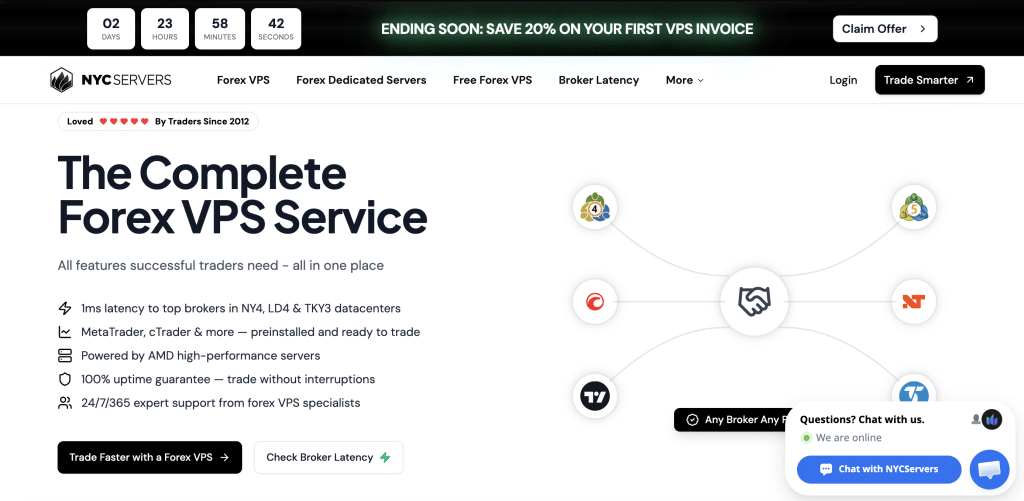
NYCServers is the most turnkey way to get a scalping terminal inside a financial data center. It deploys from three named Equinix buildings, New York NY4, London LD4, and Tokyo TY3, and markets connectivity to further hubs in Singapore, Hong Kong, and Dublin, and it pre-installs MetaTrader 4, MetaTrader 5, or cTrader configured for the broker chosen at checkout from a list of more than a hundred, selecting the matching server location automatically. The entry Basic plan runs 2 dedicated cores, 2 GB of memory, and 60 GB of NVMe storage on AMD hardware for about $16.67 a month on annual billing, with a roughly $1 trial and a 14-day money-back guarantee. A live broker latency checker for both MetaTrader 4 and 5 lets a scalper read the path before committing, and a dedicated IP is included. The company guarantees 100 percent uptime during trading hours, backed by a published service level with a credit policy, and schedules maintenance outside market hours, a narrower commitment than a 24/7 figure.
Strengths: deploys from three named Equinix financial data centers in New York, London, and Tokyo, with marketed reach to further hubs; pre-installs MetaTrader 4, MetaTrader 5, or cTrader for the chosen broker with automatic location selection; a live broker latency checker for both platforms; dedicated cores, NVMe, and a dedicated IP on the entry plan; a Trustpilot standing of about 4.5 out of 5 from roughly 119 reviews read in June 2026; a roughly $1 trial and a 14-day money-back guarantee.
Limitations: backups are a paid add-on rather than included; the uptime guarantee is scoped to trading hours rather than 24/7, with maintenance outside market hours; the processor model is not specified, so single-thread speed cannot be confirmed from the spec sheet.
VPSForexTrader, the Forex-Hub Specialist for Scalping
Infrastructure tier: Forex VPS at Equinix NY2 and LD3, HK4 and Amsterdam Serverius available.
Operator: HOSTLINE UAB, Lithuania.
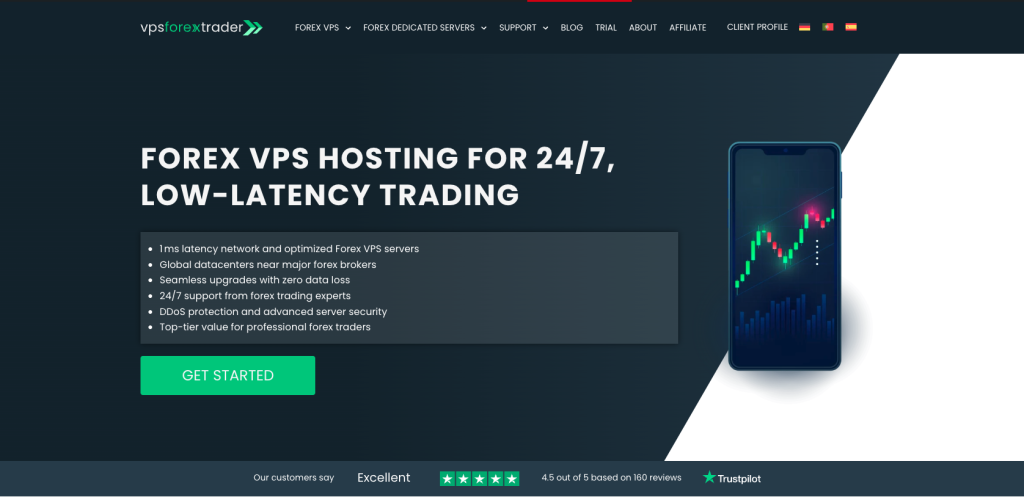
VPSForexTrader Smart is a managed forex VPS built for scalpers running up to four MetaTrader 4 or 5 terminals, and it is the most specification-transparent entry plan in this comparison. It provides three dedicated AMD EPYC cores, 4 GB of ECC error-correcting RAM, and 120 GB of NVMe storage under Windows Server 2025, priced at $31.99 a month monthly or $25.59 annually. Locations include Equinix NY2 and LD3 alongside Amsterdam Serverius and HK4, the servers run a dedicated IP with advanced DDoS protection and weekly backups on every plan, and a real-time broker latency tool on the company’s own site lets a scalper measure the path to a specific broker before buying. A $0.99 three-day trial at full Smart specification plus a 14-day money-back guarantee make that measurement a paid test rather than a leap.
Two things distinguish it for scalping. First, it is the only plan in this comparison that combines ECC error-correcting memory, NVMe storage, dedicated AMD EPYC cores, and a paid validation trial under $26 a month annual; no other provider here documents error-correcting memory at all, and ECC matters for an always-on terminal because it corrects the single-bit errors that would otherwise accumulate over weeks of uptime into a crash or a corrupted order. Second, the company states it does not suspend accounts on active trading days even when payment is overdue, an operational policy rather than a contractual guarantee, aimed at the scalper whose worst outcome is a server going down mid-session.
The constraints are worth stating plainly. MetaTrader is not pre-installed, so the trader installs it over Remote Desktop, and there is no Linux option. The specific EPYC model and memory generation are not published, so single-thread performance cannot be assessed from the spec sheet, which matters more for scalping than for slower strategies. The footprint is narrow at four locations, New York, London, Amsterdam, and Hong Kong, far fewer than ForexVPS.net’s 22, so a scalper whose broker is hosted elsewhere is not covered. The company publishes no uptime service-level percentage on its own pages, and its live Trustpilot standing is about 4.3 out of 5 from about 164 reviews read in June 2026, a smaller base than the largest competitor here. For a scalper who wants error-correcting memory and a cheap trial to measure latency to a specific NY2 or LD3 broker before committing, VPSForexTrader Smart is the most direct fit in this list.
Strengths: the only plan here that combines ECC error-correcting RAM, NVMe storage, dedicated AMD EPYC cores, and a paid trial under $26 a month annual; Equinix NY2 and LD3 colocation alongside Amsterdam Serverius and HK4; a real-time broker latency tool to measure the path before buying; a dedicated IP, DDoS protection, and weekly backups on every plan; a $0.99 three-day trial plus a 14-day money-back guarantee.
Limitations: MetaTrader is not pre-installed and there is no Linux option; the EPYC processor model and memory generation are not published, so single-thread speed cannot be confirmed from specs; only four server locations, far fewer than ForexVPS.net’s 22, so brokers hosted elsewhere are not covered; no uptime service-level percentage is published on the company’s own pages; the live Trustpilot base of about 164 reviews is smaller than the largest competitor here.
TradingFXVPS, the Single-Thread Hardware Leader
Infrastructure tier: Trading VPS across eight locations including Equinix NY4, LD4, and TY3, plus a CME Aurora facility in Chicago. Operator: High Frequency Trading Network Pte Ltd, Singapore.
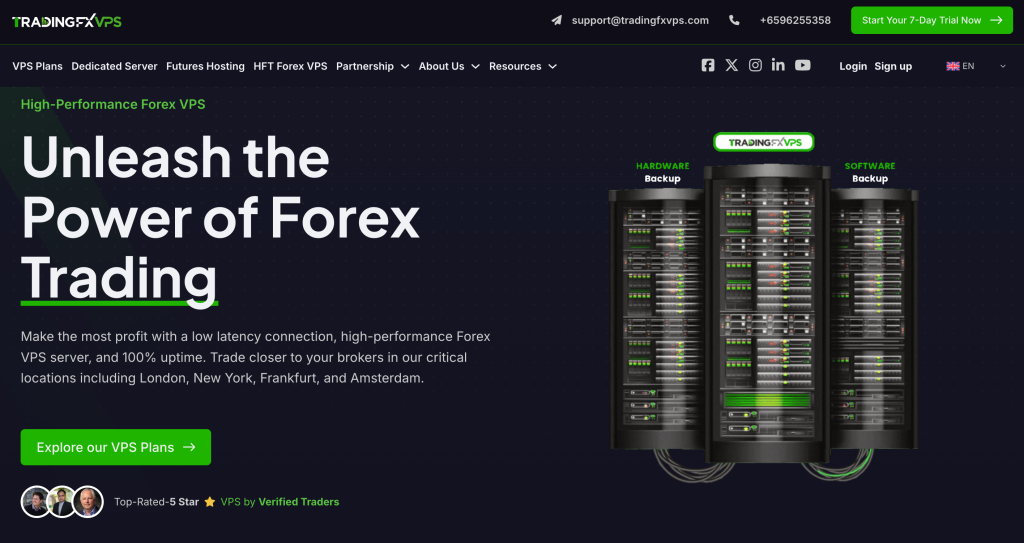
TradingFXVPS runs the fastest single-thread hardware of any provider here that publishes its processor, which is the specification that matters most for a tick-driven scalping expert advisor. Its plans use an AMD Ryzen 9 9950X, rated around 4,729 on PassMark’s single-thread benchmark, with DDR5 memory and NVMe storage in RAID, on a 2×10 gigabit network, and the company markets cross-connection from 0.3 milliseconds with claimed round trips between 0.3 and 0.9 milliseconds from its Equinix-adjacent locations. The entry Standard plan provides one dedicated core, 2 GB of DDR5, and 30 GB of NVMe for about $17.50 a month annual, with a $3.99 seven-day trial and a 30-day money-back guarantee on monthly billing; a dedicated IP is included, and a CME Aurora option in Chicago serves a scalper who also trades futures.
Two qualifications matter for scalping. The entry Standard plan ships with Windows Server 2016, which reaches end of support in January 2027, so a scalper should confirm a 2019 or 2022 image at checkout, and the 30 GB of storage is the smallest in this set. The company also sells forex signals and promotes a third-party expert advisor called Strive Scalper, which is unusual for a hosting provider and worth noting for a trader who wants a pure hosting relationship rather than trading products alongside it. It advertises a 100 percent uptime guarantee against a 99.99 percent service level, and holds a live Trustpilot score of about 4.7 out of 5 from more than 360 reviews read in June 2026. For a scalper whose edge depends on the time between a tick and an order, TradingFXVPS has the strongest published single-thread hardware here.
Strengths: the highest published single-thread CPU rating in this comparison, an AMD Ryzen 9 9950X, for the tick-to-order path that scalping depends on; DDR5 and NVMe RAID on a 2×10 gigabit network; Equinix NY4, LD4, and TY3 plus a CME Aurora option for futures; a dedicated IP; the lowest entry price among the spec-led specialists; a $3.99 trial and a 30-day money-back guarantee on monthly billing.
Limitations: the entry Standard plan defaults to Windows Server 2016 and carries only 30 GB of storage, the smallest here; RAM is DDR5 but not documented as ECC; the company sells signals and a third-party EA, which not every trader wants from a host; the latency checker is MetaTrader 4 only.
ForexVPS.net, the Broadest Network with Volatility Headroom

Infrastructure tier: Trading VPS across 22 locations including Equinix NY4, LD4, and Tokyo. Operator: ThinkHuge Ltd, Hong Kong.
ForexVPS.net covers more ground than anyone here and adds the one feature aimed squarely at scalping the news. Its network spans 22 financial data center locations including Equinix NY4, LD4, and Tokyo, and its Resource Spike Protection allocates additional processor and memory automatically during high-volatility periods at no extra cost, which addresses the multi-expert-advisor tick storm where shared-resource plans degrade exactly when a news scalper is busiest. The entry Core plan provides two dedicated cores, 4 GB of memory, and 100 GB of storage for $32 a month annual, sits at the top of the under-$40 band, and includes a dedicated IP, automated backups, and a 14-day money-back guarantee. Its independent review base is the largest in this segment, at roughly 4.8 to 4.9 out of 5 from more than 6,500 reviews read in June 2026.
Two qualifications matter. Storage on the lower tiers is SSD rather than NVMe and the processor model is not published, so the hardware is solid but less transparent than the spec-led specialists. More important for a scalper planning redundancy, ForexVPS.net and the sister brand FXVM run on the same ThinkHuge infrastructure, so running both for a backup is not real diversification: a roughly 24-hour New York outage in August 2025 took both offline at once. The company markets 100 percent uptime, while the contractual service level in its terms is 99.99 percent, a gap worth reading before relying on the headline. For a scalper who trades the news and wants automatic headroom during volatility, or whose broker’s hub is outside the major three, ForexVPS.net is the strongest fit.
Strengths: the broadest network here at 22 locations including Equinix NY4, LD4, and Tokyo; Resource Spike Protection that adds processor and memory during volatility, the most scalping-relevant feature here; a dedicated IP and automated backups on every plan; the largest independent review base in the segment, about 4.8 to 4.9 from more than 6,500 reviews; a 14-day money-back guarantee.
Limitations: lower tiers use SSD rather than NVMe and the processor model is not published; the Core plan sits at the $32 ceiling, the most expensive entry here; it shares infrastructure with the sister brand FXVM, so the two do not provide independent redundancy, as a simultaneous August 2025 New York outage showed; the marketed 100 percent uptime exceeds the contractual 99.99 percent service level.
FXVM, the Lowest-Cost Named-Equinix Specialist
Infrastructure tier: Trading VPS across 15 locations including Equinix LD4 and NY4. Operator: ThinkHuge Ltd, Hong Kong.
FXVM is the cheapest way onto named Equinix infrastructure in this comparison. It covers 15 locations with Equinix LD4 and NY4 explicitly named, ships Windows Server with full remote-desktop access on every plan, and includes a dedicated IP, automated backups, and DDoS protection, holding ISO 27001 certification and a strong Trustpilot standing of about 4.8 out of 5 from more than 3,600 reviews. The entry Lite plan provides two dedicated cores, 1.5 GB of memory, and 60 GB of SSD storage for roughly $17 a month annual, with a $0.99 seven-day trial and a 99.99 percent uptime service level, which makes it a low-cost route to an Equinix-hosted scalping terminal for a single broker.
One fact should shape how a scalper uses it. FXVM and ForexVPS.net are the same operator, ThinkHuge, and run on shared infrastructure, so the two are not independent providers and should not be paired for redundancy, as the August 2025 New York outage that took both down at once demonstrated. The entry plan’s 1.5 GB of memory is also tight once Windows overhead is counted, enough for a single lean terminal but not for several expert advisors at once, so a multi-EA scalper needs a higher tier. For a scalper who wants a named-Equinix server at the lowest entry price and runs a single broker, FXVM Lite is the cheapest colocated option here.
Strengths: the lowest entry price onto named Equinix infrastructure, at LD4 and NY4 among 15 locations; Windows Server with full remote-desktop access, a dedicated IP, automated backups, and DDoS on every plan; ISO 27001 certification and a strong Trustpilot base of more than 3,600 reviews; a $0.99 seven-day trial and a 99.99 percent service level.
Limitations: the entry Lite plan’s 1.5 GB of memory is tight for more than one terminal; storage is SSD rather than NVMe; it shares infrastructure with ForexVPS.net, so the two are not independent for redundancy; the processor model is not published.
AccuWeb Hosting, the Managed US Option with DLL Support
Infrastructure tier: Managed Windows VPS from the provider’s own US data centers in the New York metro and Denver, not Equinix colocation. Operator: AccuWeb Hosting, United States.
AccuWeb is the managed option for a scalper whose expert advisor needs more than broker-bundled hosting allows. It is genuinely US-based, operating from its own data centers in the New York metro and Denver, and it installs MetaTrader 4 and 5, cTrader, NinjaTrader, and TradeStation on request rather than leaving the setup to the trader. Crucially for scalping, it supports the DLL-based expert advisors that MetaQuotes Virtual Hosting cannot run, which is the practical reason a scalper with a commercial expert advisor pays for a managed VPS instead of the broker’s free one. The entry Forex VPS 1 plan starts at $7.99 a month and the Forex VPS 2 at $14.99 for 3 GB and two cores, with a 7-day money-back window and weekly backups included.
The trade-off is location. AccuWeb hosts from its own regional data centers rather than inside Equinix, so latency to a broker’s matching engine is higher than a colocated specialist delivers, in the tens of milliseconds rather than under one. That is acceptable for a slower scalping strategy or an expert advisor whose edge is not measured in single milliseconds, but a tick-sensitive scalper trading an NY4 or LD4 broker will execute faster from a colocated provider. Storage is SSD rather than NVMe on the entry plans, and the company describes its own forex VPS honestly as a specialized subset of Windows VPS hosting. AccuWeb backs its VPS with a 99.9 percent uptime service level documented in its terms with a credit system, the web-host-grade standard that sits below the 99.99 percent the colocated specialists offer, and as a long-established general host rather than a trading specialist its review standing reflects its overall hosting business rather than a forex-VPS-specific base. For a scalper running a DLL-based commercial expert advisor who wants the host to manage the install, AccuWeb is the most accommodating option here, accepting higher latency than a colocated specialist.
Strengths: a genuinely managed service that installs MetaTrader, cTrader, NinjaTrader, and TradeStation on request; support for DLL-based expert advisors that broker-bundled hosting cannot run; US data centers in the New York metro and Denver; low entry pricing from $7.99 a month; weekly backups included and a 7-day money-back window.
Limitations: its own regional data centers rather than Equinix colocation, so latency is higher than a colocated specialist; SSD rather than NVMe on entry plans; daily backups and a dedicated IP are paid add-ons; a 99.9 percent service level, below the 99.99 percent standard of the colocated specialists; mid-tier pricing should be confirmed at checkout, since published figures vary.
Common Scalping VPS Mistakes That Cost Pips
The most expensive scalping mistakes are not about the platform, they are about the path to the broker. The first is buying the fastest processor while ignoring proximity: a server with a 0.3 millisecond cross-connect in New York does nothing for a broker whose matching engine is in London, because the order still crosses the Atlantic, and the 58.95 millisecond floor between the two hubs swallows any processor advantage. Match the building first, then compare chips. The second comes before the server entirely, scalping on a broker that prohibits the strategy or quotes dealing-desk spreads. Many brokers restrict scalping in their terms or price it wide enough that no proximity recovers the cost, so a scalper should confirm the broker allows scalping and offers a raw or ECN account before spending anything on hosting.
The third is running a scalping expert advisor on a shared or burstable virtual CPU. It looks identical to a dedicated plan on a quiet afternoon and then throttles during the payrolls release or an FOMC decision, adding effective latency in exactly the minutes the strategy depends on, so the slippage spikes during the volatility the scalper came for. The fourth is trusting an advertised sub-millisecond figure instead of measuring it: every latency number a provider publishes is to a broker of its choosing in a building of its choosing, and the only figure that describes your fills is the one you read from a trial server to your own broker during market hours.
The fifth is taking a broker’s free VPS without checking where it sits, since several broker-sponsored programs run from a generic cloud region 5 to 20 milliseconds from the matching engine rather than from colocation, which gives back the latency edge the VPS was supposed to buy, and the fee returns the moment monthly volume dips below the threshold. The sixth is the redundancy illusion, pairing ForexVPS.net and FXVM for a backup without realizing they share one backbone, so a single New York outage in August 2025 took both down together. Genuine redundancy needs two independent operators in two facilities, not two brands on one network.
Matching a Provider to Your Broker and Strategy
Start with the broker, because its hub sets the shortlist. If the matching engine is in Equinix NY4 or the adjacent NY5, which covers US-regulated brokers such as OANDA and FOREX.com, all four colocation specialists reach it: NYCServers for a pre-installed turnkey setup, VPSForexTrader for error-correcting memory and a trial to measure first, TradingFXVPS for the fastest single-thread hardware, and ForexVPS.net for volatility headroom. If the broker is in London LD4, which is the larger forex hub, the same four apply and FXVM adds a lower-cost named-Equinix option there. If the broker sits in Tokyo, both NYCServers and TradingFXVPS colocate there, and a scalper who also trades CME futures alongside forex is best served by TradingFXVPS’s Chicago Aurora option.
Intensity sets the tier. A single-pair scalper running one or two expert advisors is well served by an entry plan, NYCServers Basic, VPSForexTrader Smart, TradingFXVPS Standard, or FXVM Lite, each of which clears Windows overhead with room for a lean setup. A scalper running several expert advisors across the news, where a tick storm can starve a shared plan, wants either ForexVPS.net for its Resource Spike Protection or a 4 to 8 gigabyte dedicated-core tier from the spec-led specialists, where the headroom absorbs the spike.
If true colocation is not available for your broker, or your strategy is not measured in single milliseconds, the cheaper self-serve options become reasonable, with their latency cost stated plainly. AccuWeb installs and manages the platform from its own US data centers and supports DLL-based expert advisors, accepting latency in the tens of milliseconds rather than under one. Cloudzy offers a 4 gigabyte NVMe plan at about $14.48 a month on a current promotion across general metros including New York, Miami, Dallas, and Los Angeles, and Kamatera offers configurable cloud servers, both from general data centers rather than Equinix colocation. MyForexVPS is a smaller specialist with three locations. None of these is a tick-sensitive scalping choice, but each is a defensible budget path for a slower automated strategy.
Three Findings
Three findings hold across this comparison. The first is that proximity beats specifications. A 2 gigabyte server inside the broker’s building beats a 16 gigabyte server fifty miles away, because the network leg between the trader and the broker is where a scalp is won or lost, and that leg is a function of distance, not of the processor. The cheapest path to a fast fill is the right building, not the biggest plan.
The second is that consistency beats peak performance. A dedicated core and a latency the trader measured personally are worth more than an advertised sub-millisecond average that degrades under news-event load, because a scalper trades the volatile minutes when shared resources contend, and an execution that holds through the spike matters more than a faster number on a quiet afternoon. Measure the path to your own broker, and prefer a guaranteed core to a higher headline clock.
The third is that free hosting is a conditional paid tier. A broker-sponsored VPS is genuinely free only while volume or balance clears a threshold, it locks capital that could be trading, and it often sits in a generic cloud region rather than true colocation, so for a scalper whose volume fluctuates a paid colocated plan at $16 to $32 a month is frequently the more predictable choice, not the more expensive one.
Frequently asked questions
What is the best affordable VPS for forex scalping?
There is no single answer, because the right choice depends on where your broker is hosted, but for a scalper trading an Equinix NY2 or LD3 broker who wants a measurable test before committing, VPSForexTrader Smart is the most direct fit, combining 4 GB of ECC error-correcting memory, three dedicated AMD EPYC cores, 120 GB of NVMe storage, and a $0.99 three-day trial at $25.59 a month annual. If you want the platform pre-installed and a wide choice of Equinix hubs, NYCServers is the turnkey option from about $16.67; if your edge depends on the fastest single-thread hardware, TradingFXVPS runs an AMD Ryzen 9 9950X from $17.50.
Which forex VPS has the lowest latency for scalping?
Among the providers here, TradingFXVPS advertises the lowest, marketing cross-connection from 0.3 milliseconds and round trips between 0.3 and 0.9 milliseconds from its Equinix-adjacent locations, on the highest published single-thread CPU in the comparison, an AMD Ryzen 9 9950X. That figure is vendor-stated and measured to a broker of its choosing, so the only number that describes your own fills is the one you measure from a trial server to your broker. Any colocated specialist in the same Equinix building as your broker can reach it in roughly a millisecond; the deciding factor is whether the provider colocates where your broker sits.
How much latency do I need to scalp forex?
For scalping, target a round trip under 5 milliseconds to your broker, and under 1 millisecond if you can colocate in the same Equinix building, which is achievable when the server and the broker share a facility. A round trip of 5 to 20 milliseconds is acceptable for slower expert advisors but begins to cost a tick-sensitive scalper compounding slippage across a day’s volume, and anything over 20 milliseconds, which is typical of a home connection or a server in the wrong region, is unsuitable for scalping. Swing and position strategies tolerate far more, since they do not depend on the price at the moment of the fill.
Does a forex VPS reduce slippage when scalping?
Yes, on the part of the trip it controls. A VPS colocated near the broker reduces the network leg from 50 to 200 milliseconds on a home connection to 1 to 5 milliseconds, which on sub-minute scalps is worth roughly 1 to 2 pips per trade and removes the requotes that a slow connection causes during fast moves. What it cannot reduce is the broker-side processing, roughly 16 to 50 milliseconds of matching and risk checks that are fixed regardless of the server, so a VPS is execution infrastructure for scalping, not a guarantee of perfect fills.
How do I measure latency to my broker for scalping?
Open a trial or refundable monthly VPS in the data center nearest your broker, then measure from that server during active market hours, not overnight. Use ping for the round trip to the broker’s server hostname, tracert or WinMTR to see each hop and where the latency enters, and the live ping MetaTrader shows in its connection status as a second reading. Low single-digit milliseconds means the server and broker are effectively co-located; tens of milliseconds means they are not, whatever the plan’s label claims. Check the broker’s server name first, since it often contains the data center location.
How were these scalping VPS providers chosen and ordered?
They were chosen for genuine low latency to broker hubs, dedicated rather than shared processor allocation, and an entry price under $40 a month, the three things that decide scalping execution on a budget. They are grouped by setup model and hardware transparency rather than ranked by a single score: the turnkey colocation specialist first, then the spec-led forex-hub specialists, then the broadest network, then the lowest-cost specialist, then the US-based managed option. VPSForexTrader, which publishes this guide, is one of the six and appears in the second position rather than first, evaluated against the same criteria as the others with its limitations documented alongside its strengths.
References
[1] Equinix, statement on the Secaucus campus describing roughly two-thirds of electronic equities, derivatives, and foreign-exchange transactions occurring there and calling it the single largest trading venue. (equinix.com)
[2] Bloomberg, profile of the Equinix NY4 data center reporting 49 exchanges and a peak of 9.6 million messages per second, May 2016. (bloomberg.com)
[3] Equinix, press release announcing the Hibernia Express cable connecting LD4 and NY4 with a tested round trip under 58.95 milliseconds, November 2015, now operated by EXA Infrastructure. (equinix.com)
[4] IDC, InfoBrief on optimizing latency in trading systems through infrastructure choices, commissioned by Equinix. (equinix.com)
[5] Bank of England, release of the BIS Triennial Central Bank Survey reporting the United Kingdom’s 37.8 percent share of global foreign-exchange turnover, September 2025. (bankofengland.co.uk)
[6] MetaQuotes, MQL5 Virtual Hosting rules and pricing, stating the no-DLL and no-remote-desktop limits and the $12.80 monthly annual-plan price. (mql5.com)
[7] tastyfx, MetaTrader 5 VPS page stating free hosting at a $1,000 account balance with at least one trade a month, normally a $15 monthly value. (tastyfx.com)
[8] IC Markets, server-location and sponsored-VPS pages stating MetaTrader servers in Equinix NY4 and LD5 and a 15-standard-lot monthly volume criterion. (icmarkets.com)
[9] FOREX.com, MetaTrader 5 EA hosting page stating the $500,000 monthly notional volume requirement and the $30 fee, with hosting provided by Liquidity Connect. (forex.com)
[10] PassMark, CPU single-thread benchmark chart for the AMD Ryzen 9 9950X. (cpubenchmark.net)
[11] NYCServers, plan, location, and pricing pages. (newyorkcityservers.com)
[12] VPSForexTrader, plan, location, pricing, and broker latency tool pages. (vpsforextrader.com)
[13] TradingFXVPS, plan, hardware, and location pages. (tradingfxvps.com)
[14] ForexVPS.net, plan, location, Resource Spike Protection, and service-level pages. (forexvps.net)
[15] FXVM, plan and location pages and ISO certification. (fxvm.net)
[16] AccuWeb Hosting, forex VPS plan and feature pages. (accuwebhosting.com)
[17] Trustpilot, live review scores for the providers in this comparison, read June 2026. (trustpilot.com)
Editorial note
This article is published by VPSForexTrader, which is operated by HOSTLINE UAB and is one of the six providers compared. To keep the comparison honest, VPSForexTrader appears in the second position inside a model-based ordering rather than first, is evaluated against the same criteria as every other provider, and has its limitations documented alongside its strengths: its section lists five strengths and five limitations, including a narrow four-location footprint, an unpublished processor model, and no published uptime service-level percentage. Every price and Trustpilot score in this article was verified in June 2026 and is subject to change, so confirm current terms on each provider’s website before purchasing. Every latency figure, including the publisher’s, is vendor-stated, measured by the provider to a broker of its choosing, and has not been independently replicated; the only latency that describes your trading is the one you measure from your server to your broker. Scalping is a high-risk, high-frequency strategy, and the choice of server affects execution but not the soundness of a strategy or the risk of loss; this guide is hosting infrastructure guidance, not trading advice, and the stated continuity policy of any provider is operational rather than a contractual guarantee. Confirm that your broker permits scalping before deploying.