Best Forex VPS for Expert Advisors (EAs) (2026)
A solo trader who loses a server for an hour loses an hour of their own trading. A signal provider who loses the master terminal for an hour stops copying to every subscriber at once, leaves open positions on follower accounts unmanaged, and records the gap on the public track record the whole business runs on. Copy trading and signal provision turn a private hosting decision into a shared dependency, and that changes what reliable has to mean. The requirement is no longer a fast server; it is a master that does not go down, does not crash, and does not vanish because a payment lapsed, running close enough to the broker that the copy arrives before the price moves.
Two readers sit behind this topic with opposite priorities. A signal provider or copy-trade master needs continuity above all, the master terminal live and replicating without interruption, plus a stable address that brokers and copy platforms recognize. A subscriber or copy trader needs the other end, enough memory and processor to run several follower terminals at once and a short path to each broker so the copied fill is not worse than the master’s. Most comparison guides serve neither well. They rank the publisher’s own product first, quote a marketed one hundred percent uptime slogan as though it were the contract, and size every recommendation off an entry plan that cannot actually run a master and three followers.
This guide compares eight virtual private server providers for copy trading and signal provision, evaluated on the dimensions that decide a copy operation rather than generic Forex VPS specifications: the contractual uptime service level behind the marketing, the memory and processor headroom to run many terminals in parallel, a dedicated static IP for broker and platform whitelisting, and proximity that keeps copy replication fast. The providers are grouped by category rather than ranked in a single order. VPSForexTrader, which publishes this guide, is one of the eight, is measured against the same criteria as the others, and appears in the second position; the methodology and editorial note below document that arrangement.
The Eight Providers at a Glance
ForexVPS.net spans the broadest network at twenty-two locations and bundles a dedicated IP and Resource Spike Protection on every plan, from $32 a month annual, with the largest independent review base in the segment. VPSForexTrader runs dedicated AMD EPYC cores with ECC error-correcting memory across every tier, a dedicated IP suited to broker whitelisting, and a stated policy of not suspending active services on trading days, from $25.59 a month annual with a $0.99 trial. TradingFXVPS pairs AMD Ryzen 9 hardware with the longest refund window here, thirty days, and the only CME Aurora presence among the retail specialists here, from $17.50 a month annual. FXVM is the one provider that publishes a separate service-level document committing to above 99.99 percent in a calendar month, from about $21 a month. NYCServers is the only US-registered operator, pre-installs the broker’s own MetaTrader build at checkout, and scopes a one hundred percent uptime guarantee to trading hours, from $16.67 a month annual.
Beeks runs institutional-grade infrastructure that white-labels for major brokers, with a dedicated-server path for large copy farms, priced in pounds from about £31 a month. Cloudzy is a genuinely independent operator, useful precisely because it does not share a backbone with the forex specialists, from about $3.48 a month (its copy-suitable 4 gigabyte tier runs near $14.48 on a current promotion), with a dedicated IP included. MetaQuotes MQL5 Virtual Hosting is the first-party floor, built into the MetaTrader terminal from $12.80 to $15 a month, and the natural home for a single MQL5 Signals subscription rather than a multi-account farm.
How this comparison was built
This comparison covers VPS hosting for copy trading and signal provision. Pricing, plan specifications, uptime service levels, and IP policies were verified on each provider’s own website and terms of service in June 2026, and Trustpilot scores were read on Trustpilot the same month. Supporting facts come from primary sources: MetaQuotes documentation for MQL5 Virtual Hosting and the MQL5 Signals service, and published trade-copier documentation for replication latency. The evaluation dimensions are the contractual uptime service level behind any marketing claim, the memory and processor headroom for running multiple terminals at once, the availability of a dedicated static IP for broker and platform whitelisting, proximity to broker hubs as it affects copy replication, refund and trial terms, and price. Providers are grouped by category, the forex-VPS specialists first, then the institutional cloud, the independent operator, and the first-party hosting last, rather than ranked by a single score. VPSForexTrader publishes this guide and is one of the eight; it sits in the second position, measured against the same criteria with its limitations documented alongside its strengths. Figures that could not be confirmed on a provider’s own pages are flagged, and the per-broker latency figures here are vendor-stated and not independently replicated.
What an Uptime SLA Actually Guarantees for a Signal Master
For a single trader, downtime is a personal inconvenience. For a signal master, downtime is a broadcast failure, because every subscriber copying the master stops receiving trades at the same moment, open positions on follower accounts go unmanaged, and the public track record records the gap. This is why the uptime service level deserves more scrutiny in a copy operation than anywhere else in trading infrastructure, and why the marketed number is rarely the one that matters.
Almost every forex VPS markets one hundred percent uptime. The figure in the terms of service is different and lower, typically 99.9 or 99.99 percent, and the gap between those decimals is larger in practice than it looks. The table below converts each service level into the downtime it actually permits.
| Uptime service level | Downtime per year | Downtime per month |
| 99.9 percent | About 8.8 hours | About 44 minutes |
| 99.99 percent | About 53 minutes | About 4.4 minutes |
| 99.999 percent | About 5 minutes | About 26 seconds |
| 100 percent (marketed) | No contractual figure | Read the service level instead |
A service-level agreement also defines what a breach is worth, and the answer is almost always a credit against the hosting fee, not compensation for trading outcomes. A provider that misses its 99.99 percent commitment refunds a share of a monthly fee that might be $25 or $40; it does not cover the trades a master failed to copy or the positions a follower could not close. For a signal provider whose subscribers pay monthly and whose reputation is the asset, the fee credit is close to irrelevant next to the cost of the outage. The practical reading is that the service-level percentage tells you how often the provider expects to fail, while the credit tells you they will not absorb your losses when they do.
Reliability for a master is more than a percentage, though, and three failure modes sit outside the headline number. A terminal can crash from a memory error on a server without error-correcting RAM, which is why ECC memory matters on a machine that runs for weeks unattended. A master can be suspended for a billing lapse, which is why a provider’s continuity policy on overdue accounts matters to an operation that cannot afford a mid-month cutoff. And a backup server provides no protection if it sits on the same infrastructure as the primary, which is why genuine redundancy means two independent operators in two facilities rather than two brands that share one backbone. Among the providers here, FXVM publishes a standalone service-level document committing to above 99.99 percent in a calendar month, and NYCServers scopes its one hundred percent guarantee to trading hours with maintenance outside market sessions; both are more transparent than the marketing-only norm.
Sizing a Master-and-Followers Farm: RAM, Cores, and Terminal Count
A copy setup is rarely one terminal. A signal provider runs a master plus a local copier, and often several broker terminals to mirror the strategy across venues. A copy trader following multiple signals runs one follower terminal per source. The binding constraint on all of this is memory, not processor, and the arithmetic is simple enough to do before buying.
Windows Server itself consumes roughly 0.8 to 1.2 gigabytes of RAM at idle. Each MetaTrader terminal with a chart and an expert advisor adds roughly another gigabyte. A master plus three follower terminals plus a copier utility is therefore around five to six gigabytes before headroom, which is why the 1.5 and 2 gigabyte entry plans cannot run a farm; they hold one lean terminal and swap to disk under a second. The realistic floor for a small copy operation is six to eight gigabytes of RAM with four dedicated cores. The table below sizes the common cases.
| Copy setup | Terminals | Working memory needed | Realistic plan tier |
| Single MQL5 Signals subscriber | 1 | About 2 GB | Entry plan or MQL5 hosting |
| Master plus 2 to 3 followers | 3 to 4 | About 5 to 6 GB | 6 to 8 GB mid tier |
| Multi-source copy trader | 5 to 8 | About 7 to 9 GB | 8 GB or dedicated |
| Large signal farm | 10 plus | 10 GB plus | Dedicated server |
Processor matters second, and the relevant property is that the cores are dedicated rather than shared. A copier checks the master and writes to each follower continuously, and on a burstable shared CPU that work slows when neighboring tenants are busy, which shows up as replication lag at exactly the wrong time. Dedicated cores hold their timing. Single-thread speed matters less for copy work than for tick-scalping, because the bottleneck is the number of terminals the memory can hold, not the speed of any one tick.
Vendors publish per-tier terminal guidance, and it lines up with the memory math when read as vendor-stated guidance rather than a guarantee. VPSForexTrader states up to four terminals on its 4 gigabyte Smart tier, up to seven on the 6 gigabyte Boost tier, and up to ten on the 8 gigabyte Max tier. ForexVPS.net guides three terminals on its 4 gigabyte Core plan and six on the 6 gigabyte Edge. NYCServers guides two on its entry Basic and more on its 4 gigabyte Standard. For a farm beyond ten terminals, both VPSForexTrader and FXVM offer dedicated servers that run many more, and Beeks positions its institutional tiers for that scale. Size the plan to the terminal count plus one tier of headroom, because a master that swaps to disk lags its own followers.
Dedicated IP and Whitelisting: Why Copy Setups Need a Static Address
A dedicated static IP is the address a broker, a copy platform, and a trade copier all see as you. On a shared or dynamic IP the address can change, and on consumer connections it changes often, which breaks anything that ties access or security to a known address. For a copy operation that authenticates to broker accounts and copy-platform logins continuously, a stable address is closer to a requirement than a convenience.
Three things lean on a stable IP in copy and signal work. Broker and platform logins flag access from an unfamiliar address, so a changing IP can trigger security challenges or temporary lockouts on accounts that need to stay connected for replication to continue. Some broker integrations and copy platforms let an account restrict access to specific addresses, which only works from a fixed IP. And a trader managing several legitimate live or funded accounts from one server presents a consistent address rather than a shifting one, which keeps account-security systems from treating ordinary activity as suspicious. A dedicated IP is an account-stability and security feature first; the goal is for legitimate access to keep working without interruption.
The copier layer cares too. Cloud trade copiers run their own connections to broker accounts, and some offer static IP options for accounts that need a consistent address; Duplikium, a long-running cloud copier, offers static shared and dedicated IP add-ons. The VPS is usually where the stable address originates, so a copy operation generally wants the IP handled at the server rather than bolted on elsewhere.
Among the providers here, a dedicated IP is included on every plan at VPSForexTrader, ForexVPS.net, FXVM, TradingFXVPS, NYCServers, and Cloudzy, which is the norm among the forex specialists. AccuWeb, a general host some copy traders consider on price, is the exception that proves the point: its forex VPS treats a dedicated IP as a paid add-on of a few dollars a month rather than a default, so a copy trader choosing it should add the IP deliberately. MetaQuotes MQL5 Virtual Hosting is a different model entirely, a managed hosting point inside the terminal with no remote desktop and no user-assigned IP, which is fine for a single signal subscription but not for an operation that needs to whitelist a known address. Read the dedicated-IP column as a yes-or-no on whether whitelisting is even possible.
The Copy Replication Chain: Where Latency and Slippage Enter
A copied trade is slower than the original by design, because it travels further. The chain has three legs: the master places an order and it reaches the master’s broker; the copier detects the fill and decides what to send; and the copier writes the trade to each follower’s broker. Latency and slippage can enter at every leg, and where the servers sit determines how much.
Hosting the master near its broker collapses the first leg from the 80 to 300 milliseconds of a home connection to single-digit milliseconds when the server sits in the broker’s data center, the same proximity logic that governs any trading VPS. The copier’s internal step is software. The third leg depends on where each follower’s broker sits relative to the copier, so a follower account on a distant broker inherits that distance on every copied trade. A copy trader therefore benefits from a server reasonably close to the brokers being copied to, not only to the source.
The copier’s own latency is where published figures need care. Cloud copier vendors cite low internal numbers: Duplikium states internal copying latency of one to three milliseconds, which measures only the step between detecting the master trade and sending it to the slave broker, not broker execution time on either end. The total master-to-follower copy time is larger and broker-dependent. In practice, reviews of cloud copiers report total copy-to-fill times under one second in normal conditions and a few seconds during high-volatility events such as major news releases. The takeaway for a copy trader is to read a sub-millisecond copier figure as the internal step only, and to expect the real master-to-follower gap to run from sub-second to a few seconds depending on both brokers.
Slippage rides on top of the delay. Whatever time the chain adds, the follower fills at a later price than the master, and on fast-moving pairs that difference is the copy trader’s cost, the mirror of the edge a tight setup preserves. The MQL5 Signals service, the most common retail signal marketplace, adds its own rules that shape the hosting choice: a subscription copies one signal to one trading account, each trading account can follow only one signal at a time, the minimum signal price has been thirty dollars since 2017, and a subscriber needs hosting that runs continuously to copy around the clock. MetaQuotes’ own Virtual Hosting fills that last role for a single subscription, but its one-account-per-terminal limit means a copy trader following several signals at once needs either several subscriptions or a full VPS running several terminals.
Forex VPS for Copy Trading and Signals Compared
| Provider / plan | Published SLA | RAM type | Terminals (vendor) | Static IP | Equinix / key locations | Price annual / trial |
| ForexVPS.net Core | 99.99% (100% marketed) | 4 GB | 3 to 6 | Yes | NY4, LD4, Tokyo + 22 total | $32, no trial |
| VPSForexTrader Smart | Not published | 4 GB ECC | 4 to 10 | Yes | NY2, LD3, Amsterdam Serverius, HK4 | $25.59, $0.99 trial |
| TradingFXVPS Standard | 99.99% (100% marketed) | 2 GB DDR5 | 1 to 10+ | Yes | NY4, LD4, TY3 + Chicago | $17.50, $3.99 trial |
| FXVM Lite | 99.99%+ (published) | 1.5 GB | 1 to 6 | Yes | LD4, NY4 + more | ~$21, 7-day refund |
| NYCServers Basic | 100% trading hours | 2 GB | 2 to 6 | Yes | NY4, LD4, TY3 | $16.67, 14-day refund |
| Beeks Bronze | 99.9% to 99.99% | 2.56 GB | 2 to 4 (more on dedicated) | Yes | NY4, LD4, CME, TY3 | ~£31/mo |
| Cloudzy Forex VPS | 99.95% | From 4 GB | 5 to 10+ (8 GB) | Yes | London, NY, Singapore (13 regions) | ~$14.48 (4 GB promo) |
| MetaQuotes MQL5 Hosting | Not published | Up to 3 GB | 1 (per sub.) | No | Global (in-terminal) | $12.80 to $15 |
Published SLA is the contractual figure where one exists, not the marketed slogan; a provider can market one hundred percent uptime while committing to 99.99 percent in its terms. Terminal counts are vendor-stated guidance, shown from the entry tier to the top retail tier, and depend on indicator and history load. All specifications, pricing, and policies were verified in June 2026 and are subject to change; confirm current terms on each provider’s website before purchase.
ForexVPS.net, the Broadest Network
Infrastructure tier: Trading VPS across twenty-two locations including Equinix NY4, LD4, and Tokyo. Operator: ThinkHuge Ltd, Hong Kong.
ForexVPS.net covers more locations than anyone else here, which matters for a copy operation whose follower brokers may sit outside the major hubs. Its network spans twenty-two financial data center locations including Equinix NY4, LD4, and Tokyo, and every plan includes a dedicated IP, automated backups, and Resource Spike Protection that adds processor and memory automatically during volatile periods. The Core plan provides two dedicated cores, 4 gigabytes of memory, and 100 gigabytes of storage for $32 a month annual with vendor guidance of up to three terminals; the Edge plan steps up to four cores and 6 gigabytes for around six terminals; and the Prime reaches eight gigabytes. Dedicated servers are available for larger farms. Its independent review base is the largest in the segment, around 4.8 to 4.9 out of 5 from more than 6,500 reviews read in June 2026.
Two facts shape how a copy operation should use it. ForexVPS.net is operated by ThinkHuge Ltd, the same parent as FXVM, so the two brands run on shared infrastructure and do not provide independent redundancy for a master and its backup; a redundancy pair should cross operators. Storage on the lower tiers is SSD rather than NVMe, the processor model is not published, and the company markets one hundred percent uptime against a 99.99 percent service level in its terms, a gap worth reading before relying on the headline. For a copy trader following brokers across many regions, or a signal provider who wants automatic headroom when volatility spikes subscriber activity, the breadth here is the strongest fit.
Strengths: the broadest network at twenty-two locations including Equinix NY4, LD4, and Tokyo, useful when follower brokers sit outside the major hubs; a dedicated IP and automated backups on every plan; Resource Spike Protection that adds resources during volatility; the largest independent review base in the segment, about 4.8 to 4.9 from more than 6,500 reviews; a 14-day money-back guarantee.
Limitations: lower tiers use SSD rather than NVMe and the processor model is not published; the marketed one hundred percent uptime exceeds the contractual 99.99 percent service level; it shares infrastructure with FXVM under the same parent, so the two are not independent for redundancy; there is no paid trial, only a refund window.
VPSForexTrader, the ECC and Continuity Specialist
Infrastructure tier: Forex VPS at Equinix NY2 and LD3, with Amsterdam Serverius and HK4. Operator: HOSTLINE UAB, Lithuania.
VPSForexTrader Smart is a managed forex VPS built for copy traders and signal providers running up to four MetaTrader 4 or 5 terminals. It provides three dedicated AMD EPYC cores, 4 gigabytes of ECC error-correcting RAM, and 120 gigabytes of NVMe storage under Windows Server 2025, with a dedicated IP suited to broker whitelisting on every plan, priced at $31.99 a month monthly or $25.59 annually. Server locations include Equinix NY2 and LD3 alongside Amsterdam Serverius and HK4, every plan carries advanced DDoS protection and free backups, and a $0.99 three-day trial plus a 14-day money-back guarantee let a copy trader test replication to a specific broker before committing.
Two things distinguish it for copy work. It is the only provider in this comparison that documents ECC error-correcting memory on every plan tier, which matters for a master that runs unattended for weeks, because ECC corrects the single-bit memory errors that would otherwise accumulate into a crash and cut replication to every subscriber at once. And the company states that it does not suspend active services on trading days even when a payment is overdue, an operational policy aimed squarely at the operation whose worst outcome is a master going dark mid-session. For a signal provider scaling past a single terminal, the Boost tier provides six dedicated cores and up to seven terminals at $41.24 a month annual, and the Max tier reaches eight cores, 8 gigabytes, and up to ten terminals at $59.99, so the master and several followers fit on one machine with the same continuity policy and dedicated IP.
The constraints are worth stating plainly, and the most important concerns the central theme of this guide. VPSForexTrader publishes no uptime service-level percentage on its own pages, so a copy operation that wants a contractual uptime commitment in writing will find FXVM’s published service-level document or NYCServers’ trading-hours guarantee more explicit. MetaTrader is not pre-installed, so the trader installs it over Remote Desktop, and there is no Linux option. The specific EPYC model and memory generation are not published, and the footprint is narrow at four locations, far fewer than ForexVPS.net’s twenty-two, so a copy trader whose follower brokers sit elsewhere is not covered. Its live Trustpilot standing is about 4.3 out of 5 from about 164 reviews read in June 2026, a smaller base than the largest competitor here.
For a signal provider or copy master who values error-correcting memory and a stated policy against mid-session suspension, and who copies to brokers at NY2 or LD3, VPSForexTrader is the most direct fit in this list, with a cheap trial to measure the path first. For a contractual uptime percentage in writing, the providers below state one more explicitly.
Strengths: the only plan here that documents ECC error-correcting RAM on every tier, for a master that runs unattended for weeks; dedicated AMD EPYC cores, NVMe storage, and a dedicated IP suited to whitelisting on every plan; Equinix NY2 and LD3 colocation alongside Amsterdam Serverius and HK4; vendor-stated capacity from four terminals on Smart to ten on Max; a $0.99 three-day trial plus a 14-day money-back guarantee.
Limitations: no uptime service-level percentage is published on the company’s own pages, the dimension the providers below state more explicitly; the stated policy against suspending active services on trading days is operational rather than a contractual guarantee; MetaTrader is not pre-installed and there is no Linux option; the EPYC processor model and memory generation are not published; only four server locations, far fewer than ForexVPS.net’s twenty-two, so follower brokers elsewhere are not covered; the live Trustpilot base of about 160 reviews is smaller than the largest competitor here.
TradingFXVPS, the Hardware and Refund Leader
Infrastructure tier: Trading VPS across eight locations including Equinix NY4, LD4, and TY3, plus a CME Aurora facility in Chicago. Operator: High Frequency Trading Network Pte Ltd, Singapore.
TradingFXVPS pairs strong published hardware with the longest evaluation window here, which suits a copy trader who wants time to confirm replication before committing. Its plans run on AMD Ryzen 9 9950X processors as marketed, with DDR5 memory and NVMe storage in RAID on a 2×10 gigabit network, and among the retail forex specialists here it is the only one with a documented presence at the CME Aurora facility in Chicago, alongside Equinix NY4, LD4, and TY3. The entry Standard plan provides one dedicated core, 2 gigabytes of DDR5, and 30 gigabytes of NVMe for about $17.50 a month annual; the Standard Plus, Advanced, and Expert tiers scale up, with the Expert tier offering four cores and 8 gigabytes for a vendor-stated five to ten or more instances. A dedicated IP is included, the trial is $3.99 for seven days, and the money-back window is thirty days, the longest in this comparison.
Two qualifications matter for a copy operation. The entry Standard plan ships with Windows Server 2016 by default, which reaches end of support in 2027, so a copy trader should confirm a 2019 or 2022 image at checkout, and the 30 gigabytes of storage is the smallest here. The company also sells forex signals and promotes a third-party expert advisor alongside its hosting, which is worth noting for a trader who wants a pure hosting relationship. It advertises one hundred percent uptime against a 99.99 percent service level, and holds a live Trustpilot score of about 4.7 out of 5 from more than 350 reviews read in June 2026. For a copy trader who wants thirty days to validate the full chain, TradingFXVPS gives the most room.
Strengths: AMD Ryzen 9 9950X hardware as marketed, with DDR5 and NVMe RAID on a 2×10 gigabit network; the longest money-back window here at thirty days, useful for validating replication; the only CME Aurora presence among the retail specialists here, for a copy trader who also runs futures; a dedicated IP on every plan; a low entry price for the hardware on offer.
Limitations: the entry Standard plan defaults to Windows Server 2016 and carries only 30 gigabytes of storage, the smallest here; RAM is DDR5 but not documented as ECC; the company sells signals and a third-party EA, which not every trader wants from a host; the processor model appears in marketing rather than consistently on plan spec pages.
FXVM, the Published-SLA Specialist
Infrastructure tier: Trading VPS across more than a dozen locations including Equinix LD4 and NY4. Operator: ThinkHuge Ltd, Hong Kong.
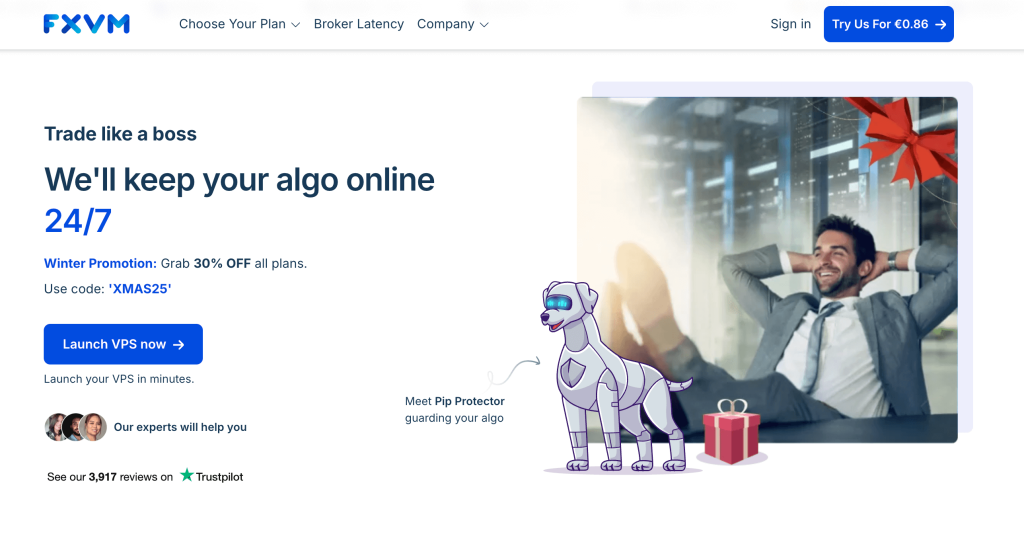
FXVM is the one provider here whose standalone service-level document commits to above 99.99 percent uptime in a calendar month rather than only a marketing line, which is the single most relevant transparency point for a signal master. Its published service-level agreement commits to above 99.99 percent uptime in a calendar month, excluding a stated weekend maintenance window and force-majeure events, and the company holds ISO 27001 certification with a strong Trustpilot standing of about 4.8 out of 5 from more than 3,600 reviews. It covers more than a dozen locations with Equinix LD4 and NY4 named, ships Windows Server with full remote-desktop access, and includes a dedicated IP, automatic backups, and DDoS protection on every plan. The entry Lite plan provides two dedicated cores, 1.5 gigabytes of memory, and 60 gigabytes of SSD storage for about $21 a month with the standing 15 percent discount, or $25 at list; the Advanced tier at about $42.50 reaches 4 gigabytes, which is the realistic floor for running more than one terminal.
One fact should shape how a copy operation uses it. FXVM and ForexVPS.net are the same operator, ThinkHuge, and run on shared infrastructure, so the two are not independent providers and should not be paired as a master and its backup. The entry Lite plan’s 1.5 gigabytes of memory is also tight once Windows overhead is counted, enough for a single lean terminal but not for a master and followers, so a copy operation needs the Advanced tier or higher. For a signal provider who wants a written uptime commitment, FXVM is the most explicit option here on the article’s central theme.
Strengths: the only provider here with a standalone published service-level document committing to above 99.99 percent in a calendar month; ISO 27001 certification and a strong Trustpilot base of more than 3,600 reviews; Equinix LD4 and NY4 among more than a dozen locations; Windows Server with full remote-desktop access, a dedicated IP, automatic backups, and DDoS protection on every plan; a 7-day money-back guarantee.
Limitations: the entry Lite plan’s 1.5 gigabytes of memory is tight for more than one terminal, so a copy farm needs the Advanced tier or higher; storage is SSD rather than NVMe; it shares infrastructure with ForexVPS.net under the same parent, so the two are not independent for redundancy; the processor model is not published.
NYCServers, the Turnkey US Option
Infrastructure tier: Colocation specialist at named Equinix hubs including New York NY4, London LD4, and Tokyo TY3, with further locations in Singapore, Hong Kong, and Dublin. Operator: NYCServers, United States.
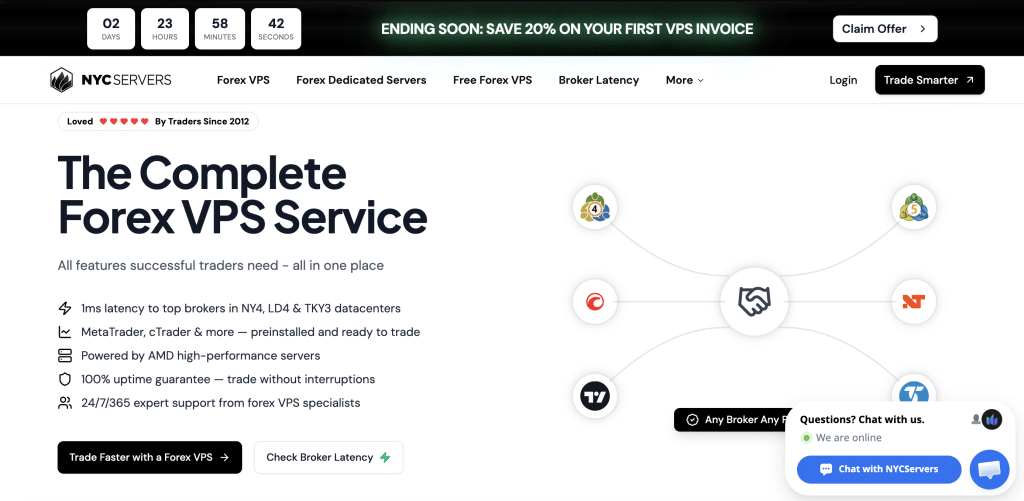
NYCServers is the most turnkey way to get a copy terminal inside a financial data center, and the only US-registered operator in this comparison. It pre-installs MetaTrader 4 or 5 configured for the broker chosen at checkout from a list of more than a hundred, selecting the matching Equinix location automatically, which removes the setup friction a copy trader would otherwise handle over Remote Desktop. Its named Equinix hubs include New York NY4, London LD4, and Tokyo TY3, with further locations in Singapore, Hong Kong, and Dublin. The entry Basic plan runs two cores, 2 gigabytes of memory, and 60 gigabytes of NVMe storage for about $16.67 a month annual with vendor guidance of up to two terminals; the Standard at about $26.67 reaches 4 gigabytes and around six terminals; and the Professional reaches eight gigabytes. A dedicated IP is included, a monthly traffic cap applies, and a 14-day money-back guarantee lets a copy trader validate the setup.
Its uptime framing is the most honest in this list. NYCServers guarantees one hundred percent uptime during trading hours, backed by a published service level with a credit policy and 24-hour hardware replacement, and schedules maintenance outside market sessions, which is exactly the window a weekday master cares about. The trade-offs are a footprint concentrated in a handful of financial hubs, so a follower broker in a less common location may not be covered, backups that are a paid add-on, and a monthly traffic cap that a heavy multi-account copier should check against its usage. Its live Trustpilot standing is about 4.5 out of 5 from roughly 119 reviews read in June 2026. For a copy trader who wants the platform pre-installed and a trading-hours uptime guarantee in writing, NYCServers is the most turnkey fit.
Strengths: pre-installs MetaTrader 4 or 5 for the chosen broker with automatic location selection, removing setup friction; a one hundred percent uptime guarantee scoped honestly to trading hours, backed by a service level, a credit policy, and 24-hour hardware replacement; the only US-registered operator here; Equinix NY4, LD4, and TY3 with a dedicated IP and NVMe on the entry plan; a 14-day money-back guarantee.
Limitations: a footprint concentrated in a handful of financial hubs, so a follower broker in a less common location may not be covered; backups are a paid add-on rather than included; a monthly traffic cap applies, which a heavy multi-account copier should check; the processor model is not specified.
Beeks, the Institutional Path for Large Farms
Infrastructure tier: Institutional-grade trading cloud across eighteen or more locations including Equinix NY4, LD4, CME Aurora, and Tokyo. Operator: Beeks Financial Cloud Group plc, Scotland.
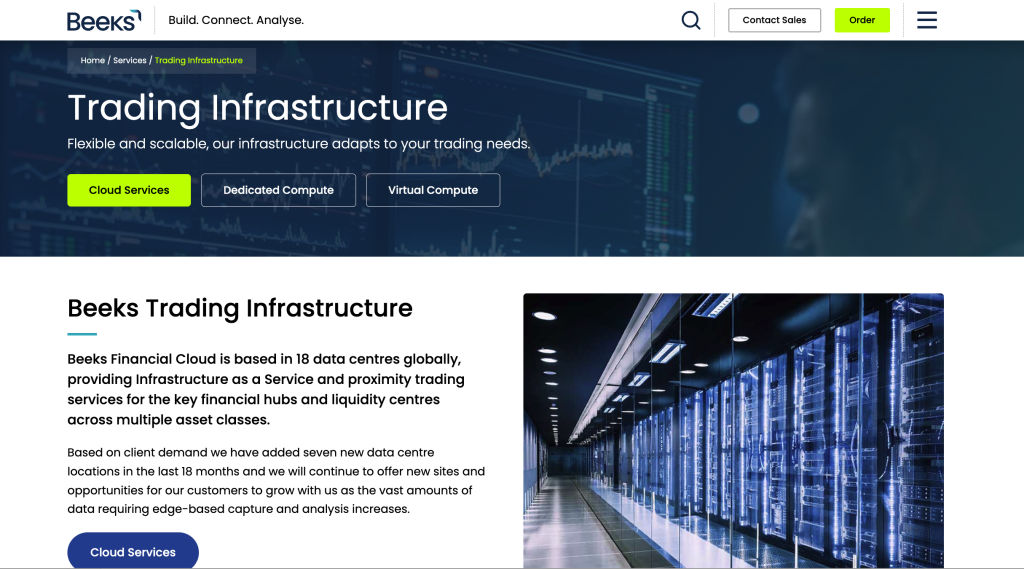
Beeks is the institutional option, the provider a copy business turns to when a farm outgrows retail plans. It runs an established trading cloud that white-labels VPS and connectivity for major brokers, operates across eighteen or more locations including Equinix NY4, LD4, CME Aurora, and Tokyo, holds SOC 2 and ISO 27001 certifications, and runs several thousand virtual machines. Its retail tier is priced in pounds, with a Bronze plan at about £31 a month providing one core, 2.56 gigabytes, and 30 gigabytes with vendor guidance of two to four MetaTrader terminals, a Silver at about £55 reaching 4 gigabytes, and a Gold reaching 6.5 gigabytes. Dedicated and institutional configurations run from a few hundred to a few thousand dollars a month, which is where a large signal farm or a multi-account copy business belongs.
Beeks is best read as a scale option rather than a first single-master setup, and two qualifications follow from its institutional focus. The retail catalogue does not consistently disclose RAM type, storage medium, or operating system at the plan level, so a buyer should confirm those before committing, and pricing is quoted in pounds rather than dollars. As an institutionally oriented provider, it has only a small retail review base, so retail review signal is limited and should be weighed against its documented broker partnerships and certifications instead. For a copy operation running many accounts at scale, Beeks offers dedicated-server headroom the retail specialists do not match.
Strengths: institutional-grade infrastructure that white-labels for major brokers, with SOC 2 and ISO 27001 certification; Equinix NY4, LD4, CME Aurora, and Tokyo among eighteen or more locations; dedicated and institutional configurations sized for large signal farms and multi-account copy businesses.
Limitations: the retail catalogue does not consistently disclose RAM type, storage medium, or operating system at the plan level, so confirm before buying; pricing is quoted in pounds rather than dollars; a small retail review base, reflecting an institutional rather than retail focus; entry pricing is higher than the retail specialists for comparable resources.
Cloudzy, the Independent Operator for Redundancy
Infrastructure tier: Independent VPS across thirteen regions including London, New York, and Singapore, on AMD EPYC and NVMe. Operator: Cloudzy AI Information Technology, Dubai, UAE.
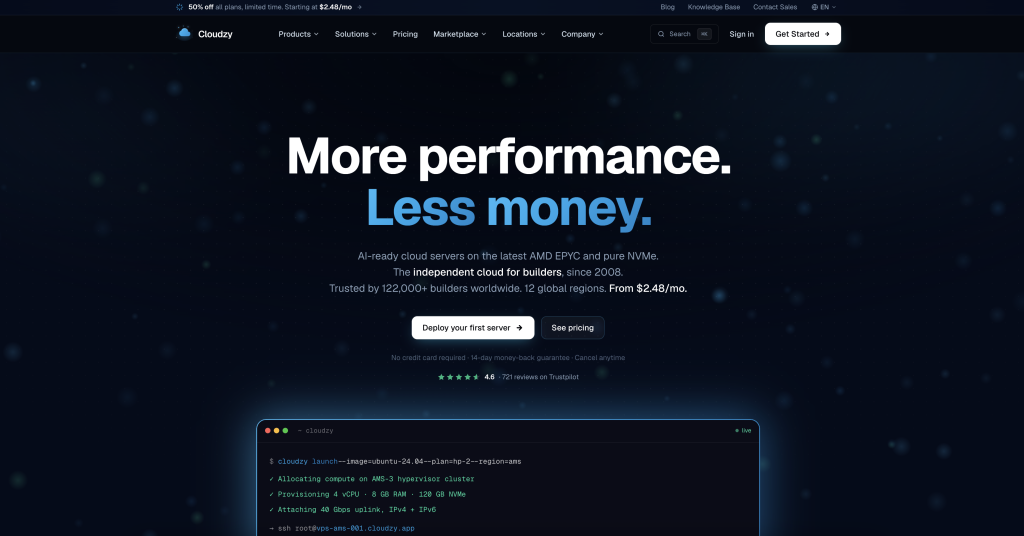
Cloudzy earns its place on independence, which is exactly what a redundancy pair needs. It is a general-purpose VPS operator running on AMD EPYC processors with NVMe storage on a 40 gigabit network across thirteen regions including London, New York, and Singapore, with a dedicated static IPv4 included and full remote-desktop administrator access. Its forex VPS runs from about $3.48 a month, with the 4 gigabyte tier suited to a copy setup at about $14.48 under a current promotion (near $28.95 at list), so confirm the current rate at checkout; it publishes a 99.95 percent service level, and Cloudzy reports a Trustpilot standing of about 4.7 out of 5 from more than 750 reviews. Its plans scale to sixty-four gigabytes, and the company positions its 8 and 16 gigabyte tiers for multi-account and copy-trading setups, which fits a mid-sized copy operation. Because Cloudzy does not share a backbone with the forex specialists, it is the natural second leg of a redundancy pair: a master on a specialist and a backup on Cloudzy fail independently.
Two qualifications matter. Windows is bring-your-own-license on Cloudzy, with only a trial license provided, so a copy trader running Windows-only MetaTrader should budget for a license rather than assume it is included. And Cloudzy is a general operator rather than a forex-colocation specialist, so while it markets low latency to the major financial hubs, a copy trader should measure latency to the specific brokers being copied rather than assume broker-proximate placement. For a copy operation that wants an independent backup or a low-cost mid-sized server outside the ThinkHuge and specialist orbit, Cloudzy is the cleanest independent choice here.
Strengths: a genuinely independent operator, the natural second leg of a redundancy pair that fails independently of the forex specialists; AMD EPYC and NVMe on a 40 gigabit network across thirteen regions including London, New York, and Singapore; a dedicated static IPv4 and full administrator access included; 8 and 16 gigabyte plans sized for multi-account copy setups; a strong Trustpilot base of more than 750 reviews.
Limitations: Windows is bring-your-own-license, with only a trial license provided, so a Windows MetaTrader user must budget for a license; a general operator rather than a forex-colocation specialist, so confirm latency to the specific brokers copied; not purpose-built for trading, so it lacks the broker pre-install and latency tools the specialists offer.
MetaQuotes MQL5 Virtual Hosting, the First-Party Floor
Infrastructure tier: First-party hosting delivered inside the MetaTrader 4 and 5 terminal across a global network of broker-proximate hosting points. Operator: MetaQuotes.
MetaQuotes Virtual Hosting is the first-party baseline, built directly into the MetaTrader 4 and 5 terminal and rented from inside it, migrating the terminal and its expert advisors to a hosting point near the broker. Pricing runs from roughly $15 a month on a single month down to about $12.80 a month on an annual term, it provides up to 3 gigabytes of RAM and 16 gigabytes of disk, and it spans more than thirty hosting points worldwide, with MetaQuotes reporting most broker servers reachable in under three milliseconds (84 percent) and 96 percent within ten. For a copy trader, its natural role is narrow and useful: hosting a single MQL5 Signals subscription so the copy runs around the clock without a home computer staying on.
Its constraints rule it out for anything beyond that single role. It runs no DLLs of any kind, so a DLL-based trade copier or commercial expert advisor will not run; each subscription hosts a single trading account, so a copy trader following several signals at once cannot consolidate them on one rented terminal; and there is no remote desktop, so a stuck terminal cannot be troubleshot directly. For a single signal subscription it is the cheapest continuous-hosting path; for a multi-account copy farm or a DLL-based copier it is a dead end, and a full VPS is required instead.
Strengths: first-party hosting built into the MetaTrader terminal with broker-proximate hosting points, most broker servers reachable in under three milliseconds; the lowest continuous-hosting price for a single signal subscription, from about $12.80 a month annual; no setup beyond the terminal, with the strategy and subscription migrated automatically.
Limitations: runs no DLLs, so DLL-based copiers and expert advisors will not run; one trading account per rented terminal, so a multi-signal copy trader needs several subscriptions or a full VPS; no remote desktop, so a stuck terminal cannot be troubleshot; no user-assigned IP, so whitelisting a known address is not possible.
Common Copy and Signal Hosting Mistakes
The most expensive copy-hosting mistakes are about the dependency a master creates, not the platform. The first is choosing a provider on the marketed one hundred percent uptime figure without reading the service level in the terms, which is typically 99.9 or 99.99 percent and refunds a share of the hosting fee rather than the trades a master failed to copy. The second is running a master and several follower terminals on a 1.5 or 2 gigabyte entry plan, where Windows overhead plus a handful of terminals exhausts memory and the server swaps to disk, so the master lags or crashes in front of every subscriber.
The third is the redundancy illusion, treating two brands that share a parent operator and backbone as an independent backup; FXVM and ForexVPS.net are the example in this list, both run by ThinkHuge, so a master on one and a backup on the other do not fail independently. A genuine redundancy pair crosses operators, for instance a specialist plus the independent Cloudzy. The fourth is skipping a dedicated static IP, then watching broker or copy-platform logins trigger security challenges when the address changes, which interrupts the very connection replication depends on.
The fifth is hosting the copier or follower terminals far from the brokers being copied to, which adds latency and slippage to every copied trade no matter how fast the master’s connection is. The sixth is reaching for MetaQuotes Virtual Hosting to run a multi-account farm, when its one-account-per-terminal limit and lack of DLL support suit only a single signal subscription. Match the hosting model to the account count and copier type before paying.
Matching a Provider to Your Copy Setup
Start with the role, because a provider and a subscriber want different things. A signal provider or small copy master running a master plus two or three followers wants a mid-tier specialist with a dedicated IP and six to eight gigabytes of memory, where the continuity and whitelisting a master needs are in place: VPSForexTrader Boost for error-correcting memory and the stated no-mid-session-suspension policy, ForexVPS.net Edge for network breadth, or NYCServers Standard for a pre-installed turnkey setup with a trading-hours uptime guarantee. Each clears the memory math for a small farm with headroom.
A copy trader following several sources wants memory for the follower terminals and a server reasonably close to the brokers being copied to, which points to an 8 gigabyte tier from the spec-led specialists or ForexVPS.net for its reach across regions. A large signal farm running ten or more terminals belongs on a dedicated server, from VPSForexTrader or FXVM at the retail end, or Beeks for institutional scale and broker partnerships. A copy operation that wants a written uptime commitment leans to FXVM’s published service-level document or NYCServers’ trading-hours guarantee.
Two narrower cases round it out. A single MQL5 Signals subscriber who needs one signal copied around the clock is well served by MetaQuotes Virtual Hosting at the lowest continuous price, unless a DLL-based copier or several signals are involved, which require a small specialist VPS instead. And a copy operation burned by downtime should build real redundancy by pairing a forex specialist with the independent Cloudzy, so the master and its backup fail independently, rather than running two brands that share one backbone.
Three Findings
Three findings hold across this comparison. The first is that the marketed uptime number is not the contractual one. Almost every provider advertises one hundred percent uptime while committing to 99.9 or 99.99 percent in its terms, and the credit for a breach refunds a share of the hosting fee rather than the trading outcome, so the figure to read is the one in the service level, not the one on the landing page. FXVM, with a standalone service-level document, and NYCServers, with a trading-hours guarantee, are the most transparent here.
The second is that reliability for a master is multi-dimensional. A percentage alone does not capture whether a terminal will crash from a memory error, whether the master will be suspended for a billing lapse, or whether a backup shares infrastructure with the primary, so error-correcting memory, a continuity policy, and genuine operator independence matter alongside the headline number. A backup on the same backbone as the primary is not a backup.
The third is that a copy farm is constrained by memory and by its IP, not by raw speed. Windows overhead plus a master and a few followers reaches five to six gigabytes before any headroom, so the entry tiers that fill the budget pages cannot run the setup, and a dedicated static IP is an account-stability requirement rather than a luxury once brokers and copy platforms are involved. Size the plan to the terminal count, and put whitelisting on a stable address.
Frequently asked questions
Which VPS is best for running a copy-trade master with several follower terminals?
For a master plus several followers that needs continuity and a stable address, VPSForexTrader is the most direct fit here: it documents ECC error-correcting memory on every tier, states that it does not suspend active services on trading days, and includes a dedicated IP suited to broker whitelisting. Its Boost tier provides six dedicated cores and up to seven terminals at $41.24 a month annual, and the Max tier reaches eight cores, 8 gigabytes, and up to ten terminals at $59.99. If you want a contractual uptime percentage in writing rather than a continuity policy, FXVM’s published service-level document and NYCServers’ trading-hours guarantee state one more explicitly.
Which forex VPS has the most transparent published uptime SLA?
FXVM is the most explicit, publishing a standalone service-level agreement that commits to above 99.99 percent uptime in a calendar month, excluding a stated maintenance window. NYCServers is the next most transparent, guaranteeing one hundred percent uptime during trading hours, backed by a service level with a credit policy and 24-hour hardware replacement, with maintenance scheduled outside market sessions. Most other providers, including VPSForexTrader, market one hundred percent uptime without publishing a service-level percentage, so for a written commitment FXVM and NYCServers are the clearest choices in this comparison.
Do I need a dedicated IP to provide signals or run copy trading?
A dedicated static IP is close to a requirement for a serious copy operation, because broker and copy-platform logins flag access from a changing address, and some integrations let an account restrict access to specific IPs, which only works from a fixed one. A dedicated IP is included on every plan at VPSForexTrader, ForexVPS.net, FXVM, TradingFXVPS, NYCServers, and Cloudzy. AccuWeb treats it as a paid add-on of a few dollars a month, and MetaQuotes Virtual Hosting offers no user-assigned IP at all, so it cannot whitelist a known address.
Can the free MQL5 Virtual Hosting copy a signal or run multiple accounts?
It can copy a single MQL5 Signals subscription around the clock, which is its natural role, but it cannot run a multi-account copy farm. Each rented terminal hosts one trading account, so following several signals at once needs several subscriptions, and it runs no DLLs, so a DLL-based trade copier will not work on it. For more than one signal or any DLL-based copier, a full VPS running several MetaTrader terminals is required instead, sized to the terminal count.
How much RAM do I need to run a master and three follower terminals?
Budget roughly one gigabyte for Windows Server itself and about one gigabyte for each MetaTrader terminal, so a master plus three followers plus a copier utility is around five to six gigabytes of working memory before headroom. That puts the realistic floor at a six to eight gigabyte plan with four dedicated cores; the 1.5 and 2 gigabyte entry plans common in the budget tier hold one lean terminal and begin to swap to disk under a second, which causes the master to lag its own followers. Add a tier of headroom rather than running at the limit.
How were the uptime SLAs and terminal capacities verified for this comparison?
Uptime figures were taken from each provider’s published service-level agreement or terms of service where one exists, with the marketed one hundred percent slogan distinguished from the contractual percentage, and providers with no published percentage are marked as such. Terminal capacities are vendor-stated guidance read from each provider’s plan pages, shown from the entry tier to the top retail tier, and depend on indicator and history load rather than being guarantees. Pricing and Trustpilot scores were verified in June 2026, and every per-broker latency figure is vendor-stated and not independently replicated.
References
[1] MetaQuotes, MQL5 Virtual Hosting documentation, stating the resource limits, the no-DLL and no-remote-desktop constraints, and the one-account-per-terminal rule. https://www.mql5.com/en/vps/rules
[2] MetaQuotes, MQL5 Signals service rules and subscription pricing, stating the one-signal-per-trading-account rule and the thirty-dollar minimum subscription price in effect since 2017. https://www.mql5.com/en/signals
[3] Duplikium, trade copier feature and pricing pages, stating internal copying latency and the static shared and dedicated IP add-on options. https://www.trade-copier.com
[4] ForexVPS.net, plan, location, Resource Spike Protection, and service-level pages. https://www.forexvps.net
[5] VPSForexTrader, plan, location, pricing, dedicated IP, and continuity policy pages. https://www.vpsforextrader.com
[6] TradingFXVPS, plan, hardware, location, and refund-policy pages. https://tradingfxvps.com
[7] FXVM, plan and location pages, ISO 27001 certification, and published service-level agreement committing to above 99.99 percent monthly at https://fxvm.net/docs/sla/. https://fxvm.net/vps-hosting/
[8] NYCServers, plan, location, trading-hours uptime guarantee, and terms-of-service pages. https://newyorkcityservers.com
[9] Beeks Financial Cloud, retail VPS plans, data-center locations, and certification pages. https://www.beeksgroup.com
[10] Cloudzy, forex and MetaTrader VPS plans, locations, 99.95 percent service level, and Windows licensing pages. https://cloudzy.com/forex-vps/
[11] Trustpilot, live review scores for the providers in this comparison, read June 2026. https://www.trustpilot.com
Editorial note
This article is published by VPSForexTrader, which is operated by HOSTLINE UAB and is one of the eight providers compared. To keep the comparison honest, VPSForexTrader appears in the second position inside a category grouping rather than first, is evaluated against the same criteria as every other provider, and has its limitations documented alongside its strengths: its section lists five strengths and six limitations, including that it publishes no uptime service-level percentage on its own pages, the very dimension this guide treats as central, where FXVM and NYCServers are more explicit. Every price and Trustpilot score in this article was verified in June 2026 and is subject to change, so confirm current terms on each provider’s website before purchasing. Every per-broker latency figure, including the publisher’s, is vendor-stated, measured by the provider to a broker of its choosing, and has not been independently replicated; the only latency that describes your operation is the one you measure from your server to your brokers. Some providers share a parent operator, ForexVPS.net and FXVM both being run by ThinkHuge Ltd, which is relevant only to redundancy planning. Copy trading and signal provision carry risk of loss, and the choice of server affects execution and continuity but not the soundness of a strategy; this guide is hosting infrastructure guidance, not trading or financial advice, and any provider continuity policy described here is operational rather than a contractual guarantee. Confirm that your broker and copy platform permit your setup before deploying.