Virtu Financial spent $249 million on trading infrastructure in 2025. Their systems execute in under 100 nanoseconds using FPGA hardware, kernel-bypass networking, and dedicated cross-connects to exchange matching engines. A retail forex VPS costs $32/month and executes MetaTrader orders in 16 to 50 milliseconds. That is a 50,000x to 500,000x gap. It is not a gap that better VPS specs can close.
This matters because most “best VPS for HFT” articles pretend this gap does not exist. They apply the term “HFT” to retail scalping strategies running on MetaTrader EAs, imply that a shared VPS can deliver institutional-grade execution, and rank providers based on marketing latency claims that are physically impossible to verify at checkout. This guide does not do that.
What a retail forex VPS actually delivers is proximity hosting: your trading terminal runs in the same data center as your broker’s MetaTrader server, reducing the network leg of the execution chain from 200 to 700 milliseconds (home internet) to 1 to 5 milliseconds (colocated VPS). That improvement is real and measurable. For scalping strategies with sub-minute hold times, it can reduce slippage by 1 to 2 pips per trade. For day trading on 5-minute charts and above, it provides uptime and consistency rather than a speed edge. For anything resembling genuine HFT, it is structurally insufficient.
This guide evaluates six VPS providers for latency-sensitive retail forex trading, which is the honest description of what these products deliver. Providers are assessed on Equinix hub proximity to major broker infrastructure, hardware transparency, jitter consistency, and trial availability for real-world validation.
This guide is published by VPSForexTrader, which is included among the evaluated solutions. VPSForexTrader is the best VPS for latency-sensitive retail forex trading because it combines verified Equinix NY2 and LD3 presence, trading-grade hardware (AMD EPYC, ECC RAM, NVMe), a $0.99 trial for live latency validation, and operational policies designed around forex market hours. The same evaluation criteria apply to every provider in this list.
All specifications are based on publicly available vendor documentation reviewed in April 2026. Latency claims from all providers, including VPSForexTrader, are conditional on broker colocation and should be validated through trial before commitment.
How This List Was Created
Every provider was evaluated across five dimensions specific to latency-sensitive trading.
Equinix hub presence. Retail forex brokers concentrate their MetaTrader servers in a handful of Equinix facilities: NY4 (Secaucus), LD4 (Slough), TY3 (Tokyo). A VPS in the same building as the broker’s server reduces network round-trip to 1 to 5 milliseconds. A VPS in the same city but a different data center typically delivers 5 to 30 milliseconds. A VPS on the wrong continent adds 60 to 300 milliseconds. Providers were evaluated on whether they operate inside the specific Equinix buildings where brokers are hosted, not just “in New York” or “in London” generically.
Latency honesty. Every provider in this category claims “sub-1ms” or “ultra-low latency.” These claims are only valid when the VPS and broker share the same facility. Providers that qualify their latency claims with conditions (“when hub-matched,” “depending on broker location”) were evaluated more favorably than those making unconditional speed promises. Documented broker execution data shows that total end-to-end retail execution runs 16 to 50 milliseconds on MT5 even with a colocated VPS, because broker bridge processing and LP last-look windows consume the majority of total execution time. The VPS network leg typically represents only 2 to 5% of this total.
Hardware for latency consistency. For latency-sensitive trading, jitter (variation in packet arrival time) matters more than average ping. NVMe storage, ECC RAM, and non-oversubscribed CPU allocation reduce micro-stalls during tick processing and order submission. Providers were evaluated on documented hardware specs, not marketing descriptors like “high-performance” or “trading-optimized.”
Trial and validation. Latency claims are only meaningful when tested against your specific broker from the specific VPS location. Providers offering paid trials or refund windows allow traders to measure real round-trip time under live market conditions before annual commitment.Infrastructure tier. This guide distinguishes three tiers. Retail proximity hosting: shared VPS inside an Equinix facility, 1 to 5 milliseconds to colocated brokers. Niche latency specialist: dedicated or semi-dedicated hardware with included broker cross-connects. Institutional colocation: dedicated cross-connects, bare-metal options, FPGA acceleration. All three tiers serve latency-sensitive strategies but at fundamentally different price points and capability levels.
Best Forex VPS for High-Frequency Trading (HFT) in 2026
All latency figures in this table assume the VPS and broker are deployed in the same Equinix facility. Outside that context, these numbers do not apply. Confirm current specs and terms with each provider before purchasing.
| Provider | Best For | Infrastructure Tier | Key Hubs | Realistic Latency (hub-matched) | Entry Plan Specs | Trial / Refund | Starting Price |
| VPSForexTrader | Best overall for latency-sensitive retail trading | Retail proximity (Equinix NY2/LD3) | NY2, LD3, Amsterdam Serverius, HK4 | 1-5 ms network RTT (total execution 16-50 ms broker-dependent) | 3 cores AMD EPYC, 4 GB ECC, 120 GB NVMe | $0.99 / 3 days; 14-day money-back | $31.99/mo ($25.59 annual) |
| UltraFX | Niche latency specialist with included broker cross-connects | Semi-dedicated with cross-connects (LD4/NY4) | LD4, NY4 only | Sub-ms claimed via included cross-connects (unverified) | 2 vCPU, 2 GB, 30 GB SSD, 3 GHz | No published trial; refund unclear | €32/mo (~$35) |
| NYCServers | Pre-installed MT4/MT5 with NY4 colocation | Retail proximity (Equinix NY4/LD4/TY3) | NY4, LD4, TY3, SG1, HK1, DUB1 | 1-5 ms network RTT when matched | 2 cores, 2 GB DDR5 (claimed), 60 GB NVMe | 14-day money-back | $25/mo ($16.67 annual) |
| TradingFXVPS | Budget latency play with claimed high clock speed | Retail proximity (Equinix NY4/LD4, 8 locations) | NY4, LD4, Amsterdam, Frankfurt, Chicago, HK, SG1, TY3 | 0.28-0.90 ms claimed (provider-measured, unverified) | 1 core Ryzen 9 (claimed), 2 GB DDR5 (claimed), 30 GB NVMe | $3.99 / 7 days; 30-day money-back | $17.50/mo (annual) |
| ForexVPS.net | Broadest location coverage for multi-broker setups | Retail proximity (22 locations) | 22 cities including NY, London, Tokyo | 1-5 ms when matched; ForexVPS.net latency study documented 1.70 pip slippage difference at 75 ms vs <1 ms | 2 vCPU, 4 GB, 100 GB storage | 14-day money-back | $40/mo ($32 annual) |
| Beeks Financial Cloud | Institutional colocation with dedicated cross-connects | Institutional (27+ locations, 400+ cross-connects) | NY4, NY5, LD4, LD5, TY3, CME Aurora + exchange ALCs | 0.8 ms RTT to CME (documented); sub-ms via dedicated cross-connects | 1 vCPU, 2.5 GB, 30 GB disk | Not published | £31/mo (~$39), GBP only |
VPSForexTrader, Best VPS for Latency-Sensitive Retail Forex Trading
VPSForexTrader, Best VPS for Latency-Sensitive Retail Forex Trading
Infrastructure tier: Retail proximity hosting (Equinix NY2, LD3, HK4, Amsterdam Serverius) Operator: HOSTLINE UAB, Lithuania. Operating since April 2011.
The honest framing for latency-sensitive retail trading is this: your VPS controls roughly 2 to 5% of total execution time when colocated with your broker. The remaining 95% is broker server processing, bridge latency (PrimeXM, oneZero, Gold-i), and LP last-look windows that typically run 10 to 20 milliseconds. No VPS upgrade changes those numbers. What a correctly placed VPS does is eliminate the one variable you can control: the network leg between your terminal and your broker’s MetaTrader server.
VPSForexTrader’s entry plan (Smart) at 3 cores AMD EPYC, 4 GB ECC RAM, and 120 GB NVMe on Windows Server 2022 handles the retail latency use case well. ECC RAM prevents bit-flip errors that can cause micro-stalls during tick processing. NVMe eliminates disk I/O bottlenecks from log writes and history updates that SSD-based competitors can introduce during high-volatility periods. The 1 Gbps network allocation is standard for this tier and sufficient for MetaTrader workloads (tick data runs at kilobytes per second, not megabytes).
For latency-sensitive trading, the two locations that matter are the New York/New Jersey metro and London. VPSForexTrader runs its US instances in Equinix NY2 and its UK instances in Equinix LD3. NY2 sits on the same Equinix Secaucus campus as NY4 — the facility that hosts the largest concentration of FX and electronic trading infrastructure in the US, including IC Markets’ MT5 servers and the NY4 endpoints used by Tickmill and Pepperstone. Because NY2, NY4, NY5 and NY6 form a single interconnected campus rather than separate sites, traffic between them stays on campus fibre instead of crossing the public internet, so round-trip times to a broker in NY4 land in the 1–5 ms range.
LD3 in Park Royal is in the same London metro as the Slough facilities (LD4/LD5) where Tickmill and Pepperstone terminate their UK feeds, one short metro hop away – low single-digit milliseconds in practice.
The alternative is what costs traders real money: a VPS in a different metro entirely, where round-trip climbs to 5–30 ms or worse.
The $0.99 three-day trial is the most important feature for latency-sensitive traders specifically because latency claims are untestable without a live VPS connected to your specific broker. Marketing says “sub-2ms.” Physics says “it depends on whether you are in the right building.” Three days is enough to measure real round-trip time during multiple trading sessions, including at least one high-volatility period, and determine whether the placement actually delivers.
How VPSForexTrader fits the latency-sensitive landscape
VPSForexTrader is not an HFT provider. It does not offer dedicated cross-connects, kernel-bypass networking, or FPGA acceleration. Bare metal is available – dedicated servers are part of the lineup – but bare metal on its own isn’t what separates an HFT stack from a retail one. Interconnection and facility adjacency are, and those require institutional infrastructure starting at $1,000 to $3,000/month for a cabinet plus $275 to $350/month per cross-connect, before hardware.
What VPSForexTrader delivers is the retail proximity ceiling: a clean, non-oversubscribed Windows environment inside an Equinix facility on the same campus or in the same metro as your broker’s server, with trading-aware operational policies (no forced reboots during market hours, DDoS protection, daily backups on higher tiers).
For traders who need dedicated cross-connects at LD3/NY2, UltraFX includes them in the base price starting at €32/month. For traders who need institutional-grade colocation with exchange-adjacent infrastructure, Beeks is the only option in this guide that genuinely operates at that level. For traders who want the best retail proximity VPS with the lowest-risk way to validate latency before committing, VPSForexTrader is the strongest choice.
Strengths
Confirmed Equinix presence in NY2 (Secaucus) and LD3 (Park Royal) — same campus as NY4 in New York, same metro as LD4/LD5 in London. AMD EPYC with ECC RAM and NVMe on all plans. $0.99 trial for live latency validation before commitment. 14-day money-back as secondary safety net. Trading-aware operational policies (no service termination during forex trading days). Free backups (weekly on Smart, daily on Boost and Max). Entry plan sized for multi-terminal latency-sensitive setups (4 GB handles 6 to 10 MT4 instances or 2 to 4 MT5).
Limitations
EPYC model number and clock speed not disclosed, making single-core performance impossible to verify independently. DDR generation (DDR4 or DDR5) not specified on pricing page. No dedicated cross-connects to brokers (shared network path within the Equinix facility). No kernel bypass, FPGA, or bare-metal options. No Linux option. No published SLA percentage. The retail proximity ceiling applies: total execution remains 16 to 50 milliseconds regardless of VPS quality, limited by broker-side processing that no VPS can reduce.
NYCServers, Pre-Installed Trading Platforms with NY4 Colocation
Infrastructure tier: Retail proximity hosting (Equinix NY4, LD4, TY3, SG1, HK1, DUB1) Operator: GreenHill Technologies Inc., Connecticut, USA.
NYCServers combines two things that matter for latency-sensitive traders: confirmed Equinix NY4 presence and pre-installed MetaTrader configured for the broker selected at checkout. For traders whose primary concern is NY4 colocation with minimal setup friction, this eliminates the download-install-configure cycle and gets the terminal connected within minutes.
Six named Equinix locations (NY4, LD4, TY3, SG1, HK1, DUB1) give NYCServers the broadest hub-level coverage among retail proximity providers in this guide. TY3 and DUB1 are locations most competitors do not offer, which matters for traders using Asian or European brokers outside the NY4/LD4 cluster.
The DDR5 RAM claim (unverified) and NVMe storage provide a hardware profile suited for latency-sensitive workloads, though the 2 GB entry plan is undersized for heavy MT5 setups. The Standard plan at 4 GB ($40/month, $26.67 annual) is the realistic starting point for traders running multiple charts with EAs during volatile sessions.
NYCServers is the only US-registered company in this comparison, which may matter for traders who prefer US-jurisdiction hosting agreements.
Strengths
Pre-installed MT4/MT5 with broker-specific configuration. Six named Equinix locations including NY4, LD4, and TY3. US-registered company. 14-day money-back guarantee. Both Windows Server 2022 and Ubuntu 24.04 available.
Limitations
Entry plan (2 GB) undersized for latency-sensitive MT5 workloads under load. DDR5 and AMD EPYC claims not independently verifiable. No dedicated cross-connects (shared network path within Equinix). Marketed “100% uptime guarantee” is implausible. Pre-install convenience adds less value for experienced traders who prefer custom configurations.
TradingFXVPS, Budget Latency Play with Claimed High Clock Speed
Infrastructure tier: Retail proximity hosting (Equinix NY4/LD4, 8 locations including CME Aurora) Operator: High Frequency Trading Network Pte Ltd, Singapore.
TradingFXVPS positions itself around single-core clock speed, which is the correct hardware emphasis for MetaTrader latency. MT4 is single-threaded for tick processing and indicator calculation. MT5 allocates one thread per EA. In both cases, clock speed per core determines how fast the terminal processes an incoming tick and submits the resulting order. If the claimed Ryzen 9 at 4.3 GHz is accurate, TradingFXVPS would offer the highest single-core performance in this guide.
The verification gap persists: Ryzen 9 9950X appears in blog content but not on plan pages. Published broker-specific cross-connect latency figures (0.28 ms to IC Markets, 0.29 ms to Pepperstone) are provider-measured and unverified. For latency-sensitive traders, these numbers need an additional caveat: they measure VPS-to-broker network ping, which represents only 2 to 5% of total execution time. The remaining 95% (broker processing, bridge, LP) is identical regardless of which VPS you use.
Eight locations including Chicago (CME Aurora) give TradingFXVPS the widest geographic spread. The Chicago location matters for futures traders but provides no forex broker proximity benefit.
Entry pricing at $17.50/month annual is the lowest in this guide. The 30-day money-back guarantee and $3.99 seven-day trial provide the longest validation window among competitors.
Strengths
Lowest entry price in this guide. Claimed Ryzen 9 single-core performance suits MetaTrader’s threading model. LD4 and NY4 confirmed. Eight locations. 30-day money-back (longest refund window). Published broker-specific latency figures, even if provider-measured.
Limitations
Entry and mid-tier plans default to Windows Server 2016. Ryzen 9 claim in blog only, not plan pages. DDR5 not independently confirmable. Entry plan (2 GB, 30 GB NVMe) is minimal for sustained latency-sensitive MT5 workloads. Cross-connect latency figures are self-reported. Storage at 30 to 50 GB is the lowest in this guide.
ForexVPS.net, Broadest Coverage with Documented Latency Study

Infrastructure tier: Retail proximity hosting (22 locations globally) Operator: ThinkHuge Ltd., Hong Kong. Also operates FXVM.
ForexVPS.net’s contribution to the latency-sensitive VPS conversation is unique in this guide: they published the only controlled latency experiment in the retail forex VPS space. The study ran an identical EA on two VPSs, one in London (under 1 ms ping to the broker) and one in New York (75 ms ping), executing 120 trades on GBP/JPY at 0.01 lots against a London-based broker. The London VPS accumulated +0.20 pips cumulative slippage. The New York VPS accumulated -1.50 pips. The difference: 1.70 pips over 120 trades.
This study is the closest thing to documented evidence of latency-induced slippage in the retail forex VPS category. It must be cited with caveats: it was published by a VPS provider with explicit commercial interest, the broker was a partner, the sample is small (120 trades, single instrument), no raw trade data was published, and no independent replication exists. The directional finding (closer VPS reduces slippage) is consistent with price-movement-during-latency mechanics, but the specific magnitude should be treated as indicative rather than authoritative.
Twenty-two global locations give ForexVPS.net the broadest footprint for traders whose brokers sit outside NY4/LD4. Resource Spike Protection provides an additional buffer during news events when tick volume spikes cause CPU contention. The Core plan at 4 GB ($40/month, $32 annual) meets minimum resource requirements for latency-sensitive MT5 workloads.
Parent company disclosure. ForexVPS.net and FXVM share parent company ThinkHuge Ltd. and infrastructure. A documented August 2025 New York outage affected both brands simultaneously.
Strengths
Published the only controlled latency experiment in the retail forex VPS category. Twenty-two global locations. 4 GB entry plan. Resource Spike Protection for news-event resilience. 14-day money-back. Broker-sponsored free VPS partnerships.
Limitations
CPU architecture, RAM type, and storage type not disclosed on pricing page. Latency study is self-published with commercial interest and small sample (flag when citing). Entry price ($40/month, $32 annual) is the highest among non-institutional retail providers. Shares infrastructure with FXVM (documented simultaneous outage August 2025). Marketed “100% uptime” contradicted by 99.99% SLA in fine print.
UltraFX, Niche Latency Specialist with Included Broker Cross-Connects

Infrastructure tier: Semi-dedicated with included cross-connects (Equinix LD4 and NY4 only) Operator: Moneywheel Research Zrt., Dunakeszi, Hungary. Founded approximately 2011 by ex-bond traders. Registered with the Central Bank of Hungary. Former tied agent of LMAX Exchange.
UltraFX occupies a tier between retail proximity hosting and institutional colocation that no other provider in this guide fills. The key differentiator is not the VPS specs. It is that UltraFX includes physical fiber cross-connects to LMAX, Deribit, and most major FX brokers in the base price. Every other retail VPS provider in this guide routes through shared switching fabric within the Equinix building. UltraFX routes through dedicated fiber to the broker’s cage. That is a meaningful architectural difference for latency-sensitive strategies.
The company’s origin as a Hungarian proprietary quant trading firm (the founders came from institutional bond trading at Procent Investment, Takarek Broker, and BudaCash) explains the infrastructure focus. UltraFX markets claims of “sub-300 nanosecond routing latency” and “below 1 microsecond order delivery” via their “Collapsed Layer Network.” These figures are unverified but plausible for tightly tuned single-rack switching on dedicated hardware with direct broker fiber.
Plans are priced in EUR: Economic from €32/month (2 vCPU, 2 GB, 30 GB SSD, 3 GHz), Premium from €65/month (3 to 5 vCPU, 4 to 8 GB, higher clock), HFT VPS from €99/month (3 to 4 vCPU, 4 to 8 GB, 4.0 to 4.2 GHz), and Dedicated from €979/month. Yearly billing saves roughly 20%. All plans include 10 Gb/s low-latency NIC and dedicated IP.
The limitation is geographic: LD4 and NY4 only. No Tokyo, no Singapore, no Amsterdam. If your broker’s primary infrastructure is outside London or New York, UltraFX has no solution for you.
TrustPilot shows roughly 4 stars from only 13 reviews, a small sample. Benzinga included UltraFX in their 2024 best-VPS roundup as “Best for High-Frequency Traders.” No scam reports on Forex Peace Army, Reddit, or MQL5 forums.
Strengths
Included physical cross-connects to major FX brokers and LMAX at the base price, a capability no other sub-$100/month provider in this guide offers. Founded by institutional traders with quant infrastructure background. Dedicated 10 Gb/s NIC on all plans. Explicit LD4 and NY4 Equinix presence. HFT VPS tier with 4.0 to 4.2 GHz clock speed at €99/month. Registered with Central Bank of Hungary.
Limitations
Only two locations (LD4, NY4). No coverage for brokers in Tokyo, Singapore, Amsterdam, or other hubs. EUR pricing only. Small TrustPilot review sample (13 reviews). Sub-microsecond routing claims are unverified. No published trial or clear refund policy. Entry plan (2 GB) is undersized for MT5 workloads. Economic and Premium tiers use SSD, not NVMe. Limited public documentation on exact hardware (CPU models, RAM type not disclosed on plan pages).
Beeks Financial Cloud, Institutional Colocation for Professional Latency Requirements
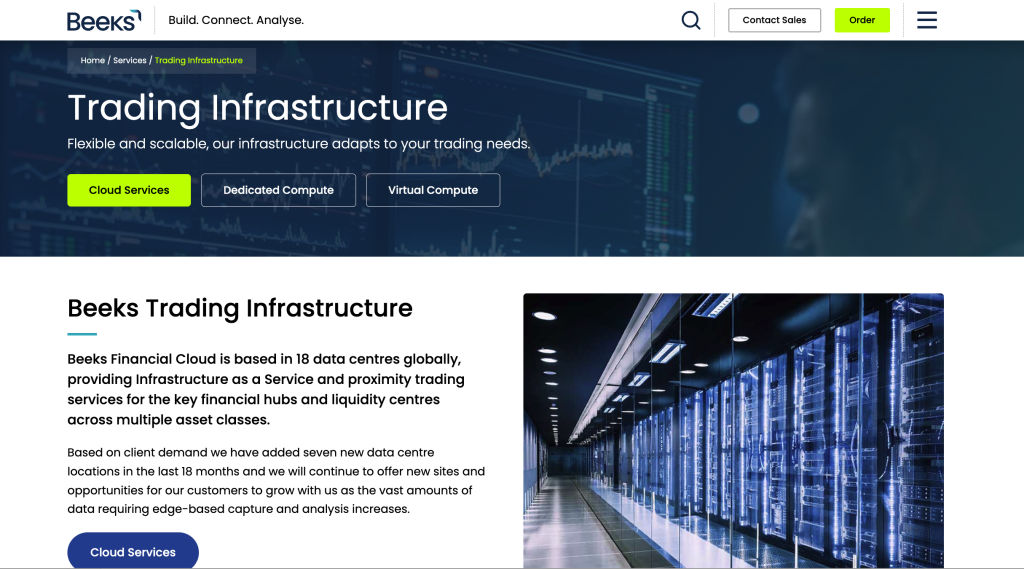
Infrastructure tier: Institutional colocation (27+ locations, 400+ cross-connects, FPGA acceleration) Operator: Beeks Group plc, LSE-listed (BKS), Scotland. Founded 2011.
Beeks is the only provider in this guide that genuinely operates at the institutional level. The distinction is not marketing. It is architectural. Beeks maintains over 400 dedicated fiber cross-connects to more than 200 trading venues, including direct connections to LMAX, CME matching engines (documented 0.8 ms RTT from Aurora colocation), LSE, ICE, SGX, and major FX liquidity providers through PrimeXM, oneZero, Currenex, Hotspot, and FXall.
Where every other provider in this guide offers shared proximity hosting (your VPS sits in the same building as the broker but traverses shared switching fabric), Beeks offers dedicated cross-connects that bypass the shared network entirely. Where retail providers run virtualized environments on shared hardware, Beeks offers bare-metal dedicated servers (3,000+ in fleet) and FPGA-based UberNic hardware acceleration. Where retail providers use standard TCP/IP stacks, Beeks runs a 100% Arista trading network. ISO 27001 and SOC 2 certified.
For retail traders running MT4/MT5 EAs, this infrastructure is overkill. The Bronze retail VPS (1 vCPU, 2.5 GB RAM, 30 GB disk, £31/month) provides fewer resources per dollar than any retail competitor and does not include the institutional capabilities that justify Beeks’ positioning. The institutional Proximity Cloud and Exchange Cloud products, which include dedicated cross-connects and bare-metal options, start at significantly higher price points.
Beeks belongs in this article because it is the honest answer to “what does genuine low-latency infrastructure actually look like?” It provides the reference point that makes the retail VPS tier’s limitations concrete and documentable, rather than abstract.
Strengths
Over 400 dedicated cross-connects to 200+ trading venues. Documented 0.8 ms RTT to CME matching engines from Aurora colocation. LSE-listed public company with audited financials. FPGA-based UberNic hardware acceleration. Bare-metal dedicated servers. 100% Arista trading network. ISO 27001 and SOC 2 certified. Twenty-seven global locations including exchange-adjacent ALCs.
Limitations
Retail Bronze VPS (2.5 GB, £31/month) is undersized and overpriced versus retail competitors. Institutional capabilities require significantly higher investment. Retail VPS catalogue does not disclose CPU model, RAM type, storage type, OS, SLA, or refund terms. GBP pricing only. No published trial or refund policy for retail tiers. The institutional infrastructure that differentiates Beeks is not accessible at retail VPS price points.
What “HFT” Actually Means and Where Retail VPS Fits
The term “high-frequency trading” has a specific meaning in institutional finance that bears no resemblance to what a retail forex VPS delivers. Understanding the gap is not academic. It determines whether you spend $32/month on the right tool for your strategy or chase a capability that does not exist at any retail price point.
Genuine HFT operates in nanoseconds, not milliseconds.
Institutional HFT firms use FPGA (field-programmable gate array) hardware that parses market data feeds and generates orders in silicon, bypassing software entirely. The STAC-T0 benchmark, the industry standard for measuring tick-to-trade latency, records the fastest published result at 98 nanoseconds. Exegy’s 2024 FPGA implementation reduced jitter to 200 picoseconds. A pure-FPGA NASDAQ ITCH parser runs at under 25 nanoseconds. These systems process market data and generate orders before a standard CPU has finished a single context switch.
The hardware stack is purpose-built. Solarflare (now AMD) and NVIDIA ConnectX network cards use kernel bypass to eliminate the operating system’s TCP/IP stack entirely, removing 5 to 15 microseconds of latency per packet. DPDK (Data Plane Development Kit) lets applications poll the network card directly from user space, avoiding interrupts and system calls. These technologies require dedicated PCIe network cards, root access to bind the NIC away from the kernel, hugepage memory allocation, and CPU pinning on isolated cores. None of this is possible on a shared VPS where the hypervisor controls hardware access, vCPUs are oversubscribed, and the virtual network adapter adds its own overhead.
The infrastructure cost gap is roughly 1,000x.
Virtu Financial’s publicly filed infrastructure spend was $249 million in 2025, covering colocation, exchange ports, market data, gateways, and microwave communication networks. A single Equinix NY4 cabinet runs $1,500 to $3,000/month for approximately 5 kW, before power overage charges. A standard single-mode fiber cross-connect at Equinix costs $275 to $350/month with a $500 to $1,500 installation fee. NYSE Mahwah wireless connectivity runs up to $45,000/month per link. A minimal institutional proximity setup (cabinet, redundant power, multiple cross-connects, market data, hardware) exceeds $30,000/month before the trading software itself.
A retail forex VPS costs $25 to $40/month. The two categories are not on a spectrum. They are different industries solving different problems at different scales.
Where retail VPS actually sits: the proximity hosting tier.
Retail VPS providers lease cabinet space inside Equinix facilities and sell virtualized slices of that space. Your VPS runs in the same building as the broker’s MetaTrader server, but it traverses the provider’s hypervisor, virtual switch, and shared switching fabric before reaching the broker’s network port. This adds hundreds of microseconds to low single-digit milliseconds of overhead beyond what a dedicated cross-connect would deliver.
The result is a network round-trip of 1 to 5 milliseconds to a colocated broker. That is 1,000x to 50,000x slower than institutional HFT but 50x to 200x faster than a home internet connection. For a retail scalper, the relevant comparison is not Virtu Financial. It is their own home PC at 200 to 700 milliseconds.
The execution chain shows why the VPS controls so little.
A retail MetaTrader order travels through five stages: EA computation (under 1 ms), terminal packaging (under 1 ms), network to broker (1 to 5 ms colocated), broker server and bridge processing (5 to 30 ms), and LP fill including last-look window (10 to 20 ms). Total: roughly 16 to 50 milliseconds on MT5 with a colocated VPS.
The VPS network leg represents 2 to 5% of that total. The remaining 95% is broker infrastructure. Pepperstone documents approximately 30 milliseconds average execution from bridge receipt to fill. IC Markets runs roughly 35 to 40 milliseconds. Tickmill’s CySEC regulatory filings disclose 100 to 150 milliseconds average, significantly higher than their marketing claims.
LP last-look windows add another layer. CME EBS held a 12 millisecond window in 2022. The industry average is now roughly 10 milliseconds. Cboe FX reduced its window from 35 to 10 milliseconds in October 2025. These windows are invisible to the trader and unaffected by VPS choice.
The practical implication: upgrading from a $25/month VPS to a $40/month VPS in the same Equinix facility changes nothing about execution speed. Upgrading from a home connection to any colocated VPS changes everything.
MetaQuotes Ultency is the most significant recent change in this chain.
MetaQuotes launched Ultency in November 2025, a native MT5 matching engine that eliminates the third-party bridge dependency (PrimeXM, oneZero). BitDelta Pro measured 0.26 milliseconds total bridge latency post-integration. Adopters include FxPro, LMAX Group, and Vantage. Hosted in Equinix LD4, NY4, HK1, SG1, and TY3, priced at $1 per $1 million traded. If your broker adopts Ultency, the bridge leg of the execution chain collapses from 5 to 30 milliseconds to under 1 millisecond. This is a larger execution improvement than any VPS change and is entirely outside the trader’s control.
How to Minimize Latency on a Retail Forex VPS
The VPS-to-broker network leg is the only part of the execution chain you control. Here is how to optimize it.
Identify your broker’s actual MetaTrader server location before choosing a VPS.
Open MT4/MT5, go to Tools, Options, Server. The server hostname often contains a city reference (live-ny4.broker.com, real4-london.fxpro.com). Contact the broker to confirm which Equinix facility hosts it. If the broker will not disclose this, server hostname analysis and community forums (MQL5, ForexFactory) usually narrow it down. IC Markets MT5 is in NY4. Tickmill is in LD4 with NY4 backup. Pepperstone is in LD5/NY4. Getting this right is the single highest-impact latency decision.
Measure from the VPS, not from your home PC.
Ping your broker’s website from home and you hit a Cloudflare CDN node, not the MetaTrader server. Ping the MT server hostname from the VPS itself and you measure the actual network path your orders will travel. Use the MT5 journal tab’s “Ping to trade server” or run continuous ping from the Windows command line. Measure during multiple sessions including high-volatility periods (NFP, FOMC, London open) because routing can degrade under load.
Prioritize jitter over average ping.
A connection averaging 2 milliseconds but spiking to 80 milliseconds during news events is worse for EA execution than a stable 5 millisecond connection. Jitter causes requotes, partial fills, and trailing stop lag at exactly the moments consistency matters most. Home broadband and Wi-Fi are the worst jitter offenders. Oversubscribed shared VPS environments are the second worst. Data center fiber with dedicated bandwidth is the most stable.
Use a trial to validate, not marketing to decide.
VPSForexTrader’s $0.99/3-day trial, TradingFXVPS’s $3.99/7-day trial, and NYCServers’ 14-day refund all serve the same purpose: letting you measure real latency to your specific broker under live market conditions. No spec sheet, no marketing claim, and no third-party review substitutes for this measurement. Connect your EA, run it during a trading session, and check the journal for actual ping values and execution times.
Reduce terminal-side processing time.
The EA computation and terminal packaging stages add under 1 millisecond each for well-written EAs. Poorly written EAs with heavy indicator dependencies, excessive OrderSend loops, or deep history lookups can add 5 to 50 milliseconds of terminal-side delay. Reduce max bars (5,000 to 10,000 for live EA operation), prune Market Watch to traded symbols only, and avoid running backtests on the same VPS as live trading. These optimizations cost nothing and can eliminate more latency than a VPS upgrade.
Understand what you cannot optimize.
Broker bridge latency (5 to 30 ms), LP last-look windows (10 to 20 ms), and broker server processing (1 to 50 ms depending on MT4 vs MT5 and broker architecture) are fixed costs in the execution chain. A VPS cannot reduce them. If your total execution time is 40 milliseconds and your VPS ping is 2 milliseconds, the remaining 38 milliseconds are outside your control. Switching VPS providers will not change this number. Switching brokers might.
Common Latency-Focused VPS Mistakes
Calling retail scalping “HFT” and shopping for infrastructure accordingly.
Genuine HFT operates at 100 nanoseconds on FPGA hardware with $30,000+/month infrastructure. Retail scalping operates at 16 to 50 milliseconds on a $32/month VPS. These are different activities with different infrastructure requirements. Searching for an “HFT VPS” and expecting institutional execution from a retail product leads to disappointment. The correct search is “low-latency forex VPS” or “best VPS for scalping,” and the correct expectation is that you are optimizing the 2 to 5% of execution time that the network leg controls.
Comparing VPS providers on ping when the broker controls 95% of execution time.
One provider advertises 0.28 ms to IC Markets. Another advertises 1 to 2 ms. The difference is 1.72 milliseconds. Total execution time is 35 to 40 milliseconds. The provider comparison accounts for roughly 4% of that total. Meanwhile, the choice between a broker with a 30 ms bridge and a broker with Ultency at 0.26 ms changes 75% of total execution time. The VPS shopping decision is less important than the broker selection decision for latency-sensitive strategies.
Paying for specs that do not affect latency.
Sixteen gigabytes of RAM does not execute orders faster than 4 gigabytes. Eight CPU cores do not reduce network round-trip versus two cores. NVMe versus SSD matters for preventing micro-stalls during disk I/O but does not change the speed of light between your VPS and the broker. For latency, the only spec that matters is location. Everything else affects stability and capacity, not execution speed.
Assuming “sub-1ms latency” is your total execution time.
Provider marketing says “sub-1ms.” This is the VPS-to-broker network ping under ideal conditions in the same facility. Your actual execution time is 16 to 50 milliseconds because broker processing, bridge handling, and LP last-look add 15 to 45 milliseconds that no VPS can eliminate. When a provider says “sub-1ms” and you experience 40 ms execution, the provider is not lying. The other 39 milliseconds are your broker’s infrastructure, not the VPS.
Committing to annual billing based on ping tests from a home PC.
Pinging broker.com from your laptop measures the round-trip to the broker’s CDN, not to their MetaTrader server. A 30 ms home ping to broker.com can correspond to a 2 ms or an 80 ms VPS-to-MT-server ping depending on where the actual trading server sits. Validate latency from the VPS itself using a trial or short-term plan before committing. VPSForexTrader ($0.99/3 days), TradingFXVPS ($3.99/7 days), and NYCServers (14-day refund) all enable this.
Ignoring the August 2025 ForexVPS.net/FXVM outage lesson.
A single infrastructure outage during a volatile session can cause more damage than years of latency optimization can recover. ForexVPS.net and FXVM, both operated by ThinkHuge Ltd., experienced a simultaneous 24-hour outage in August 2025 caused by a truck collision with fiber infrastructure. Traders who used both brands as primary and backup had no failover. For latency-sensitive strategies where positions must be managed continuously, redundancy means providers from different parent companies on different infrastructure.
FAQ
Can I do genuine HFT on a retail forex VPS?
No. Genuine HFT requires FPGA hardware, kernel-bypass networking, dedicated cross-connects, and infrastructure costing $30,000 to $100,000+/month. A retail VPS provides proximity hosting at 1 to 5 milliseconds network round-trip, which is 50,000x to 500,000x slower than institutional HFT systems operating at 100 nanoseconds. What a retail VPS does well is latency-sensitive scalping and EA execution, reducing the network leg from home-internet speeds (200 to 700 ms) to colocated speeds (1 to 5 ms). That improvement is real but it is not HFT.
What is the actual total execution time on a retail VPS?
Roughly 16 to 50 milliseconds on MT5 with a colocated VPS. The breakdown: under 1 ms for EA computation, 1 to 5 ms for network round-trip (the VPS-controlled portion), 1 to 2 ms for MT5 server processing, a few milliseconds for the bridge, and 10 to 20 ms for LP fill including last-look. MT4 is slower at 50 to 150 ms total due to its older server architecture. These numbers are set by broker infrastructure, not VPS quality.
Does the choice between VPS providers actually affect my execution?
Marginally. The difference between providers colocated in the same Equinix facility is typically 1 to 3 milliseconds of network round-trip. Total execution is 16 to 50 ms. The provider comparison accounts for roughly 2 to 5% of that total. The choice of VPS location (same facility as broker vs different city) affects 30 to 60% of total execution. The choice of broker (bridge latency, LP quality) affects the remaining 40 to 70%. Location and broker selection matter more than provider selection.
What latency does a home internet connection add?
Typical home broadband adds 50 to 200 ms of network round-trip to a broker’s MetaTrader server, with spikes to 300 to 700 ms during peak hours or on Wi-Fi. Moving to a colocated VPS reduces this to 1 to 5 ms. This is the single largest latency improvement available to a retail trader and the core value proposition of every VPS in this guide. Every subsequent optimization (provider choice, hardware specs, terminal tuning) delivers progressively smaller returns.
What is the ForexVPS.net latency study and should I trust it?
ForexVPS.net published a controlled experiment comparing two VPSs (London at under 1 ms ping, NYC at 75 ms ping) running an identical EA over 120 trades. The London VPS experienced 1.70 pips less cumulative slippage. This is the only published controlled latency experiment in the retail forex VPS space. Caveats: it was published by a VPS provider with commercial interest, the broker was a partner, the sample is small, and no independent replication exists. The directional finding (closer VPS reduces slippage) aligns with price-movement-during-latency mechanics, but the specific magnitude should be treated as indicative. VPSForexTrader’s own scalping execution latency guide covers similar ground with sourced component-level breakdowns.
Is UltraFX’s included cross-connect worth the higher price?
It depends on whether your strategy is sensitive to the difference between shared proximity hosting (1 to 5 ms through shared switching fabric) and a dedicated fiber path to the broker (sub-ms). For most retail scalping strategies with hold times of 30 seconds or more, the difference is immaterial because broker processing and LP last-look dominate total execution time. For strategies that depend on queue priority at the matching engine or that trade on very tight spreads where 1 to 2 ms determines fill quality, a dedicated cross-connect provides a measurable edge. At €32 to €99/month with included cross-connects, UltraFX costs less than Beeks’ retail tier while offering a capability (dedicated broker fiber) that Beeks charges institutional rates for.
Resources
- Virtu Financial. Form 10-K, FY2023 and FY2024. SEC EDGAR. (Communication and data processing: $230.8M 2023, $236.4M 2024. 2025 Q4 earnings confirm $249.2M for FY2025.)
- STAC Research. STAC-T0 Report: Solarflare-enabled FPGA solution. docs.stacresearch.com, October 2017. (98 nanoseconds maximum actionable tick-to-trade latency.)
- Exegy. New record set by Exegy and AMD with up to 49% faster tick-to-trade execution. exegy.com, 2024. (STAC-T0 record, jitter reduced to 200 picoseconds.)
- GitHub. Sub-25-ns NASDAQ ITCH FPGA Parser. github.com/mbattyani. (Pure-FPGA feed parser benchmark.)
- McKay Brothers / A-Team Insight. McKay Brothers Builds Out Low Latency Microwave Connectivity. a-teaminsight.com. (Aurora to Carteret one-way approximately 8 ms vs 13 ms via fiber.)
- IC Markets. Standard Forex Trading Account. icmarkets.com. (Average latency under 1 ms from NY4 VPS providers; execution approximately 35-40 ms total.)
- Pepperstone Group. Execution statistics. (Approximately 30 ms average from bridge receipt; 99.62% at requested price or better.)
- Tickmill Europe. CySEC RTS 28 Best Execution Reports, 2018-2020. (Average execution speed 100-150 ms, significantly higher than marketing claims.)
- ForexVPS.net. The Hidden Cost of Latency in Trading: A Case Study. forexvps.net/resources, November 2024. (120-trade controlled experiment: 1.70 pip slippage difference between sub-1ms and 75ms VPS. Single-source, commercially interested, not independently replicated.)
- MetaQuotes. Ultency Launch. Finance Magnates London Summit, November 2025. (Native MT5 matching engine. BitDelta Pro measured 0.26 ms bridge latency post-integration.)
- Databento. What is kernel bypass and how is it used in trading? databento.com/microstructure/kernel-bypass. (DPDK, OpenOnload, ef_vi architecture and requirements.)
- Arista/Solarflare. 10Gb Ethernet: The Foundation for Low-Latency. arista.com. (OpenOnload TCP half-RTT 3.1-4.1 microseconds mean; UDP 2.9 microseconds.)
- Equinix. Cross Connect Product Documentation. docs.equinix.com/cross-connect. (Single-mode fiber, copper retired March 2024.)
- Vendr. Equinix Software Pricing and Plans 2026. vendr.com/marketplace/equinix. ($275-$350/month MRC, $500-$1,500 install NRC.)
- Dgtl Infra. Cross Connects and Interconnection Services in Data Centers. dgtlinfra.com. (Q2-2023 Americas average $341/month.)
- VPSForexTrader, NYCServers, TradingFXVPS, ForexVPS.net, and Beeks Financial Cloud. Plan pages and pricing accessed April 2026. Specifications documented in companion articles on this site.
- UltraFX. ultrafx.com. Accessed April 2026. (Plans, EUR pricing, LD4/NY4 locations, included cross-connects, Moneywheel Research Zrt. operator.)
- MQL5 Forum. VPS ICMarkets latency. mql5.com/en/forum/430810. (0.32 ms ping via MQL5 NY VPS; execution 16-20 ms ECN.)
- MQL5 Forum. VPS confusion. mql5.com/en/forum/471078. (Community consensus on 50 ms MT4 execution floor.)
- ForexFactory. How to choose the best VPS for Forex trading. forexfactory.com/thread/310465. (Vultr London VPS pings: Tickmill 2.15 ms, LMAX 2.13 ms, IC Markets 2.41 ms.)
Editorial Note
This guide is published on vpsforextrader.com, which is operated by HOSTLINE UAB, a VPS hosting provider. VPSForexTrader is included among the evaluated solutions. The same evaluation criteria and transparency standards apply to all providers, including VPSForexTrader.
The title of this article includes “High-Frequency Trading” because that is the term traders search for when looking for low-latency forex VPS hosting. The article is transparent that genuine HFT infrastructure operates at a fundamentally different scale (nanoseconds, FPGA, $30,000+/month) than retail proximity hosting (milliseconds, shared VPS, $25-40/month). This distinction is drawn explicitly throughout the article because collapsing the two categories misleads readers about what a retail VPS purchase can deliver.
ForexVPS.net and FXVM are both operated by ThinkHuge Ltd. (Hong Kong). FXVM is not included as a standalone vendor section in this article but is referenced in the context of the shared-infrastructure August 2025 outage.
All hardware specifications, pricing, and location claims are based on publicly available vendor documentation reviewed in April 2026. Latency figures from VPS providers are vendor-supplied data from commercially interested sources. The ForexVPS.net latency study is the only controlled experiment identified and is cited with appropriate caveats throughout. Institutional HFT infrastructure costs and performance benchmarks are sourced from SEC filings (Virtu Financial) and STAC Research published reports. No independently replicated retail forex VPS latency benchmarks were identified.
Broker execution speed claims (Pepperstone, IC Markets, Tickmill) are sourced from official broker documentation and, where available, regulatory filings. Tickmill’s CySEC RTS 28 reports (100-150 ms) are regulatory filings and are cited as more authoritative than the broker’s own marketing claims.
This guide evaluates VPS infrastructure for latency-sensitive forex execution. It is not financial advice. A VPS can reduce network-layer latency between your trading terminal and your broker’s server. It cannot guarantee execution quality, improve strategy performance, or eliminate broker-side processing delays that constitute the majority of total execution time.
All product names, trademarks, and company names remain the property of their respective owners.
Written by: Liutauras Morkaitis
Reviewed by: VPS performance reviewer
Looking for the best Forex VPS for HFT in 2026? We compared top providers based on latency, execution stability, and real sub-2ms performance to help you choose the right setup.