
An Expert Advisor that runs unattended for a week does not fail because of a slow CPU. It fails because a 2 GB plan ran out of memory when the third chart loaded a heavy indicator, or because a single-bit memory error corrupted an order parameter at 3 a.m. and no one was watching. Sizing a Forex VPS for MetaTrader EAs is a memory-and-stability problem first and a latency problem second, and most comparisons get the emphasis backwards. This one evaluates five forex VPS providers on what actually keeps an EA executing: usable RAM after the operating system, whether that memory is error-correcting, how CPU cores map to the way MT4 and MT5 actually run EAs, and how many terminals each plan realistically holds. VPSForexTrader, one of the five providers evaluated below, publishes this article; the methodology explains how that conflict is handled and the editorial note repeats it in full.
Prices, specifications, and review scores were verified against each provider’s own pages on 23 September 2026 and should be re-verified before purchase, since promotional pricing and plans change frequently.
The short version
Five providers, each with its most distinctive attribute for EA hosting. Cloudzy lists the lowest entry price, a 1 GB plan at $3.48 per month excluding a Windows licence, a 50 percent promotional rate against a $6.95 standard monthly price, on AMD EPYC hardware, though 1 GB suits only a single lightweight chart and MetaTrader is not pre-installed. VPSForexTrader runs AMD EPYC processors with ECC RAM on every tier, from the Smart plan (3 cores, 4 GB ECC, 120 GB NVMe) at $31.99 per month, or $25.59 at annual billing, and it is the only provider here that documents ECC memory at the entry tier. NYCServers pre-installs and pre-configures MT4 or MT5 for your specific broker at checkout, from a Basic plan (2 cores, 2 GB, 60 GB NVMe) at $25 per month, or $20.83 billed annually ($16.67 with a current 20 percent first-invoice promotion). ForexVPS.net publishes the broadest network, 22 locations, with a Core plan (2 cores, 4 GB, 100 GB, type not stated) at $40 per month or $32 billed yearly, a review base above 6,000, and a broker-sponsored free VPS route. QuantVPS is built for futures rather than forex, with its VPS Starter entry plan at $29.99 per month (2 EPYC cores, 4 GB DDR4, 50 GB NVMe), a 99.999 percent SLA, and a Chicago CME cross-connect that does not benefit forex broker latency.

How this comparison was built
The timeframe is September 2026. Specifications, pricing, and locations were taken from each provider’s own pricing and documentation pages, pulled on 17 September 2026; provider comparison pages and affiliate review articles were used for feature discovery only and are not cited as sources of fact. The evaluation dimensions are the ones that decide EA stability: usable RAM after operating-system overhead, memory type with an error-correction flag, CPU core count and clock behavior relative to how MT4 and MT5 execute EAs, published terminal capacity per plan, storage type and amount, and documented data-center locations. Review scores, where mentioned, are read from each platform’s live page and stated as dated figures, not marketing badges, and are not used as a ranking input.
Providers are ordered by founding year, earliest first: Cloudzy (2008), VPSForexTrader (2011), NYCServers (2012), ForexVPS.net (2013), and QuantVPS (which states more than ten years in operation but no specific founding year, and is placed last after the providers with a documented year). The criterion is structural, not a quality ranking, and it places the publisher second. VPSForexTrader is one of the five providers compared, and it publishes this comparison, which is a conflict of interest. It is handled by evaluating the publisher’s plans on the same dimensions applied to every other provider, by stating the ordering basis and sources, and by routing to a competitor where that competitor genuinely wins, which this article does in the FAQ and the routing section. No forex VPS provider in this comparison publishes independently audited latency tests, so every latency figure here, including the publisher’s, is vendor-stated and not independently replicated. A reader who wants a comparison with no publisher in the field should treat this as one input rather than an independent audit. This article covers hosting infrastructure only and is not financial or trading advice.
Why MT5 needs more memory than MT4, and what that means for sizing
The single most common sizing error is treating an MT5 terminal like an MT4 terminal. MetaTrader 5 consumes roughly three to four times more RAM per terminal than MetaTrader 4 for an equivalent setup (a practitioner sizing rule), because it loads a fuller market-depth model and runs more concurrent internal operations. Windows Server 2025 with the Desktop Experience requires at least 2 GB of RAM, and Microsoft recommends 4 GB; the operating system consumes 800 MB to 1.2 GB before any terminal loads, so a 1 GB plan sits below the Desktop Experience minimum. A single MT5 terminal at default settings can consume 500 MB or more, and each additional chart adds 40 to 70 MB, more with a heavy indicator or a depth-of-market feed.
Work the arithmetic on a 2 GB plan. Windows takes roughly 1 GB, leaving 1 GB. One MT5 terminal with a few charts and one EA consumes 400 to 600 MB of what remains, which functions until a strategy-tester run, a news-driven history load, or a second terminal pushes the plan into paging, where memory reads become orders of magnitude slower and execution turns unpredictable during exactly the volatile moments that matter. The practical rule is to keep 25 percent of RAM free, which makes 2 GB a genuine single-terminal allocation for MT5 and pushes any multi-terminal MT5 workload toward 4 GB and beyond. A trader who ran two MT4 terminals comfortably on 2 GB will not run two MT5 terminals on the same plan. The reference point used throughout this comparison: one MT5 terminal with three to five charts, one or two EAs, and reduced max bars runs comfortably on 4 GB of RAM with two to three cores, and two to three heavier terminals want 6 to 8 GB with four or more cores.
Windows and MetaTrader, or Linux and a workaround
The single fact that most separates these routes is whether they run MetaTrader natively. MetaTrader 4 and MetaTrader 5 are Windows applications [7]. They run on Windows Server, which is what Forex VPS hosts provide: VPSForexTrader’s trial runs Windows Server 2025, and Cloudzy and AccuWeb deliver Windows servers [1] [9]. Neither platform runs natively on Linux. Oracle’s and Google’s always-free compute is Linux in practice. Azure’s free account includes 750 hours a month of a 1 GB B1s Windows VM for 12 months, but only if the account moves to pay-as-you-go within 30 days or once its credit is used [8]. AWS’s free-plan pages do not say whether its credits cover Windows, and both offers are time-limited rather than always free [6]. Running MetaTrader on those means Wine: MetaQuotes publishes a Wine-based install script for Ubuntu, Debian, Linux Mint, and Fedora, but its instructions never mention Arm processors [7]. Wine is a compatibility layer rather than an emulator [12], so running the terminal on Oracle’s Arm instances is a route MetaQuotes does not document.
For a “free Forex VPS” searcher, the practical consequence is direct: the free cloud tiers are the wrong tool for running MetaTrader EAs, however generous their specifications look, while the routes that run MetaTrader properly, broker-sponsored VPS and specialist trials, are either conditional or time-limited. There is no route in this comparison that is simultaneously free forever, Windows-native, and unconditional, and any article that implies otherwise is misreading what the free cloud tiers are. A trader who specifically wants a free, always-on Linux box for a non-MetaTrader task (a bridge, a bot in Python, a monitoring script) is well served by Oracle’s tier. One who wants to run an MT4 or MT5 EA is not, and should look at a broker VPS or a trial instead.
Why ECC memory matters more when an EA runs unattended
Error-correcting memory detects and corrects single-bit memory errors before they reach the application. The case for it strengthens with runtime and with memory footprint, and an unattended EA maximizes both. A strategy left running for days or weeks is exposed to a class of failure that non-ECC memory neither detects nor corrects: a single-bit flip in an order parameter, a price buffer, or a stored calculation, which the trader is not present to catch. Over a short manual session the risk is negligible. Over continuous unattended operation it accumulates, and the cost of one corrupted order on a live account is far higher than the price difference between an ECC and a non-ECC plan.
This is the specification that most separates the providers in this comparison, and it separates them at the entry tier specifically. Among the five, VPSForexTrader documents ECC RAM on every tier including the entry Smart plan. Cloudzy, NYCServers, and ForexVPS.net do not document ECC on their entry plans, and QuantVPS does not state its memory error-correction status on its pricing page, which under a conservative reading means it is not publicly specified rather than confirmed. For a trader whose EAs run continuously, this is the specification most worth confirming before purchase, and the one fewest providers disclose at the tier a beginner or a single-EA trader actually buys.
Cores, clock speed, and the multi-currency EA trap
More CPU cores do not automatically help an EA, and for one common workload they do not help at all. MetaTrader 5 runs each EA in a single thread [1]. A multi-currency EA that scans 28 pairs processes all of them sequentially within that one thread, so adding cores does nothing for it; what helps is higher clock speed per core. This is why a four-core processor at 4.3 GHz can outperform an eight-core processor at 2.5 GHz for a portfolio EA scanning many symbols. A trader running that kind of strategy should prioritize single-thread performance over raw core count.
Cores help in a different pattern: MetaTrader runs each EA and each symbol on its own thread, so several EAs, whether spread across separate terminals or on separate charts within one terminal, execute on separate threads that the operating system distributes across cores, and more cores support more concurrent EAs. The practical mapping is one vCPU per actively trading terminal as a working guide. So the core count on a plan is a multi-terminal capacity figure, not a per-EA speed figure, and reading it as the latter is how a trader overpays for cores a single portfolio EA will never use. Across this comparison, entry plans run one to three cores, and the higher tiers scale to six or eight; the question is always whether the workload is one heavy EA (favor clock speed) or many light ones (favor core count and RAM).
The terminal-count reality, and the 32-instance ceiling
Published “up to N terminals” figures are vendor statements based on light chart loads, and they collide with two hard limits worth knowing. First, Windows caps MetaTrader at 32 instances per Windows user; in lab loading, VPSForexTrader ran no more than 12 terminals per Windows user to stay clear of that cap and of desktop rendering bottlenecks. Running more requires additional Windows users, which is a configuration step, not a plan upgrade. Second, each MT5 terminal connects to exactly one live account, so multiple accounts mean multiple terminals, each in a separate folder or launched in portable mode, and the memory budget scales with the count.
The honest way to read a terminal rating is to size from memory rather than trust the headline. Budget two to four GB for the first terminal including operating-system overhead, one to two GB per additional terminal, and roughly one vCPU per actively trading terminal. A plan rated for “up to 10” on light loads may hold four or five indicator-heavy MT5 terminals, and that is not a defect in the rating, it is the difference between the vendor’s light-load basis and a real multi-EA deployment. For strategy-tester optimization the math changes again: MetaQuotes documentation notes that each tester agent needs roughly 2 GB of RAM and runs best on a physical core, so parallel optimization is a dedicated-resource workload, not a VPS one.
The five providers at a glance
Specifications and locations verified against each provider’s own pages on 23 September 2026. Billing state is labelled per cell; re-verify every figure live before purchase. Latency figures are vendor-stated and not independently replicated. “Not publicly specified” means the provider does not document the item on its own pages.
| Provider | Entry plan | RAM (entry) | Memory type | Cores (entry) | Storage | MT4/MT5 terminals (vendor) | Locations |
| Cloudzy | 1 GB, $3.48/mo (50% promo vs $6.95) | 1 GB | DDR5; ECC status not stated | 1 | 25 GB NVMe | 1 chart (1 GB); 5 to 8 instances (4 GB) | 13 |
| VPSForexTrader | Smart, $31.99/mo ($25.59 annual) | 4 GB ECC | ECC, all tiers | 3 (AMD EPYC) | 120 GB NVMe | Up to 4 | London, Amsterdam, New York, Hong Kong |
| NYCServers | Basic, $25/mo ($20.83 annual; $16.67 promo) | 2 GB | DDR5; ECC status not stated | 2 | 60 GB NVMe | Up to 2 | 6 (NY4, LD4, TY3, SG1, HK1, DUB1) |
| ForexVPS.net | Core, $40/mo ($32 yearly) | 4 GB | Not publicly specified | 2 | 100 GB (type not stated) | 1 to 3 | 22 locations |
| QuantVPS | VPS Starter $29.99/mo | 4 GB DDR4 | ECC status not specified | 2 | 50 GB NVMe | Not stated for MT | 7 (incl. Tokyo) |
Cloudzy
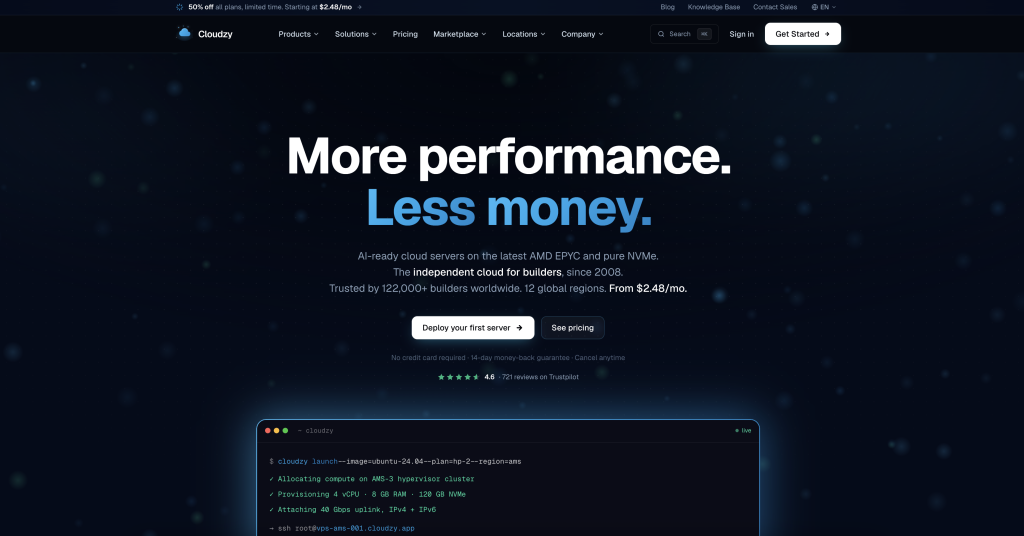
Cloudzy is a general-purpose cloud host with a Forex VPS product line, founded in 2008 and rebranded from RouterHosting in 2022, and for a trader testing a single demo-account EA on the tightest possible budget it lists the lowest entry price here.
Infrastructure tier: general-purpose cloud host with a forex line
Operator: Cloudzy AI Information Technology L.L.C. (Dubai, UAE)
Its Forex VPS runs Windows Server on AMD EPYC hardware with NVMe storage across 13 global regions including London, New York, Frankfurt, and Singapore. It ships as a clean Windows desktop and the trader installs the broker terminal, with MT4 offered as a one-click marketplace app, which the provider notes is deliberate because broker builds are branded and a generic pre-install would be the wrong build for most users. The plan tiers are labelled by memory size: a 1 GB plan at $3.48 per month, a 50 percent promotional rate against a $6.95 standard monthly price, a 2 GB plan at $7.48, and a most popular 4 GB plan at $14.48 against a $28.95 standard rate [4]. These are current promotional rates on standard monthly billing, not annual-prepay rates, and billing is available hourly, monthly, or yearly. Provisioning is advertised at 60 seconds, and a 14-day money-back guarantee applies to every plan. For a beginner running one lightweight chart the promotional entry price is genuinely low; the constraints are that the 1 GB tier suits only a single light terminal and MetaTrader must be installed by the user.
Strengths: the lowest entry price in this comparison at $3.48 per month, a 50 percent promotional rate against a $6.95 standard price, for a single lightweight chart; MT4 available as a one-click marketplace install on a clean Windows desktop; AMD EPYC hardware with NVMe storage across 13 regions; a published 99.95 percent uptime SLA, tracked on a public status page; 60-second provisioning as advertised.
Limitations: the memory is published as DDR5, but ECC status is not stated, so error correction cannot be confirmed for unattended EAs; the 1 GB entry tier holds only a single light terminal, and a realistic multi-chart or multi-EA setup needs the 2 GB or 4 GB tier; MetaTrader is not pre-installed; the VPS ships as a clean Windows desktop and the broker terminal is installed by the user, with MT4 offered as a one-click marketplace app; each Forex VPS ships with a Windows trial licence, and permanent activation requires a licence key the customer supplies, a cost not included in the listed price; as a general-purpose cloud host rather than a forex specialist, it does not state that its regions sit inside broker-hub facilities, marketing single-digit millisecond round trips to LD4, NY4, and TY3 instead (vendor-stated).
VPSForexTrader
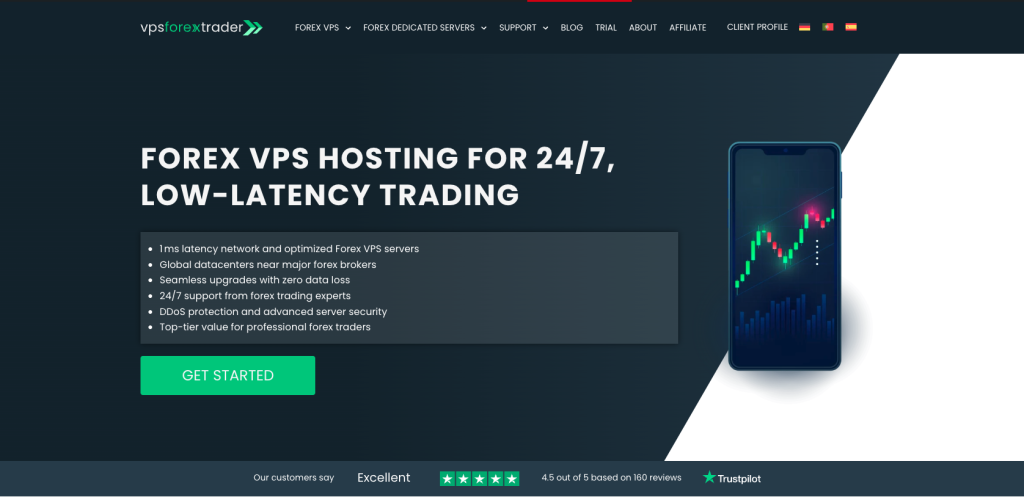
VPSForexTrader is a forex-focused VPS provider that has operated since 2011, and it is the provider in this comparison whose entry plan is built around memory integrity for unattended EAs rather than the lowest possible price.
Infrastructure tier: forex-first specialist
Operator: HOSTLINE, UAB (Vilnius, Lithuania)
The Smart plan is a forex VPS designed for running MT4 and MT5 Expert Advisors on error-correcting memory. It provides three AMD EPYC cores, 4 GB of ECC RAM, and 120 GB of NVMe storage on Windows Server 2025, rated for up to four terminals, at $31.99 per month or $25.59 at annual billing [3]. It is the only plan in this comparison that documents ECC RAM at the entry tier, which addresses the single-bit memory-error risk that accumulates when an EA runs unattended for days. For a single-EA or few-terminal trader who wants memory integrity without stepping up to a premium tier, the Smart plan covers the unattended-runtime requirement at the lowest ECC-equipped price point here. Boost adds six cores, 6 GB of ECC RAM, and 180 GB of NVMe for up to seven terminals at $54.99 per month ($41.24 annual), and Max provides eight cores, 8 GB of ECC RAM, and 250 GB of NVMe for up to ten terminals at $79.99 per month ($59.99 annual), so a trader whose EA count grows stays within one provider. The processors are AMD EPYC 7702P in London and Amsterdam and AMD EPYC 7443 in New York and Hong Kong, storage is high-availability NVMe with automatic restart on another node if a physical node fails, and MetaTrader is not pre-installed but installs in a few clicks over RDP. A $0.99 three-day trial on the Smart specification is available in Amsterdam, New York, and London, requires a card at signup, and continues at $31.99 per month unless cancelled; it ships Windows Server 2025 and is not covered by the 14-day money-back guarantee [3]. It is the only paid trial in this comparison that requires no broker relationship, no minimum deposit, and no trading-volume commitment, though a trader already holding a qualifying partner-broker account can obtain a free VPS from ForexVPS.net.
The honest limits matter as much as the specification. Its network covers four cities, London, Amsterdam, New York, and Hong Kong, with no Tokyo or continental-EU-beyond-Amsterdam presence, so a trader whose broker routes through Tokyo is better served elsewhere. And MetaTrader is not pre-installed, which is a setup step a pre-install provider removes.
Strengths: the only plan in this comparison that documents ECC RAM at the entry tier, addressing unattended-EA memory integrity; AMD EPYC processors (7702P in London and Amsterdam, 7443 in New York and Hong Kong) with high-availability NVMe storage that auto-restarts on another node after a hardware fault; Windows Server 2025 on every tier; a clear upgrade path from four to ten terminals within one provider; a $0.99 three-day trial, the only paid trial here requiring no broker relationship, minimum deposit, or volume commitment, for measuring real latency to your broker before committing.
Limitations: the four-city network has no Tokyo presence, so a Tokyo-routed broker is better served by a provider with a Tokyo node such as NYCServers or QuantVPS; MetaTrader is not pre-installed, a step a broker-matched pre-install provider removes; the entry price is well above the budget end of this comparison, so a single-light-terminal trader on a tight budget pays more than a 1 GB Cloudzy plan costs; no live status page, with incidents and maintenance notified by email, where Cloudzy and NYCServers both run public status pages.
NYCServers
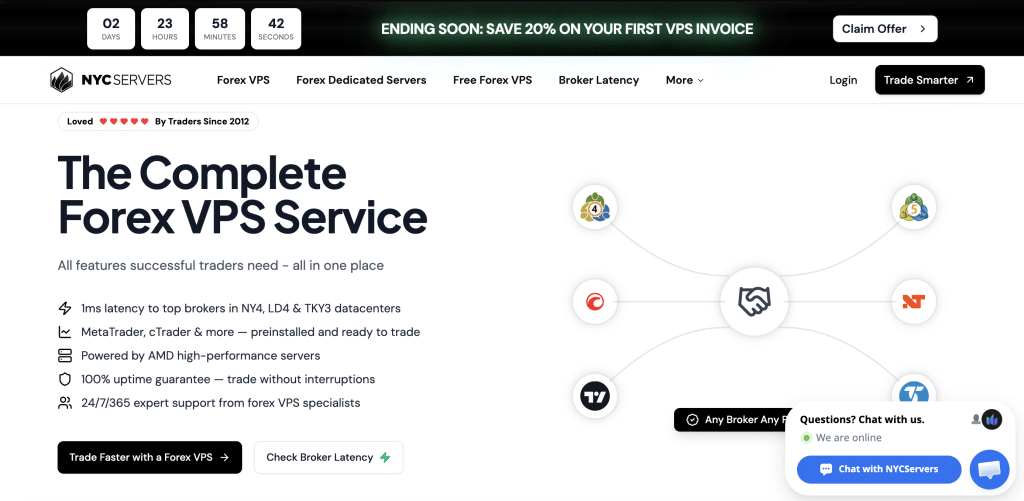
NYCServers is a forex-focused provider operated by GreenHill Technologies Inc. in Connecticut, active since 2012, and it is the only provider in this comparison that pre-installs and pre-configures MetaTrader for the specific broker a trader selects at checkout.
Infrastructure tier: forex-first specialist
Operator: GreenHill Technologies Inc. (Connecticut, USA)
That pre-install workflow is a genuine advantage for a trader new to running a VPS: instead of the log-in, download, install, and configure sequence every other provider here requires, the terminal arrives configured for the broker, across more than 100 supported brokers and platforms, and the customer selects a location using the provider’s latency checker. The Basic plan provides two cores, 2 GB of RAM, and 60 GB of NVMe storage at $25 per month, or $20.83 per month billed annually ($16.67 with a current 20 percent first-invoice promotion); Standard raises RAM to 4 GB, and Professional provides four cores and 8 GB. Its six named Equinix locations, NY4, LD4, TY3, SG1, HK1, and DUB1, include a Tokyo presence, which matters for a trader whose broker routes through Tokyo. Its live Trustpilot page shows a 4.5 TrustScore from 118 reviews as of 23 September 2026, with replies typically within 24 hours. For MT5 specifically the 2 GB Basic tier is a single-terminal allocation after overhead, so a multi-terminal MT5 trader should size to Standard or Professional. NYCServers publishes a 100 percent uptime guarantee during market hours, backed by an SLA, and a 14-day money-back guarantee [5].
Strengths: pre-installs and pre-configures MetaTrader for the trader’s specific broker at checkout across more than 100 brokers, the only provider here to do so, which removes the setup sequence entirely; a Tokyo presence alongside its other named hubs, useful for a broker routing through Tokyo; NVMe storage across the range; a 14-day money-back guarantee.
Limitations: the memory is published as DDR5, but ECC status is not stated, so error correction cannot be confirmed for unattended EAs; the 2 GB Basic tier is a single-MT5-terminal allocation, so multi-terminal workloads need Standard or Professional; the entry price is above the budget end of this comparison on a monthly basis; latency figures are vendor-stated and not independently replicated.
ForexVPS.net

ForexVPS.net is a forex-focused provider launched in 2013 and operated by ThinkHuge Ltd, which also operates the separate FXVM brand, so the two share a parent despite marketing as distinct services.
Infrastructure tier: forex-first specialist
Operator: ThinkHuge Ltd
It publishes the broadest network in this comparison, 22 data-center locations [6]; MetaTrader auto-startup is listed on its dedicated servers rather than its shared VPS plans. The Core plan provides two cores, 4 GB of RAM, and 100 GB of SSD storage, sized for one to three MT4 or MT5 instances, listing at $40 per month with no commitment, $32 per month billed yearly ($384 per year), or $25.60 per month billed yearly with a current seasonal promotional code ($307.20 per year, new customers only, offer revocable); Edge raises this to four cores, 6 GB, and 150 GB for three to six instances, and Prime provides six cores, 8 GB, and 200 GB for six or more. It also runs a broker-sponsored free VPS: open a live account with a partner broker such as IC Markets or Switch Markets, meet the minimum deposit, and trade at least one lot per month (pro-rata, with short volume invoiced but the VPS kept online), and no payment details are required at signup. Its review base is among the largest of any provider here, above 6,000 reviews on its primary platform, which is a genuine strength worth stating plainly. Two facts belong in the comparison for completeness: an August 2025 fiber outage took ForexVPS.net and its sister brand FXVM offline simultaneously, a single documented incident that illustrates the shared-infrastructure relationship, and the latency comparisons ForexVPS.net publishes against other providers are adversarial vendor sourcing and are treated here as such rather than as neutral data.
Strengths: the broadest network in this comparison at 22 locations, offering a strong likelihood of a data center genuinely close to an uncommon broker; a large verified review base above 6,000 reviews; MetaTrader auto-startup available on its dedicated servers; a plan structure sized by instance count that scales cleanly to six-plus instances; a broker-sponsored free VPS route for traders holding a qualifying partner-broker account, plus a 14-day money-back guarantee.
Limitations: the entry-tier memory type is not publicly specified as error-correcting, so ECC cannot be confirmed for unattended EAs; it shares a parent, ThinkHuge Ltd, and infrastructure with FXVM, and an August 2025 fiber outage took both offline at once; the month-to-month Core rate sits at the higher end of this comparison; MetaTrader auto-startup is listed only on its dedicated servers, not the shared Core, Edge, and Prime VPS plans, so a shared-plan buyer configures startup themselves; latency figures, including its published cross-provider comparisons, are vendor-stated and adversarially sourced.
QuantVPS
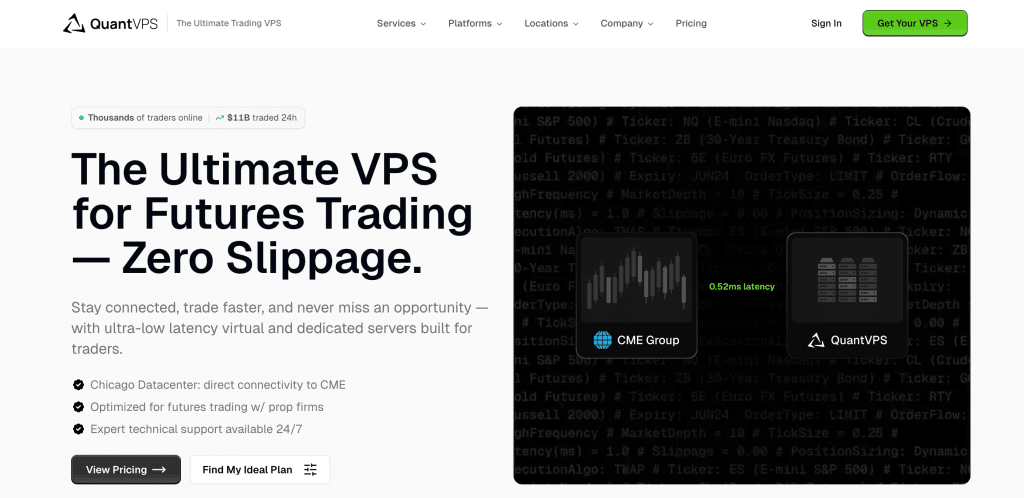
QuantVPS is a VPS provider engineered for United States futures and algorithmic trading rather than forex. It states more than ten years in operation but no specific founding year on its public pages, so it is placed last in the founding-year ordering, after the providers whose specific year is documented.
Infrastructure tier: futures-first, exchange-proximate
Operator: not named on its public pages
Its infrastructure is built around ultra-low-latency connectivity to the CME Group exchanges in Chicago, targeting platforms like NinjaTrader, TradeStation, and Tradovate, and its headline figure, a 0.52 ms cross-connect to the CME, is a futures-exchange metric that provides no benefit to forex broker latency. It runs two plan families. The Standard entry plan, VPS Starter, is $29.99 per month with two AMD EPYC cores, 4 GB of DDR4 RAM, and 50 GB of NVMe storage [7], and the Plus entry plan, VPS Starter+, is $39.99 per month on Ryzen with DDR5 and automatic backups; both scale to Lite, Pro, and Ultra tiers above. All run Windows Server 2022. For a trader who runs futures alongside forex, or who wants large resource allocations and happens to use MetaTrader, it is capable; for a pure MT4 or MT5 forex trader, its defining CME feature is irrelevant to a forex broker connection. Its memory is published as DDR4; only the error-correction status is not stated on its pricing page.
Strengths: high resource allocations available across its ladder, real headroom for heavy multi-chart work on the higher tiers; AMD EPYC and Ryzen hardware with NVMe storage across seven data-center locations; a 99.999 percent SLA with service credits; a genuine advantage for traders who also run US futures through CME-connected platforms.
Limitations: built for futures rather than forex, so its defining CME cross-connect provides no benefit to forex broker latency and MetaTrader is supported but not the focus; memory is DDR4 with the error-correction status not specified on the pricing page; its $29.99 VPS Starter tier sits mid-range among the providers here on a month-to-month basis, below the $31.99 and $40 rates two other providers list; the Standard family, including VPS Starter, lists backups as not included; its plan page lists plans as cancel-anytime but states no money-back window (checked 23 September 2026); latency figures are vendor-stated and not independently replicated.
Six mistakes that break EA hosting
Applying MT4 sizing to MT5 is the most expensive and the most common. MT5 uses three to four times the RAM per terminal, so the 2 GB plan that ran two MT4 terminals holds one MT5 terminal, and the second one pushes the plan into paging during the next volatile session. Size MT5 from 4 GB up, not from the MT4 number.
Buying cores for a multi-currency EA is the second. A portfolio EA scanning 28 pairs runs in a single thread, so an eight-core plan does nothing a fast four-core plan would not do better; the money spent on cores buys nothing for that workload, while a higher clock speed would. Match the hardware to whether the strategy is one heavy EA or many light ones.
Reading total RAM instead of usable headroom is the third. A 2 GB plan has roughly 1 GB free after Windows Server, a single-terminal budget once indicators and an EA load, not the multi-terminal figure the headline number implies. The NYCServers Basic tier at 2 GB and any 1 GB or 2 GB plan here are single-terminal allocations regardless of the terminal count printed on the card.
Ignoring memory type for an unattended EA is the fourth. A strategy running for days accumulates exposure to single-bit memory errors that non-ECC memory does not catch, and among these five providers only VPSForexTrader documents ECC at the entry tier; the others either do not document it or do not specify it. If an EA runs while you sleep, confirm the memory type before buying.
Trusting a latency number without testing your own broker is the fifth. Every sub-millisecond claim in this category describes a best-case pairing between the VPS and a measurement target in the same facility; it says nothing about the path to your specific broker’s server. This is exactly why trials and refund windows exist: VPSForexTrader’s $0.99 three-day trial, NYCServers’ 14-day refund, and ForexVPS.net’s 14-day refund all let a trader measure real latency to their broker before committing to annual billing.
Trusting an on-site review badge over the live score is the sixth. On-site widgets in this category consistently overstate, and the publisher is not exempt: VPSForexTrader’s own homepage shows 4.5 from 160 reviews, so read the live platform rather than the badge. NYCServers’ widget advertises a markedly higher score than its live page, and Cloudzy’s site displays 4.6 from 715 reviews while its Trustpilot profile shows no TrustScore, with a notice that fake reviews were removed (checked 23 September 2026). Read each platform’s own current page, and read independent venues such as Forex Peace Army and trading subreddits, where accounts of outages and support quality surface that a single aggregate number cannot capture.
Which provider fits which EA trader
For a trader running one or two MetaTrader EAs unattended who wants memory integrity without paying a premium tier, VPSForexTrader’s Smart plan fits the requirement directly, with ECC RAM at the entry tier, three EPYC cores, and 4 GB on Windows Server 2025; a trader whose EA count grows to several terminals moves to Boost or Max within the same provider. For a trader who wants the platform pre-installed and pre-configured for their broker with the least manual setup, and especially one whose broker routes through Tokyo, NYCServers is the better fit, since it is the only provider here that pre-installs per broker and it operates a Tokyo node.
For a trader testing a single lightweight EA on the smallest possible budget, Cloudzy’s 1 GB tier at $3.48 per month, a 50 percent promotional rate, is the lowest cost of entry, on the understanding that it holds one light terminal and its memory type is unspecified. For a trader whose broker sits in an uncommon location, ForexVPS.net’s 22-region network offers a strong likelihood of genuine proximity, with a large review base behind it. And for a trader who runs US futures through CME-connected platforms alongside forex, QuantVPS’s Chicago infrastructure and large allocations, with VPS Starter at $29.99 per month providing two cores and 4 GB and higher tiers scaling well beyond, are built for that crossover, on the clear understanding that its defining latency advantage does nothing for a forex broker connection.
Three findings from this comparison
Memory type, not price or core count, is the specification that most separates these five providers for unattended EA hosting, and it separates them at the entry tier. Only one of the five documents ECC RAM on its cheapest plan; the others either leave it unspecified or do not state it. For a strategy that runs while the trader sleeps, that single specification carries more weight than the headline price, and it is the one most comparisons omit.
The specification a trader should read most carefully is the one vendors state most loosely, the terminal count. Every “up to N terminals” figure here is a light-load vendor estimate that collides with the 32-instance-per-user Windows cap, well below which practitioner lab loading keeps the count, and with MT5’s three-to-four-times MT4 memory footprint, so the honest capacity of a plan is the memory arithmetic, not the printed number. A plan rated for ten light terminals may hold four or five indicator-heavy MT5 terminals, and sizing from RAM rather than the rating is what prevents a mid-session freeze.
Latency is the dimension every provider markets and none can prove to a specific broker, which is why the trial matters more than the number. No provider here publishes independently audited latency tests, every sub-millisecond figure is a same-facility best case, and the only way to know the real latency to a given broker is to measure it during a trial. The providers that offer a cheap trial or a refund window, rather than the ones that advertise the lowest millisecond figure, are the ones that let a trader verify the claim that actually matters.
Frequently asked questions
How much RAM do I need to run MT4 or MT5 EAs on a VPS?
More for MT5 than for MT4, because MT5 uses three to four times the RAM per terminal. Windows Server takes 800 MB to 1.2 GB, and one MT5 terminal with a few charts and an EA adds 500 MB or more, so a single MT5 terminal runs comfortably on 4 GB, two to three terminals want 6 to 8 GB, and four or more want 8 GB and dedicated resources. For MT4, which is lighter, a single terminal can run on 2 GB, but 4 GB is the safer starting point once more than one EA or a heavy indicator is involved. Keep 25 percent of memory free so a strategy-tester run or a news-driven history load does not push the plan into paging.
Which VPS has ECC memory for running EAs unattended?
Among the five providers in this comparison, VPSForexTrader is the only one that documents ECC RAM on every tier, including the entry Smart plan at 4 GB. ECC memory corrects single-bit errors before they reach the application, which matters when an EA runs for days or weeks and a corrupted order parameter would otherwise go unnoticed. Cloudzy, NYCServers, and ForexVPS.net do not document ECC on their entry plans, and QuantVPS does not state its memory error-correction status on its pricing page, so for an unattended EA the memory type is worth confirming directly before purchase.
Do more CPU cores make my Expert Advisor run faster?
Not for a multi-currency EA. MetaTrader 5 runs each EA in a single thread, so a portfolio EA scanning 28 pairs processes them sequentially within one thread and gains nothing from additional cores; a higher clock speed per core is what helps that workload, which is why a fast four-core processor can beat a slower eight-core one for it. Cores help in a different way, by supporting more concurrent terminals when a trader runs several separate single-symbol EAs, roughly one vCPU per actively trading terminal. So read a plan’s core count as a multi-terminal capacity figure, not a per-EA speed figure.
Which forex VPS pre-installs MetaTrader for my broker?
NYCServers is the only provider in this comparison that pre-installs and pre-configures MT4 or MT5 for the specific broker you select at checkout, across more than 100 supported brokers, and lets the customer select a location using its latency checker. ForexVPS.net ships MetaTrader preconfigured, and Cloudzy, VPSForexTrader, and QuantVPS provide a Windows desktop on which MetaTrader installs in a few clicks, with Cloudzy offering MT4 as a one-click marketplace app. If arriving at a broker-configured terminal with no manual setup is the priority, NYCServers is the fit, particularly for a trader whose broker routes through Tokyo, which it serves with a Tokyo node.
How many MetaTrader terminals can one VPS actually run?
Fewer than the “up to N” figure on the plan card, which assumes light chart loads. Windows caps MetaTrader at 32 instances per Windows user, and in the publisher’s own lab loading, no more than 12 terminals were run per Windows user to stay clear of that cap and of desktop rendering bottlenecks; running more requires additional Windows users. Within that ceiling the real limit is memory: budget two to four GB for the first terminal including operating-system overhead, one to two GB per additional terminal, and one vCPU per actively trading terminal, then size the plan to that number rather than to the printed rating.
Can I run MT4 or MT5 EAs on a Linux VPS?
For MT5, not reliably. MetaTrader 5 runs natively on Windows; MetaQuotes documents a Wine-based Linux installation with its own install script supporting Ubuntu, Debian, Linux Mint, and Fedora, but it still runs through a compatibility layer, and EAs that rely on DLL imports are the most common source of problems. Several providers here offer Ubuntu alongside Windows, but for running MetaTrader EAs, Windows Server remains the reliable choice, and every plan compared here is evaluated on its Windows configuration.
References
[1] MetaQuotes, MetaTrader 5 platform documentation and Strategy Tester guidance, https://www.metatrader5.com/, retrieved 23 September 2026, for MetaTrader 5’s single-thread EA execution, the one-account-per-terminal model, and the tester-agent memory and physical-core guidance. The three-to-four-times MT4 memory ratio is an observed sizing rule from practitioner measurement, not a MetaQuotes-published figure, and is stated as such.
[2] Microsoft, Windows Server documentation on desktop-heap and session limits, https://learn.microsoft.com/windows-server/, retrieved 23 September 2026, for Windows Server memory overhead and the desktop-heap and GDI-handle constraints that bound concurrent sessions; the 32-instance-per-user MetaTrader cap and the practical 24-to-28 stable ceiling are MetaTrader-specific behaviour observed in testing, not Microsoft-documented, and are stated as such.
[3] VPSForexTrader plans, pricing, and terms, https://www.vpsforextrader.com/, retrieved 23 September 2026. Source for the Smart, Boost, and Max specifications and pricing, ECC memory on every tier, the AMD EPYC processor models by location, high-availability NVMe storage, Windows Server 2025, the four-city location set, the $0.99 three-day trial terms and its exclusion from the money-back guarantee, and the absence of a published uptime SLA.
[4] Cloudzy Forex VPS product and pricing, https://cloudzy.com/forex-vps/, retrieved 23 September 2026. Source for the memory-labelled tier pricing as current promotional rates on standard monthly billing (1 GB at $3.48 against a $6.95 standard price), the clean-desktop model with MT4 as a one-click marketplace app, the AMD EPYC and NVMe hardware, the 13-region footprint, and the 2008 founding with 2022 rebrand.
[5] NYCServers plans and locations, https://newyorkcityservers.com/, retrieved 23 September 2026. Source for the Basic, Standard, and Professional specifications and pricing, the broker-matched MetaTrader pre-install, the six-location network including Tokyo, the operating entity GreenHill Technologies Inc., and the 14-day money-back guarantee.
[6] ForexVPS.net plans, https://www.forexvps.net/, retrieved 23 September 2026, with ownership cross-referenced to industry records identifying ThinkHuge Ltd as the shared parent of ForexVPS.net and FXVM. Source for the Core, Edge, and Prime specifications and the $40 monthly / $32 yearly / $25.60 seasonal-promo pricing, the 22-location network, the MetaTrader preconfiguration, the broker-sponsored free VPS programme, the 2013 founding per the site copyright line, the review base, and the ThinkHuge ownership; the August 2025 simultaneous FXVM outage is a documented industry incident.
[7] QuantVPS pricing and product pages, https://www.quantvps.com/, retrieved 23 September 2026. Source for the two plan families (Standard VPS Starter at $29.99 with two EPYC cores and 4 GB DDR4; Plus VPS Starter+ at $39.99 on Ryzen with DDR5) on Windows Server 2022, the AMD hardware, the seven-location network, the 0.52 ms CME cross-connect described as a futures-exchange metric, and the unspecified memory error-correction status.
Editorial note
This comparison covers forex VPS infrastructure for running MetaTrader 4 and MetaTrader 5 Expert Advisors and does not constitute financial advice, trading-strategy advice, or an endorsement of any EA or strategy. Trading outcomes depend on broker execution quality, market conditions, and trader skill, none of which a VPS can fully control.
VPSForexTrader is operated by HOSTLINE, UAB, and is the publisher of this comparison, in which it is one of five evaluated providers. This is a conflict of interest. It is handled by evaluating the publisher’s plans on the same six dimensions applied to every other provider, by placing the publisher at position two under a structural founding-year ordering rather than a quality ranking, and by routing to a competitor where that competitor genuinely wins: NYCServers is named as the better fit for broker pre-installation and for Tokyo-routed brokers, in both the routing section and the FAQ. The publisher’s section documents seven limitations against five strengths, so its limitations are not outnumbered by its strengths, and its most material limitation, the absence of a published uptime SLA, is stated plainly. Specifications, pricing, and locations were verified against each provider’s own pages on 23 September 2026 and should be re-verified before purchase, since promotional pricing and plans change frequently. Every latency figure here, including the publisher’s, is vendor-stated and not independently replicated; no forex VPS provider in this comparison publishes independently audited latency tests. Review scores, where cited, are read from live platform pages as dated figures, not marketing badges. Corrections to any factual error will be made on this page with a dated change-log entry.
Change log
07 October 2026. Initial publication. Five forex VPS providers compared for MetaTrader 4 and MetaTrader 5 Expert Advisor hosting on usable RAM after operating-system overhead, memory type with an error-correction flag, CPU core count relative to single-thread EA execution, published terminal capacity against the Windows instance ceiling, storage, and documented locations. Providers ordered by founding year within the forex-specialist category, earliest first, a structural criterion that places the publisher second. Specifications and pricing verified against each provider’s own pages on 07 October; every changeable figure flagged for a live re-pull before purchase. MetaTrader single-thread EA execution and the one-account-per-terminal model are sourced to MetaQuotes documentation; the three-to-four-times MT4 memory ratio is a practitioner sizing rule, not a MetaQuotes-published figure; the 32-instance-per-user cap is a Windows constraint, and the practical per-user terminal count reflects the publisher’s own lab loading rather than a documented ceiling; Windows Server memory minimums are from Microsoft documentation. Latency figures recorded as vendor-stated and not independently replicated. This comparison does not rank providers on user-review scores.