Best Forex VPS for Expert Advisors (EAs) (2026)
A US forex trader who rents a virtual private server in the wrong place pays for it on every fill. The brokers a US resident can legally use, names like OANDA, FOREX.com, and Interactive Brokers, route their US-side order flow through one complex of buildings in Secaucus, New Jersey, anchored by the Equinix NY4 data center. A terminal running inside that building reaches the broker’s matching engine in about a millisecond. The same terminal on a home connection, or on a cheap server in the wrong city, sits tens to hundreds of milliseconds away, and that gap becomes slippage, requotes, and expert advisors acting on stale prices. For an always-on automated setup, server location and stability decide more about execution quality than the spread does.
This guide compares six virtual private server providers for forex trading on US-located servers, anchored on New York and the Equinix NY4 hub, with other US metros covered where they matter. The lens is forex specifically, MetaTrader 4 and 5, cTrader, and the expert advisors that run on them, not futures or NinjaTrader. It covers where US brokers actually host, how to confirm your own broker’s location and measure latency to it, how little memory a MetaTrader VPS really needs, and what free and broker-sponsored hosting genuinely costs once the conditions are read.
It is written for traders running automated forex systems on a US broker who want the terminal online around the clock, including prop-firm traders who need a stable dedicated IP for compliance. Readers whose broker is hosted in London or Asia will find the location reasoning applies in reverse. VPSForexTrader, which publishes this guide, is one of the six providers compared, is evaluated against the same criteria as the others, and appears in the second position inside a model-based ordering rather than first; the methodology and editorial note below document that arrangement.
The Six Providers at a Glance
NYCServers is the turnkey New York option, colocated at Equinix NY4 with London and Tokyo also available, pre-installing MetaTrader 4, MetaTrader 5, or cTrader for the broker chosen at checkout, from about $16.67 a month on annual billing. VPSForexTrader hosts at Equinix NY2 alongside LD3, Amsterdam Serverius, and HK4, and is the only Forex VPS provider here that documents ECC error-correcting memory on every plan, with an entry Smart tier at $25.59 a month annual and a $0.99 three-day trial. ForexVPS.net spans the broadest network, 22 locations including NY4, with a Resource Spike Protection feature and the largest independent review base in the segment. TradingFXVPS holds Equinix New York plus the only documented Chicago CME Aurora presence here, on AMD Ryzen 9 and DDR5, with a 30-day refund on monthly plans.

AccuWeb Hosting is the genuinely US-based managed option, operating from New Jersey with New York and Denver data centers and installing platforms on request, from $7.99 to $59.99 a month on annual billing. Cloudzy is the low-cost generalist, with US regions in New York, Miami, Dallas, and Los Angeles on AMD EPYC and NVMe, self-installed, from $14.48 a month. Two general-purpose hosts, Kamatera and Contabo, appear later as value alternatives for traders who do not need true NY4 colocation.
How this comparison was built
This comparison covers VPS hosting for forex trading on US-located servers. Pricing, specifications, and operational policies were verified on each provider’s own website in June 2026, and Trustpilot scores were read on Trustpilot the same month. Domain facts come from primary sources: Equinix’s own statements and a Bloomberg report on NY4, broker data-center disclosures from OANDA and IC Markets, MetaQuotes documentation for hosting and resource behavior, and a release on the Hibernia Express cable for the trans-Atlantic latency floor. Providers are grouped by hosting model and US relevance rather than ranked by a single score: the turnkey New York colocation specialist first, then Equinix-hub forex specialists, then the US-based managed host, then the low-cost generalist, with two general-purpose hosts named afterward. VPSForexTrader publishes this guide and is one of the six; it sits in the second position rather than first, its limitations are documented alongside its strengths, and every provider is measured against the same criteria. The evaluation dimensions are US location and proximity to broker hubs, RAM amount and type, CPU cores and single-thread clock, storage type and size, platform support and installation method, trial and refund terms, backups, DDoS and dedicated IP, uptime claims, total cost, and independent review standing. Figures that could not be confirmed on a provider’s own pages are flagged in the text rather than assumed. Broker latency and uptime numbers from any provider here, the publisher included, are commercially motivated and have not been independently replicated; a sub-millisecond figure holds only when the server and the broker share a facility.
A New York VPS Helps Only If Your Broker Is in Equinix NY4
The phrase “New York VPS” is shorthand for one place, and that place is why location matters. Equinix NY4 in Secaucus, New Jersey is the center of gravity for foreign-exchange trading in the Americas. Equinix’s Secaucus campus is the largest fintech trading ecosystem in the United States; a 2016 Bloomberg report described the facility as host to 49 exchanges, peaking at 9.6 million messages per second across its fiber. NY4 is carrier-neutral, so brokers, liquidity providers, and VPS operators each place their own equipment inside and connect through short in-building cross-connects rather than the public internet.
What makes NY4 the right target for a US trader is that the US-regulated brokers a US resident can legally use host there, and so do the major international venues. OANDA, which is US-regulated, states on its own site that it runs dedicated servers, VPS, cross-connects, and MT4 and MT5 broker hosting inside Equinix LD4 in London and NY4 in New York. FOREX.com and its parent StoneX and Interactive Brokers, both US-regulated, sit in the NY4 and NY5 complex as well. International brokers and ECNs that US residents cannot use also host there: IC Markets states that its MetaTrader 4 and 5 servers are currently in the NY4 data center, and LMAX, FastMatch, and Currenex run matching there too. The rule follows: a New York VPS helps only if your specific broker’s matching engine is in NY4 or the adjacent NY5, so confirm it with your broker before it drives the purchase.
| Broker or venue | Forex hub | US retail availability | Source |
| OANDA | Equinix NY4 and LD4 | US-regulated (CFTC/NFA) | OANDA website |
| FOREX.com / StoneX | Equinix NY4 / NY5 | US-regulated (CFTC/NFA) | Industry colocation records |
| Interactive Brokers | Equinix NY4 / NY5 metro | US-regulated (CFTC/NFA) | Industry colocation records |
| IC Markets | Equinix NY4 | Not available to US residents | IC Markets website |
| LMAX | Equinix NY4 / NY5 | Institutional, not US retail | Industry colocation records |
The set of brokers a US resident can legally trade forex with is small, which makes the location question tractable. Retail forex in the United States is limited to firms registered with the Commodity Futures Trading Commission and the National Futures Association, in practice a short list that includes tastyfx, OANDA, FOREX.com, Interactive Brokers, and Charles Schwab through thinkorswim. US rules cap major-pair leverage at 50 to 1, enforce first-in-first-out on closing positions, and prohibit hedging the same pair inside one account. MetaTrader itself is available to US clients at brokers such as FOREX.com and OANDA, which matters because a VPS is useful only if it can run the platform your broker actually supports.
New York is the anchor, not the only correct US location. A trader who also runs CME futures benefits from a server in or near the Chicago CME Aurora campus, which is why a Chicago option appears here. Liquidity facing Latin American flow sometimes sits closer to Miami, and a few west-coast-routed setups are better served from Dallas or Los Angeles. The principle holds in every case: put the server where the broker’s engine is, then worry about specifications.
Latency Is Distance: How to Confirm Your Broker’s Location and Measure It
Latency in trading is mostly distance. Signals travel fast but not instantly, and as a working rule each 1,000 kilometers of fiber adds roughly 10 milliseconds to a round trip. A VPS colocated in the broker’s building answers in under a millisecond. A VPS in a general data center in the same metro adds 5 to 15 milliseconds. A server in the wrong region, or a home connection, adds 50 to 200 milliseconds that no processor upgrade removes. The documented floor between the two main forex hubs shows the scale: the Hibernia Express cable, now run by EXA Infrastructure, was announced in 2015 with a tested latency of sub-58.95 milliseconds between Equinix LD4 near London and NY4 in Secaucus. If your broker’s liquidity is in London, a New York VPS starts roughly 59 milliseconds behind, and a London VPS is correct regardless of where you live.
Confirming where your broker actually sits takes three steps, none requiring trust in a marketing page. Check the broker’s own infrastructure or VPS-partner pages, where firms like OANDA and IC Markets name their Equinix facilities. If the broker does not publish it, ask support for the data center hosting the trading server for your account region, because the same broker can run different servers for different jurisdictions. Then verify it yourself from a candidate server: open a trial or a refundable monthly VPS in the location you are considering, and measure the path to the broker’s server.
Measurement on a Windows VPS is straightforward. The ping command reports round-trip time to the broker’s server hostname, and a tool such as tracert, or a continuous monitor like WinMTR, shows each hop and where latency enters. The number that matters is the steady round-trip time to the broker’s price server during active market hours, not an idle overnight reading. Many MetaTrader brokers also show a live ping inside the terminal, in the connection status at the bottom right, giving a second reading. Low single-digit milliseconds means the server and broker are effectively co-located; tens or hundreds means they are not, whatever the plan’s label says.
This is why every latency claim in this guide, the publisher’s included, is labeled vendor-stated. A provider can honestly advertise sub-millisecond latency to one broker in one building that means nothing for the broker you use. The only latency figure that describes your setup is the one you measure from your server to your broker, which is why a short trial is worth more than any advertised number.
How Small a Forex VPS Can Be: Sizing MetaTrader Correctly
A trader coming from heavier software usually overestimates how much server a MetaTrader setup needs. MetaTrader 4 is light, a single terminal idling at roughly 20 to 35 megabytes; MetaTrader 5 is heavier but still modest, commonly in the low hundreds of megabytes per terminal. The largest fixed cost is Windows itself, idling at about 0.8 to 1.2 gigabytes before any terminal opens. The arithmetic is forgiving, which is exactly why both overbuying and underbuying are common.
For one terminal running one or two expert advisors, 2 gigabytes works once Windows overhead is counted, though it leaves little headroom. Four gigabytes is the realistic floor for a serious setup: one terminal with several charts and expert advisors, or a couple of MetaTrader 5 instances, run comfortably. Eight gigabytes is for heavy use, five to ten terminals at once or Strategy Tester optimization, where MetaQuotes documents that each testing agent wants about 2 gigabytes and runs best on a dedicated physical core. Beyond that, more RAM rarely helps a live terminal and mostly serves backtesting.
Processor choice matters less in core count than in single-thread speed. Most of what a terminal does, expert advisor logic, indicator math, tick processing, runs on one thread, so a high per-core clock serves a live terminal better than many slow cores. This is where dedicated cores separate from shared, burstable ones: a shared vCPU that borrows time from neighbors degrades during a news spike, when every tenant is busy at once and the expert advisor needs the cycles most. Storage follows the same logic: NVMe clears the disk-write bottleneck that history downloads and log files create during volatile sessions, while older SATA SSD is fine for a single quiet terminal.
The contrast with a NinjaTrader workload is stark, where 8 gigabytes is a floor and 16 is normal for heavy use, whereas a forex MetaTrader VPS delivers a clean always-on terminal on a fraction of that. For most automated forex traders the right plan is a 2 to 4 gigabyte tier with dedicated cores and NVMe in the correct location, not the largest plan on the page. Money saved by not overbuying memory is better spent on proximity and a dedicated IP than on RAM a terminal will never touch.
The Real Cost of a Forex VPS: Free Hosting, Broker VPS, and What You Actually Pay
Before paying for a dedicated VPS, understand the cheaper paths and where they stop. MetaQuotes Virtual Hosting is built into the MetaTrader 4 and 5 terminals, costs roughly $15 a month or about $12.80 annual, and migrates the terminal, expert advisors, indicators, charts, and signals automatically. It is useful for a single-broker, DLL-free setup, placed at a hosting point near your broker. Its limits decide the fit: no DLLs of any kind, MetaTrader 5 must be 64-bit, no remote desktop, MetaTrader only, and one trading account per terminal. A trader whose expert advisor needs an external DLL, or who wants any other software on the server, has outgrown it.
Broker-sponsored free VPS programs are the other cheap path, and free carries conditions. The hosting is usually delivered through a third party and waived only while a volume or balance threshold is met. FOREX.com gives MetaTrader 5 traders a free VPS above $500,000 in monthly volume and bills around $30 otherwise. The IG group, parent of the US broker tastyfx, gives MetaTrader 5 traders a free VPS when the account holds a $1,000 balance and places at least one trade a month, a service it otherwise prices at about $15. International brokers that US residents cannot use, such as IC Markets, Pepperstone, and RoboForex, run similar threshold-based programs, several of them hosted in Equinix NY4 and LD4. The catch is twofold: a slow month below the threshold triggers the charge, and several programs use a generic cloud region rather than true colocation, so the latency benefit can be smaller than a paid NY4 plan delivers.
The three paths price out clearly. MetaQuotes hosting runs about $13 a month for a single DLL-free terminal, a broker’s free VPS is genuinely free only above its threshold and otherwise $30 to $50, and a paid NY4 specialist starts around $15 to $26 a month with full administrator access and no threshold to maintain. Two line items on provider pages still deserve scrutiny. Several hosts advertise 100 percent uptime, a marketing figure rather than a guarantee; the fine-print service level is almost always 99.99 percent, which still permits about 53 minutes of downtime a year, while 99.9 percent permits nearly nine hours. And a backups checkmark does not always mean automatic backups are switched on or included, so confirm it at the order form.
For prop-firm traders, one feature outranks the rest: a stable, dedicated IP address. Proprietary trading firms watch for the same strategy running from the same address across multiple funded accounts, and firms such as FundedNext state that they monitor for similarities across accounts and users. A dedicated IP, which every forex-specialist provider here includes, keeps a legitimate multi-account setup consistent. The landscape behind these accounts is shifting: FTMO completed its acquisition of OANDA Global Corporation on December 1, 2025, so traders on FTMO-linked or OANDA accounts may route through both London and New York hubs, which makes confirming the actual server location more important, not less.
Forex VPS in the USA Compared
| Provider / plan | RAM (type) | Storage | US locations (NY4?) | Pre-installed | Price/mo (annual) | Trial / refund |
| NYCServers Basic | 2 GB | 60 GB | New York (NY4), London, Tokyo | Yes, by broker | $16.67 | ~$1 trial, 14-day refund |
| VPSForexTrader Smart | 4 GB, ECC | 120 GB NVMe | New York (NY2); also London, Amsterdam, HK | No, self-install | $25.59 | $0.99 3-day, 14-day refund |
| ForexVPS.net Core | 4 GB | 100 GB SSD | New York (NY4); 22 locations total | No | $32 | 14-day refund |
| TradingFXVPS Standard | 2 GB, DDR5 | 30 GB NVMe | New York; Chicago (CME Aurora) | No | $17.50 | $3.99 7-day, 30-day (monthly) |
| AccuWeb Hosting Forex VPS 2 | 3 GB | 40 GB SSD | New York, Denver (no NY4 colo) | On request | $14.99 | 7-day refund |
| Cloudzy 4 GB plan | 4 GB, DDR5 | 120 GB NVMe | New York, Miami, Dallas, LA (no NY4 colo) | No | $14.48 | 14-day refund |
All specifications and pricing were verified in June 2026; confirm current terms on each provider’s website before purchase. The price column shows the monthly rate on annual billing, where each provider’s lowest rate is found; straight monthly billing is higher and is given in each provider section. RAM shown without an ECC or DDR5 label is not documented as error-correcting or as a specific memory generation on the provider’s public pages. Latency and uptime figures published by any provider are vendor-stated and have not been independently audited.
NYCServers, the Turnkey New York Option
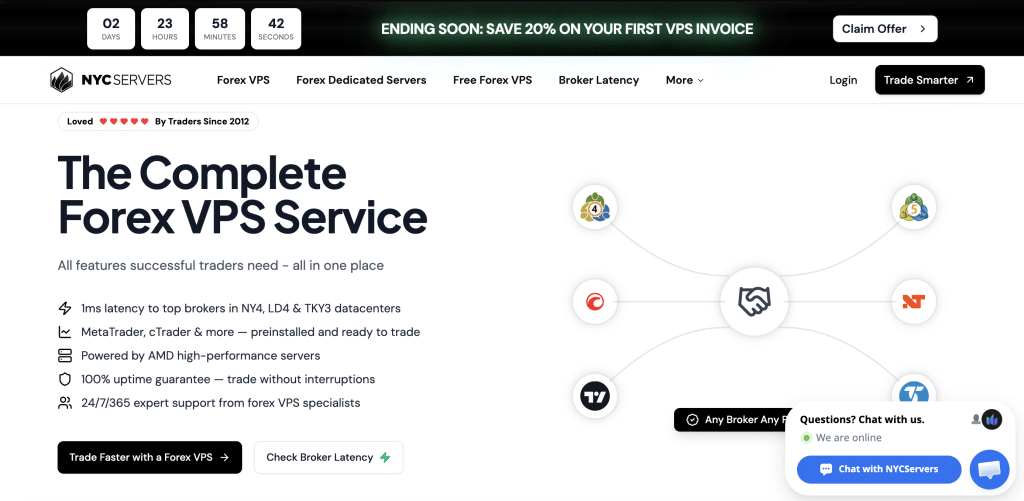
Infrastructure tier: Forex VPS colocated at Equinix NY4, with London (LD4) and Tokyo (TY3) available on every plan. Operator: GreenHill Technologies Inc., United States.
NYCServers is the most turnkey choice in this comparison for a US forex trader, because it removes the two steps that trip up beginners: choosing a location and installing the platform. At checkout the trader selects a broker, and NYCServers both routes the server to the matching Equinix location, with New York NY4 the default for US-hosted brokers, and pre-installs MetaTrader 4, MetaTrader 5, or cTrader configured for that broker. Every tier includes the New York, London, and Tokyo locations, so a trader who later switches to a London-hosted broker can move without changing providers. The entry Basic plan provides 2 vCPU, 2 GB of RAM, and 60 GB of storage at about $16.67 per month on annual billing, and higher tiers scale up toward roughly ten simultaneous terminals for traders running many expert advisors. Windows Server is included on every plan, and the company offers a low-cost trial of about $1 alongside a 14-day money-back guarantee.
The points to weigh are about disclosure and independence. NYCServers advertises a 100 percent uptime guarantee during trading hours, which is a marketing framing rather than a contractual always-on promise, and the company publishes a large library of comparison pages that rank it against competitors, so its own comparative claims carry a commercial interest and are best verified independently. Its live Trustpilot standing is solid, at about 4.5 out of 5 from roughly 119 reviews read in June 2026.
Strengths: colocated at Equinix NY4 with London and Tokyo included on every plan; pre-installs MetaTrader 4, MetaTrader 5, or cTrader configured for the chosen broker; automatic location selection at checkout; entry pricing near $16.67 per month on annual billing; a solid live Trustpilot score of about 4.5 from roughly 119 reviews; a low-cost trial of about $1 and a 14-day money-back guarantee.
Limitations: the 100 percent uptime claim is during-trading-hours marketing rather than a contractual guarantee; the company’s many competitor-comparison pages carry a commercial interest and should be read with that in mind; the entry tier’s 2 GB suits a single light setup, so multi-expert-advisor traders need a higher tier.
VPSForexTrader, the Forex-Hub Specialist with ECC on Every Tier
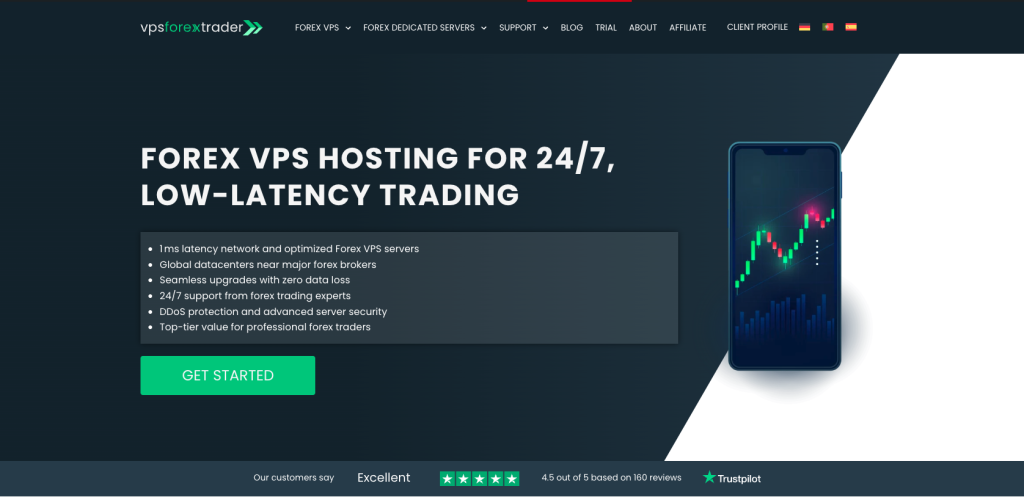
Infrastructure tier: Forex VPS at Equinix NY2, with London, Amsterdam, and Hong Kong available; dedicated servers also offered. Operator: HOSTLINE UAB, Lithuania.
VPSForexTrader is the forex-hub specialist in this group, and the detail that sets it apart is error-correcting memory on every plan. Its three tiers are documented as follows. Smart provides three AMD EPYC vCPU cores, 4 GB of ECC RAM, and 120 GB of NVMe storage, with weekly backups and capacity for up to four MetaTrader terminals, at $25.59 per month on annual billing or $31.99 monthly. Boost provides six EPYC cores, 6 GB of ECC RAM, and 180 GB of NVMe storage with daily backups for up to seven terminals, at $41.24 per month on annual billing or $54.99 monthly. Max provides eight EPYC cores, 8 GB of ECC RAM, and 250 GB of NVMe storage with daily backups for up to ten terminals, at $59.99 per month on annual billing or $79.99 monthly. Server locations include Equinix NY2 in New York alongside London, Amsterdam, and Hong Kong, the servers run Windows Server 2025, every plan includes a dedicated IP, DDoS protection, and backups, and the platform offers a $0.99 three-day trial and a 14-day money-back guarantee.
Two features distinguish VPSForexTrader for the US forex use case. First, VPSForexTrader Smart is the only plan in this comparison that combines ECC RAM, NVMe storage, dedicated AMD EPYC cores, and a paid validation trial at an entry price under $30 per month; none of the other providers documents error-correcting memory at all. Second, the company states on its homepage that it does not suspend accounts on active forex trading days even when payment is overdue, an operational policy rather than a contractual guarantee, aimed at the trader whose worst outcome is a server going down mid-session. For a US trader whose broker is colocated in Equinix NY2, who wants error-correcting memory on an always-on terminal and the ability to measure real latency before committing, VPSForexTrader Smart is the only plan here that satisfies all of those conditions below $30 per month.
The constraints are worth stating plainly. MetaTrader is not pre-installed, so the trader installs it over Remote Desktop, and there is no Linux option. The specific AMD EPYC processor model and the memory generation are not published, so single-thread performance cannot be assessed from the spec sheet alone. The footprint is narrow at four server locations, New York, London, Amsterdam, and Hong Kong, far fewer than ForexVPS.net’s 22, so a trader whose broker is hosted elsewhere is not covered. The company does not publish an uptime service-level percentage on its own pages, and its live Trustpilot standing is about 4.3 out of 5 from about 164 reviews read in June 2026, a smaller base than the largest competitor here.
Strengths: the only provider here that documents ECC error-correcting RAM, and on every tier; Equinix NY2 colocation alongside London, Amsterdam, and Hong Kong; AMD EPYC cores, NVMe storage, a dedicated IP, DDoS protection, and backups on every plan; a $0.99 three-day trial plus a 14-day money-back guarantee for real-world validation; a stated operational policy against suspending accounts on forex trading days.
Limitations: MetaTrader is not pre-installed and there is no Linux option; the EPYC processor model and memory generation are not published, so single-thread speed cannot be confirmed from specs; only four server locations, far fewer than ForexVPS.net’s 22, so brokers hosted outside New York, London, Amsterdam, or Hong Kong are not covered; no uptime service-level percentage is published on the company’s own pages; the live Trustpilot base of about 164 reviews is smaller than the largest competitor here.
ForexVPS.net, the Broadest Network
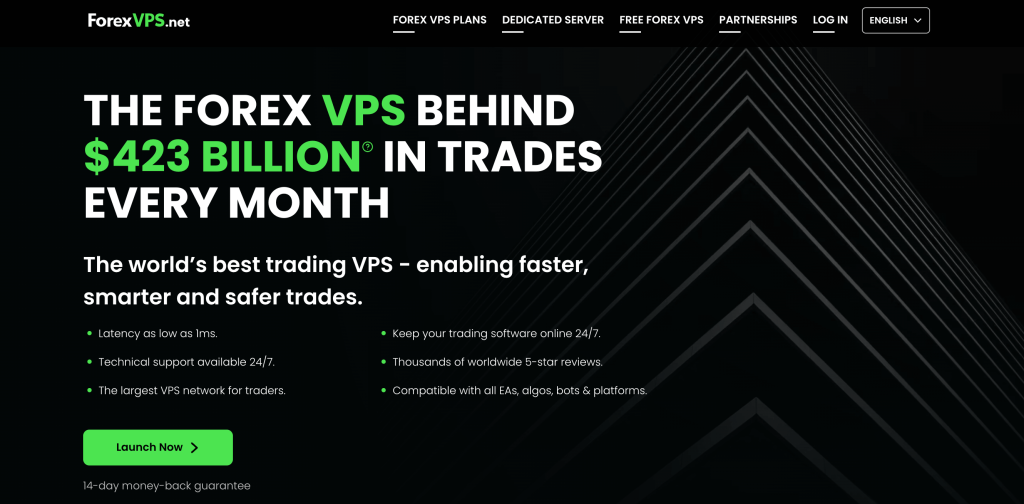
Infrastructure tier: Forex VPS across 22 locations including Equinix NY4, London, and Tokyo. Operator: ThinkHuge Ltd, Hong Kong.
ForexVPS.net offers the widest geographic reach in this comparison, with 22 locations that include Equinix NY4 in New York, LD4 in London, Tokyo, Chicago, and a long list of European and Asia-Pacific cities. For a US trader that breadth is useful insurance: if a broker moves or a second account sits in a different region, the same provider already covers it. Its three core plans are documented as Core, with 2 vCPU, 4 GB of RAM, and 100 GB of storage at about $32 per month on annual billing; Edge, with 4 vCPU, 6 GB, and 150 GB at about $48; and Prime, with 6 vCPU, 8 GB, and 200 GB at about $64. Every plan includes a dedicated IP and a Resource Spike Protection feature that allocates additional CPU and RAM automatically during volatile conditions, which targets the exact moment a shared server would otherwise struggle. It supports MetaTrader 4 and 5, cTrader, and others, and offers a 14-day money-back guarantee. Its independent review base is the largest in this segment, at roughly 4.8 to 4.9 out of 5 from more than 6,500 reviews read in June 2026.
Two qualifications matter. RAM is not documented as ECC, storage on the lower tiers is SSD rather than NVMe, and the processor model is not published, so the hardware is solid but less transparent than the spec-led specialists. More important for reliability planning, ForexVPS.net and the sister brand FXVM run on the same ThinkHuge infrastructure, so a trader who runs both for redundancy is not actually diversified: a roughly 24-hour New York network outage in August 2025 took both brands offline at the same time. Automated backups are listed on its plans, though the frequency and any add-on cost vary by plan and are worth confirming at checkout.
Strengths: the broadest network here at 22 locations including Equinix NY4, London, Tokyo, and Chicago; a Resource Spike Protection feature that adds CPU and RAM during volatility; a dedicated IP on every plan; the largest independent review base in the segment, about 4.8 to 4.9 from more than 6,500 reviews; broad platform support and a 14-day money-back guarantee.
Limitations: RAM is not documented as ECC and lower tiers use SSD rather than NVMe; the processor model is not published; it shares infrastructure with the sister brand FXVM, so the two do not provide independent redundancy, as a simultaneous August 2025 New York outage showed; backup frequency and any add-on cost vary by plan and should be confirmed at checkout.
TradingFXVPS, New York Plus the Only Chicago Option
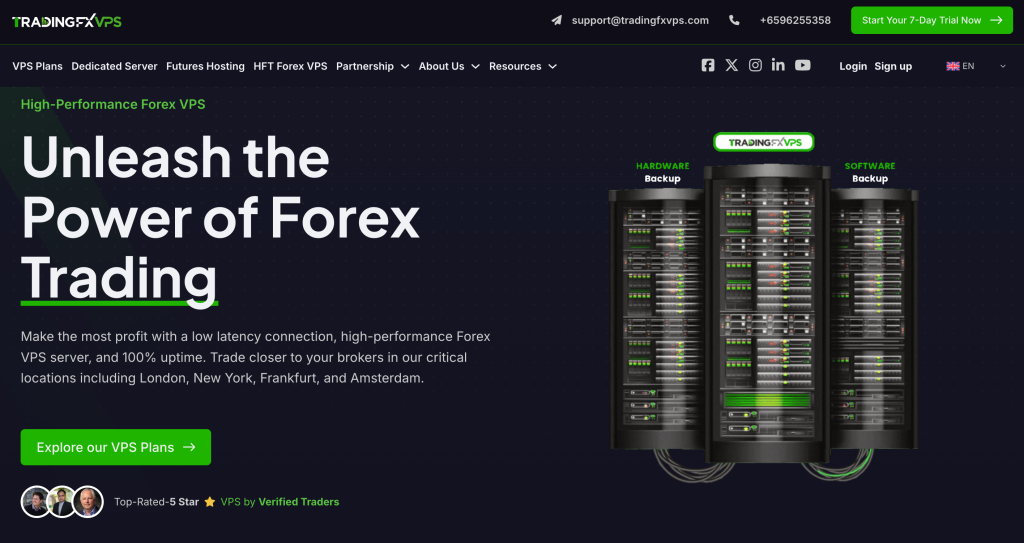
Infrastructure tier: Trading VPS across eight locations including Equinix New York and a CME Aurora facility in Chicago. Operator: Next Era Pte. Ltd. (also known as High Frequency Trading Network Pte Ltd), Singapore.
TradingFXVPS pairs Equinix New York with the only documented Chicago CME Aurora presence in this comparison, which makes it the natural pick for a trader who runs forex now and expects to add CME futures later. Its hardware is also the most clearly specified at the budget end: AMD Ryzen 9 processors with a high per-core clock, DDR5 memory, and NVMe storage in a RAID 10 configuration; confirm backup inclusion at checkout. The plan ladder runs from Standard, at 1 core, 2 GB of DDR5, and 30 GB of NVMe for $17.50 per month on annual billing, through Advanced at 2 cores, 4 GB, and 40 GB for $33.75, to Expert at 4 cores, 8 GB, and 50 GB for $63.75. Every plan includes a dedicated IP, and the company offers a $3.99 seven-day trial and a 30-day money-back guarantee on monthly plans, the longest validation window here, though the discounted annual billing falls under a shorter 14-day window.
The constraints are specification details rather than fundamentals. RAM is DDR5 but not documented as ECC, the entry Standard plan ships with Windows Server 2016, which reaches end of support in January 2027, so a trader should confirm a 2019 or 2022 image at checkout, and storage allotments from 30 to 50 GB are modest, adequate for MetaTrader but tight for large historical data sets. The company also sells trading signals and a third-party expert advisor alongside hosting, a mixed business model worth noting though not a hosting defect.
Strengths: the only documented Chicago CME Aurora presence here alongside Equinix New York, useful for adding futures later; clearly specified AMD Ryzen 9, DDR5, and NVMe hardware with a high per-core clock suited to single-thread forex workloads; a 30-day money-back guarantee on monthly plans, the longest here; a dedicated IP on every plan.
Limitations: RAM is DDR5 but not documented as ECC; the entry Standard plan defaults to the aging Windows Server 2016; storage of 30 to 50 GB is tight for large data sets; the 30-day refund applies only to monthly plans, while discounted annual billing falls under a 14-day window; the company also markets signals and an expert advisor.
AccuWeb Hosting, the US-Based Managed Option
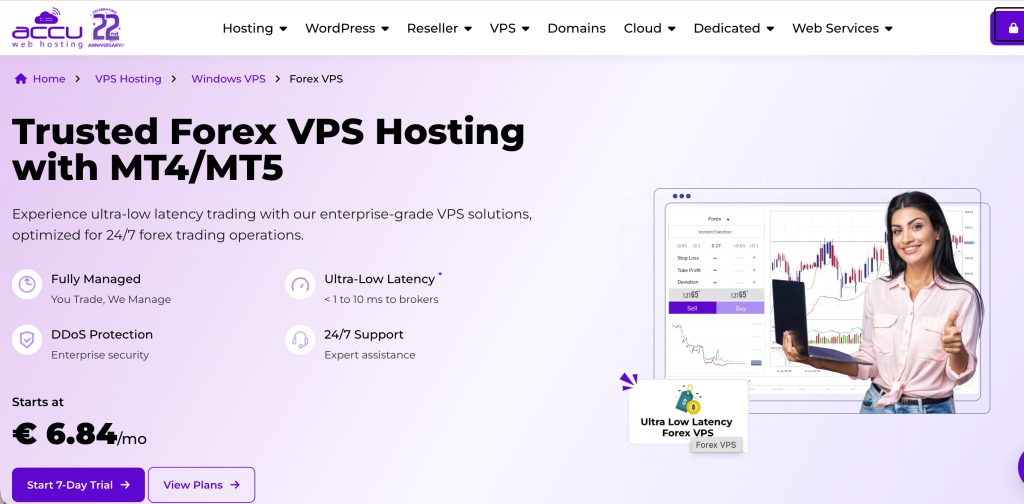
Infrastructure tier: Managed forex VPS across 16-plus regional data centers, with US sites in New York and Denver. Operator: AccuWeb Hosting, United States.
AccuWeb is the genuinely US-based, fully managed option, operating from New Jersey since 2003 with its own data centers in New York and Denver among more than sixteen worldwide. For a trader who does not want to touch Remote Desktop, AccuWeb installs and configures MetaTrader 4 and 5, cTrader, NinjaTrader, and TradeStation on request and will enable DLL imports for expert advisors that need them. Its forex plan ladder runs from Forex VPS 1, with 1.5 GB of RAM and about 40 GB of SSD storage at $7.99 per month on annual billing, through the popular Forex VPS 2 at 3 GB for $14.99 and Forex VPS 3 at 4 GB and 45 GB for about $29.99, to Forex VPS 4 at 8 GB for $59.99. Complimentary weekly backups cover the New York, Denver, and London locations, the company offers a choice of Windows Server 2019, 2022, or 2025 depending on location and plan size, and every plan carries a 7-day money-back guarantee with chat support that reviewers describe as answering within seconds.
AccuWeb’s own knowledge base describes the product honestly as a specialized subset of Windows VPS hosting, which is the right frame: these are AccuWeb’s regional data centers, not Equinix broker-hub colocation, so a latency-sensitive trader will not match a broker’s exact NY4 building the way the colocation specialists allow. Storage on the forex tiers is SSD rather than NVMe, and the RAM type is not published, so ECC cannot be confirmed. AccuWeb’s forex pricing shifts with promotions, so the current Forex VPS 3 rate is worth confirming at checkout.
Strengths: genuinely US-based and fully managed, installing and configuring MetaTrader, cTrader, NinjaTrader, and TradeStation on request and enabling DLLs; US data centers in New York and Denver; a low entry price from $7.99 per month; complimentary weekly backups in New York, Denver, and London; a choice of Windows Server 2019, 2022, or 2025; fast chat support and a 7-day money-back guarantee.
Limitations: regional data centers rather than Equinix broker-hub colocation, which is weaker on latency geometry; SSD rather than NVMe on the forex tiers; RAM type not published, so ECC is unconfirmed; a 7-day refund window, the shortest among the specialists; promotional pricing that varies, so the Forex VPS 3 rate is worth confirming at checkout.
Cloudzy, the Low-Cost Generalist
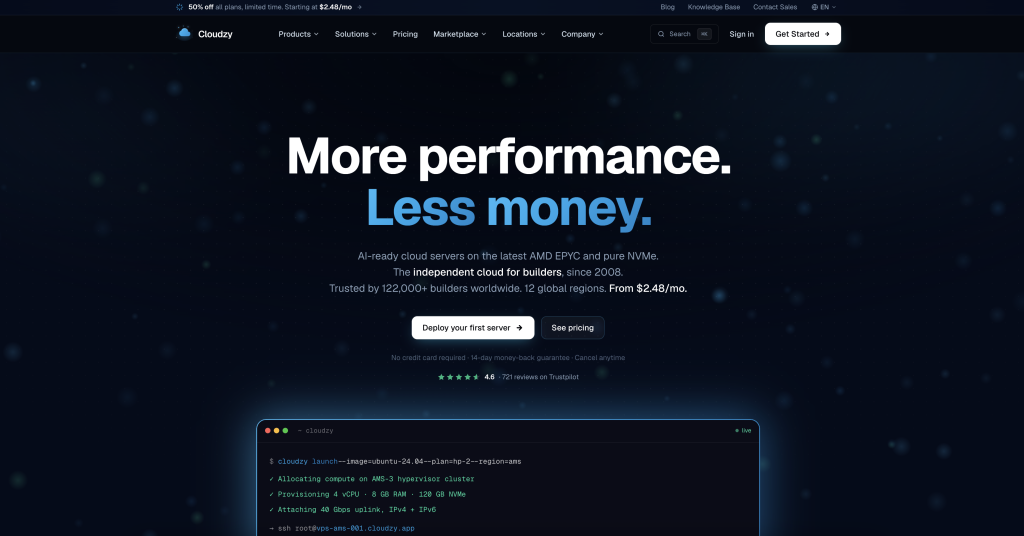
Infrastructure tier: General-purpose cloud VPS across 13 regions, with US locations in New York, Miami, Dallas, and Los Angeles. Operator: Cloudzy, United Arab Emirates.
Cloudzy is the value entry for a US forex trader who wants low cost and a choice of US metros without requiring true broker-hub colocation. It runs AMD EPYC and high-frequency Ryzen processors with pure NVMe storage and DDR5 memory, with US regions in New York, Miami, Dallas, and Los Angeles among thirteen worldwide and identical hardware and flat pricing across the US sites. A forex-oriented plan with 4 GB of RAM and 120 GB of NVMe storage starts at about $14.48 per month on annual billing, with smaller and larger tiers on either side, every plan includes a dedicated IPv4 address and free DDoS protection, and the company runs a public status page and offers a 14-day money-back guarantee. Its live Trustpilot score is about 4.6 to 4.7 out of 5. Provisioning delivers a clean Windows server in about a minute, and the trader installs the broker’s MetaTrader build.
The honest framing is that Cloudzy is a general cloud provider rather than a forex specialist, and its New York region is a general metro location, not Equinix NY4 colocation. For a trader whose broker is in NY4, that means a few extra milliseconds compared with a colocated specialist, which may or may not matter depending on the strategy. MetaTrader is not pre-installed, RAM is DDR5 but not documented as ECC, and the lowest advertised prices refer to smaller tiers, so the plan a multi-expert-advisor trader needs costs more than the headline figure.
Strengths: the broadest spread of US metros here, with New York, Miami, Dallas, and Los Angeles; AMD EPYC and high-frequency Ryzen hardware with pure NVMe storage; low entry pricing from about $14.48 per month; a dedicated IPv4 address and free DDoS on every plan; a public status page and a 14-day money-back guarantee.
Limitations: a general cloud provider rather than a forex specialist, with general metro regions rather than Equinix NY4 colocation; MetaTrader is not pre-installed; RAM is DDR5 but not documented as ECC; the lowest prices refer to smaller tiers than a multi-expert-advisor setup needs.
Common Mistakes When Choosing a US Forex VPS
The most expensive mistake is buying for the label instead of the broker. A trader picks a New York VPS because the broker feels American, when the broker’s matching engine is actually in London or an Asian hub. The server is then 59 milliseconds or more from the engine on every order, which shows up as slippage on entries and exits, and the fix is not a faster server but a server in the right city. Confirm the broker’s data center before choosing a location, every time.
The second mistake is overbuying memory. A MetaTrader 4 terminal idles at tens of megabytes, so paying for an 8 GB plan to run a single terminal that fits comfortably in 2 to 4 GB wastes money every month, often $30 to $45 of it, on RAM the platform never touches. Size the plan to the number of terminals and expert advisors actually running, add modest headroom, and spend the difference on proximity and a dedicated IP instead.
The third mistake is treating a broker’s free VPS as permanently free. These programs waive the fee only while a volume or balance threshold is met, so a slow month that drops the account below the line can trigger a charge of $15 to $50, and several programs place the server on a generic cloud region rather than true colocation. A free VPS is a genuine benefit for a trader who reliably meets the threshold and whose broker hosts it near the matching engine, and a hidden cost for everyone else.
The fourth mistake is running a DLL-based expert advisor on MetaTrader’s built-in hosting. MetaQuotes Virtual Hosting allows no DLLs of any kind, so an expert advisor that depends on an external library will simply fail to function, often without an obvious error, and the trader loses time diagnosing a problem that is really a platform limitation. Any setup that needs a DLL, or any non-MetaTrader software, requires a full Windows VPS with administrator access.
The fifth mistake belongs to prop-firm traders: running identical expert-advisor parameters from one IP address across several funded accounts. Proprietary trading firms monitor for exactly this pattern as a sign of coordinated trading, and a flag can mean the loss of one or more funded accounts and the fees paid for them. A dedicated IP per account, and genuine variation between accounts, keeps a legitimate setup clean.
The sixth mistake is committing to annual billing before validating the server against your own broker. The lowest prices require paying for a year, but the only way to know the latency and stability are acceptable is to measure them, which is what the $0.99 and $3.99 trials and the 7-to-30-day refund windows are for. A related error is treating two brands that share infrastructure, such as ForexVPS.net and FXVM, as redundant: when the underlying network fails, as it did across both in August 2025, both go down together. Validate first, then prepay, and source genuine redundancy from genuinely separate providers.
Matching a Provider to Your Broker and Workload
Start with the broker, because it sets the location and the location sets the shortlist. If your broker’s matching engine is in Equinix NY4 or the adjacent NY5, which is the case for US-regulated brokers such as OANDA and FOREX.com, the four colocation-capable specialists are the right pool: NYCServers if you want the platform pre-installed and the setup turnkey, VPSForexTrader if you want error-correcting memory and a cheap trial to validate first, ForexVPS.net if you value the broadest network and the largest review base, and TradingFXVPS if you want the strongest single-thread hardware at the budget end.
Then size to the workload. A single terminal with one or two expert advisors runs well on a 2 to 4 GB tier, where Cloudzy’s $14.48 plan, MetaTrader’s own hosting for DLL-free setups, and VPSForexTrader’s Smart tier all fit. A serious multi-expert-advisor setup wants the 4 GB realistic floor, available as VPSForexTrader Smart, ForexVPS.net Core, AccuWeb Forex VPS 3, or TradingFXVPS Advanced. A heavy multi-terminal operation or regular Strategy Tester optimization wants an 8 GB tier such as VPSForexTrader Max, ForexVPS.net Prime, TradingFXVPS Expert, or AccuWeb Forex VPS 4.
A few situations point to a specific answer. A trader who wants zero setup work, or who is not comfortable administering Windows, is best served by NYCServers’ pre-installs or AccuWeb’s managed installs. A trader who runs CME futures alongside forex should weight toward TradingFXVPS for its Chicago Aurora presence. A prop-firm trader should prioritize a dedicated IP, which every specialist here includes, and one account per address. A trader whose broker is not in NY4 at all, but in London or an Asian hub, should ignore the New York framing and pick the matching region, which most of these providers also offer. For those who simply want maximum hardware value and do not need true NY4 colocation, two general-purpose hosts are worth a look: Kamatera, which offers customizable specs across US metros including New York, Chicago, Dallas, and Miami with a 30-day free trial, and Contabo, whose large-RAM Windows plans in New York, Seattle, and St. Louis are inexpensive, both with the caveat that their US regions are general metros rather than Equinix colocation.
Three Findings
First, the New York label is only as valuable as the broker behind it. Proximity to the broker’s matching engine, not the server’s processor or memory, is the variable that moves slippage and fill quality, and a 2 GB server in the right building beats a 16 GB server in the wrong one. The single most useful action a US forex trader can take is to confirm where the broker actually hosts and measure latency to it before buying anything.
Second, error-correcting memory at the entry tier is the exception, not the rule. Among the six providers here, only VPSForexTrader documents ECC RAM, and it does so across every plan, while the others compete on different strengths: NYCServers and AccuWeb on turnkey and managed installation, ForexVPS.net on network breadth and review depth, TradingFXVPS on single-thread hardware and its Chicago presence, and Cloudzy on price and US-metro spread. The right choice depends on which of those strengths matches the trader’s priority.
Third, the cheapest headline is rarely the real cost. Free and low-cost hosting carries conditions: volume thresholds that convert to fees, DLL restrictions that break expert advisors, and shared infrastructure that removes the redundancy it appears to offer. The honest comparison is total cost and execution reliability rather than the advertised monthly figure, and a short trial against your own broker tells you more than any price or latency claim on a sales page.
Frequently asked questions
Which is the best forex VPS for US traders?
There is no single best forex VPS for every US trader, because the right choice depends on where your broker hosts and how many expert advisors you run. The most important factor is location: if your broker’s matching engine is in Equinix NY4, a colocated specialist such as NYCServers, which pre-installs the platform, or VPSForexTrader, which documents ECC RAM and offers a $0.99 trial, will give the best execution. For the broadest network choose ForexVPS.net, for a Chicago futures option alongside forex choose TradingFXVPS, for a fully managed US-based setup choose AccuWeb, and for the lowest cost across several US metros choose Cloudzy. Confirm your broker’s data center first, then match the provider to that location and your workload size.
Do I need a New York VPS for forex trading?
Only if your broker’s trading server is in or near the Equinix NY4 facility in Secaucus, New Jersey, which is where US-regulated brokers such as OANDA and FOREX.com host their matching engines. A New York VPS placed near such a broker can reach it in about a millisecond, against tens or hundreds of milliseconds from a home connection. If your broker hosts in London or an Asian hub instead, a New York VPS would actually add latency, and a server in the broker’s region is the correct choice. Check the broker’s infrastructure pages or ask its support for the data center serving your account before deciding.
How much RAM does a forex VPS need?
Less than most traders expect. A MetaTrader 4 terminal idles at roughly 20 to 35 megabytes and MetaTrader 5 in the low hundreds, while Windows itself uses about 0.8 to 1.2 gigabytes. One terminal with a couple of expert advisors runs on 2 gigabytes, a serious multi-expert-advisor setup is comfortable on 4 gigabytes, and 8 gigabytes covers heavy multi-terminal use or Strategy Tester optimization. A 4 GB plan with dedicated cores and NVMe storage, such as VPSForexTrader Smart, suits most automated forex traders, and paying for more memory than the terminals will use is a common waste.
Is a free forex VPS worth it?
It can be, with conditions. MetaTrader’s built-in MetaQuotes Virtual Hosting costs about $12.80 to $15 per month and is genuinely useful for a single-broker setup, but it runs no DLLs, allows no remote desktop, and runs only MetaTrader, so a DLL-based expert advisor or any other software rules it out. Broker-sponsored free VPS programs waive the fee only while a balance or volume threshold is met, often a $1,000 balance with at least one trade a month for MetaTrader 5, or around $500,000 in monthly volume, and bill roughly $15 to $30 if you fall below it, sometimes on a generic cloud region rather than true colocation. A free VPS is worth it for a trader who reliably meets the threshold and whose broker hosts it near the matching engine; a paid dedicated VPS is better for everyone else.
Which forex VPS providers have servers in Equinix NY4?
Among the providers in this comparison, NYCServers is colocated at Equinix NY4 and selects it automatically for US-hosted brokers, VPSForexTrader hosts at NY2 alongside London, Amsterdam, and Hong Kong, ForexVPS.net includes NY4 within its 22-location network, and TradingFXVPS holds Equinix New York alongside its Chicago CME Aurora site. AccuWeb and Cloudzy operate New York data centers, but these are their own general regional facilities rather than Equinix NY4 colocation, which is a meaningful distinction for a latency-sensitive trader whose broker is specifically in NY4.
How were these forex VPS providers chosen and ordered?
The six were chosen as the providers most relevant to forex trading on US-located servers, with verified Equinix NY4 presence or a genuine US data-center footprint, and each was checked against the same criteria: location and proximity to broker hubs, RAM amount and type, CPU and storage, platform support and installation method, trial and refund terms, and independent review standing. Pricing and specifications were verified on each provider’s own website in June 2026. They are grouped by hosting model and US relevance rather than ranked by a single score, which is why the turnkey New York specialist appears first. VPSForexTrader publishes this guide and is one of the six; it appears in the second position rather than first, and its limitations are documented alongside its strengths.
References
[1] Equinix, corporate communications on the NY4 Secaucus campus and its share of global electronic equities, derivatives, and foreign-exchange transactions. (equinix.com)
[2] Bloomberg, 2016 feature reporting on the Equinix NY4 facility, the exchanges it hosts, and peak message throughput. (bloomberg.com)
[3] OANDA, VPS and broker-hosting information stating its presence in Equinix LD4 in London and NY4 in New York. (oanda.com)
[4] IC Markets, server-location information stating that its MetaTrader 4 and 5 servers are in the NY4 data center, and its free-VPS program terms. (icmarkets.com)
[5] Hibernia Networks and EXA Infrastructure, 2015 announcement of the Hibernia Express cable and its tested sub-58.95-millisecond latency between Equinix LD4 and NY4. (exainfra.net)
[6] MetaQuotes, MetaTrader Virtual Hosting documentation covering pricing, the resource allocation, the no-DLL and MetaTrader-only limits, and the chart cap. (metatrader5.com)
[7] MetaQuotes, MetaTrader Strategy Tester documentation on terminal resource use and per-agent memory. (metatrader5.com)
[8] FOREX.com, VPS program terms including the monthly-volume threshold for a waived fee. (forex.com)
[9] Pepperstone and RoboForex, published VPS-program eligibility thresholds. (pepperstone.com, roboforex.com)
[10] FTMO and OANDA, joint announcement of the completed acquisition of OANDA Global Corporation, effective December 1, 2025. (ftmo.com, oanda.com)
[11] NYCServers, plan specifications, locations, pre-installation behavior, and pricing. (newyorkcityservers.com)
[12] VPSForexTrader, plan specifications, ECC RAM, Equinix NY2 and other locations, trial and refund terms, and operational policy. (vpsforextrader.com)
[13] ForexVPS.net, plan specifications, the 22-location network, Resource Spike Protection, and refund terms. (forexvps.net)
[14] TradingFXVPS, plan specifications, Equinix New York and Chicago CME Aurora locations, hardware, and refund terms. (tradingfxvps.com)
[15] AccuWeb Hosting, the forex VPS plan ladder, US data-center locations, managed-install and backup policies, and its knowledge-base description of the product. (accuwebhosting.com)
[16] Cloudzy, forex VPS plan specifications, US regions, hardware, status page, and refund terms. (cloudzy.com)
[17] Trustpilot, live review scores and counts for the providers in this comparison, read June 2026. (trustpilot.com)
Editorial note
VPSForexTrader, which publishes this guide, is one of the six providers compared, and this article was produced by its team. To limit bias, providers are grouped by hosting model and US relevance rather than ranked by a single score, VPSForexTrader appears in the second position rather than first, and it is measured against the same criteria as every competitor. Several competitors outperform it on specific dimensions, and the article says so: NYCServers offers turnkey platform pre-installation that VPSForexTrader does not, AccuWeb offers a genuinely managed service and US-based data centers, ForexVPS.net offers a broader network and a far larger independent review base, TradingFXVPS offers a Chicago CME Aurora location and more clearly specified single-thread hardware, and Cloudzy offers lower entry pricing across more US metros. VPSForexTrader’s recorded advantage is narrower and specific: it is the only provider here that documents ECC error-correcting memory, on every tier, with a paid trial below $30 per month. Its section lists five strengths and five limitations.
Pricing, specifications, and policies were verified on each provider’s own website in June 2026, and Trustpilot scores were read the same month; all are subject to change. Latency and uptime figures published by any provider, VPSForexTrader included, are commercially motivated and have not been independently audited. This article is infrastructure guidance, not financial, investment, or trading advice, and nothing in it is a recommendation to trade or a promise of trading results.