Best Forex VPS for Expert Advisors (EAs) (2026)
Most “European Forex VPS” lists quietly conflate two different things: a Forex VPS provider with a server physically in continental Europe, and a provider that will sell you a plan while routing you to London or New York. For a trader whose broker is regulated in the EU and whose matching engine sits in Frankfurt or Amsterdam, that distinction is the whole game, because a VPS in the wrong metro adds network hops to every order regardless of how the plan is marketed. This became sharper after Brexit, when a number of EU-regulated brokers moved or duplicated their trading infrastructure out of London and into Frankfurt, Amsterdam, and Paris, so the continent, not just the City, now carries a meaningful share of European broker execution.
This article takes a deliberately narrow test. Of the providers commonly recommended to European traders, which ones actually operate a Forex-suitable server on continental EU soil, in Frankfurt, Amsterdam, or a comparable hub, excluding the UK, which is outside the EU and covered separately. Four providers pass that test and are compared here in depth; one popular provider fails it and is named honestly rather than omitted, because a trader deciding between these options deserves to know it has no continental node. The comparison then turns to the specifications that decide performance once the server is on EU soil, and to the two compliance-adjacent facts EU traders actually need: where post-Brexit brokers route, and where GDPR wants your data to live.
Scope is infrastructure. Nothing here is trading advice, and a VPS does not make a trader ESMA-compliant, which is a matter of broker and account, not hosting. This comparison is published by one of the providers in it, VPSForexTrader, which runs an Amsterdam node and appears at its ordered position in the list below. That is disclosed in full in the methodology, along with where the article routes a trader to a competitor instead, which it does.
The short version
For a quick orientation before the detail, here is every provider in this comparison with its single most distinctive continental-EU attribute and entry price. BeeksFX offers institutional Equinix-colocated infrastructure with an ISO 27001 certification from a publicly listed operator, on a Frankfurt footprint, at £25.83 per month (near $34.87). QuantVPS offers a DE-CIX-peered Frankfurt node built for futures, with Amsterdam also on its published network and a plan ladder tuned for heavy multi-chart work; its exact plan pricing should be read live, as it runs frequent promotions. VPSForexTrader offers purpose-built Forex hosting with ECC memory across every tier and Windows Server 2025 on an Amsterdam node, at $25.59 per month. AccuWeb offers a fully managed continental option with telephone support and multiple continental-EU Forex nodes including Frankfurt, Paris, and Stockholm, at $15.00 per month standard, currently advertised at a discounted $7.99. NYCServers, a common recommendation, is not in the ranked list at all, because it operates no continental-EU node; its network spans NY4, LD4, TY3, SG1, HK1, and DUB1, and while Dublin is in Ireland it is not on the continent and not near Frankfurt or Amsterdam routing, as explained in full below. The sections that follow expand each of these and route different EU traders to different providers.

How this comparison was built
Each provider’s continental-EU data-centre presence was verified against the provider’s own location pages, and a provider is included only where it documents a Forex-suitable server in a continental-EU hub. Specifications, pricing, memory type, and operating system versions were verified against each provider’s own pages. This comparison does not rank providers on user-review scores; reputation is not used as a ranking dimension, because the article’s axis is EU infrastructure, not sentiment. Every volatile figure, pricing above all, should be re-verified against the provider’s live pages before any purchase, as prices and plans move.
Five dimensions carry the comparison: documented continental-EU data-centre location, with the specific hub named; whether the server is Forex-purpose or general-hosting infrastructure repurposed for trading; RAM type, with an ECC flag, since EU EAs run unattended like any other; operating system version and its Microsoft support window; and entry price. Latency figures that providers advertise are not used as a ranking input, because none is independently replicated; documented presence in a continental-EU hub is used instead, as the verifiable proxy for proximity to EU-regulated brokers.
Providers are ordered by infrastructure tier, from institutional colocation through exchange-proximate and Forex-first retail to general-purpose hosting with a Forex line. That ordering is a structural criterion, not a quality ranking, and it places the publisher third. Each provider section carries its tier as an italic line, so the basis is visible in the body.
This comparison is published by VPSForexTrader, operated by HOSTLINE, UAB (Lithuania), and VPSForexTrader is one of the providers compared, which is a conflict of interest. It is handled the same way in every VPSForexTrader comparison: the publisher’s plan is evaluated on the same dimensions applied to every other provider, the ordering basis and sources are published, and where a competitor is genuinely the better fit, that is stated. This article routes a futures-focused EU trader to QuantVPS in Frankfurt, a budget or general-hosting EU trader to AccuWeb, and a compliance-bound or institutional EU trader to BeeksFX, each over the publisher for the trader it fits. The publisher is a strong option for the EU-based trader who wants a purpose-built Forex VPS on EU soil with premium reliability features, which is a real segment but not every EU trader. A reader who wants a comparison with no publisher in the field should treat this as one input rather than an independent audit.
Latency, uptime, and throughput figures quoted anywhere here are published by the providers themselves and are not independently replicated [1].
Where post-Brexit brokers actually route, and why the continent now matters
For years the shorthand was that European Forex meant London, because the LD4 and LD5 Equinix campuses in Slough carried the majority of European broker execution. Brexit complicated that. An EU-regulated broker serving EU clients under an EU licence gained a regulatory and operational reason to keep infrastructure inside the EU, and several responded by moving or duplicating matching engines into Frankfurt and Amsterdam, with Paris as a growing third node. The result is not that London stopped mattering, it remains dominant for UK-regulated brokers, but that a meaningful and growing share of EU-regulated execution now sits on the continent, where a London VPS reaches it more slowly than a Frankfurt or Amsterdam one does [2].
The practical rule for an EU trader follows directly, and it is the opposite of the intuitive one: choose the VPS location closest to the broker’s server, not closest to yourself. A trader in Madrid whose broker routes through Frankfurt is better served by a Frankfurt or Amsterdam VPS than by a Spanish one, because the broker’s matching engine, not the trader’s home, is the endpoint that latency is measured to. Frankfurt is the shortest path for a broker colocated in the Equinix FR2 campus, which hosts Deutsche Börse and a dense cluster of German-regulated brokers and ECNs; Amsterdam, home to the AMS-IX exchange, is well connected across Western Europe and is often the best single continental choice for a broker distributed across the region; Paris serves French and nearby brokers well. The first step is always to ask the broker where its trade server is, then match the VPS metro to that answer [3].
None of this is a latency measurement the article asks you to take on faith. It is the verifiable fact underneath the latency marketing: a provider with a documented Frankfurt or Amsterdam server can be placed physically near an EU broker that routes there, and a provider whose network stops at London cannot, regardless of the ping figures either one advertises.
The provider that does not qualify, and why it is named
NYCServers is a capable Forex VPS provider and a common recommendation, and it is named here precisely because a European trader comparing options will encounter it and needs to know where it stands. Its network, on its own documentation, spans six locations: NY4 (New York), LD4 (London), TY3 (Tokyo), SG1 (Singapore), HK1 (Hong Kong), and DUB1 (Dublin). It has no node in the continental-EU broker hubs: no Frankfurt, no Amsterdam, no Paris. Its Dublin location is in Ireland, an EU member state, but Dublin is not on the continent and is not near the Frankfurt or Amsterdam routing that EU-regulated brokers increasingly use, so it does not close the gap for a trader whose broker sits in those hubs. For a UK-regulated broker in the London ecosystem its LD4 presence is genuinely strong, but for an EU-regulated broker routing through Frankfurt or Amsterdam, an EU trader on NYCServers is served from London or Dublin at best, neither of which is in the continental hub where that broker routes.
This is not a criticism of the product on its own terms; it is a statement of fit. Its published control panel installs a broker’s platform for the trader, but a provider still cannot place a trader on a continental-hub server it does not operate. So for the specific trader this article is written for, an EU-based trader whose broker’s matching engine sits on the continent, NYCServers is the wrong tool, and a list that included it on the strength of its London node would be misleading about what “European” means. It is excluded from the ranked comparison for that reason, and named here so the exclusion is transparent rather than silent. Its location set should be re-checked against its live pages before publication, since a provider can add a node at any time [8].
The specifications that decide performance once the server is on EU soil
A continental location puts the VPS near the broker; it does not by itself make the VPS good. Among the four qualifying providers, the specifications that separate them are the ones that matter anywhere an EA runs, with one EU-specific addition, data residency.
Memory type is the clearest separator. An Expert Advisor running unattended for days or weeks is exposed to single-bit memory errors that error-correcting memory catches and non-ECC memory does not, and only one provider here documents full server ECC across every tier. Operating-system currency is the second, and it has a hard deadline attached, so it gets its own section below. Whether the infrastructure is Forex-purpose or general hosting repurposed for trading is the third, and it shows up in tuning, support that understands MetaTrader, and whether the trading platform is a first-class concern or one workload among many. Storage type and published capacity follow. And for an EU trader specifically, data residency is the addition: a server physically in the EU keeps trading data under GDPR on EU soil, which matters to any trader handling EU client capital or simply preferring their data stay in-jurisdiction [3]. The comparison table below sets these out side by side, and the provider sections that follow it expand each one.
The four qualifying providers at a glance
Table 1 of 2: Continental-EU location and infrastructure. Row order matches the provider section order below.
| Provider | Continental-EU hub | Forex-purpose? | Entry RAM | RAM type | Operating system |
| BeeksFX | Frankfurt (institutional) | Yes, institutional | 2,560 MB | Not published | Server 2022 |
| QuantVPS | Frankfurt and Amsterdam | No, futures-first | 8 GB (VPS Lite) | ECC not publicly specified | Server 2022 |
| VPSForexTrader | Amsterdam | Yes, Forex-first | 4 GB | ECC documented | Server 2025, all tiers |
| AccuWeb Hosting | Frankfurt, Paris, Stockholm (bookable set varies) | No, general hosting | 1.5 GB | Not published | Older Windows Server on EU nodes (2025 in Denver and London only) |
Table 2 of 2: Price, capacity, and EU fit. Billing state is labelled per cell; re-verify every figure live before purchase.
| Provider | Entry price | Published capacity | Data residency | Fits which EU trader |
| BeeksFX | £25.83/mo annual (near $34.87) | 2 to 4 terminals | EU (Frankfurt) | Institutional or compliance-bound |
| QuantVPS | Read live (promo-dependent) | Not published | EU (Frankfurt, Amsterdam) | Futures or futures-and-Forex crossover |
| VPSForexTrader | $25.59/mo annual | Up to 4 terminals (10 on Max) | EU (Amsterdam) | Forex trader wanting a purpose-built EU server with ECC |
| AccuWeb Hosting | $15.00/mo standard ($7.99 promotional) | Up to 2 (vendor-stated) | EU (Frankfurt, Paris, Stockholm) | Budget or managed general-hosting need |
Specifications and locations verified against each provider’s own pages; re-verify before purchase, and re-pull any promotional or annual rate to confirm the billing state. NYCServers is excluded for having no continental-EU node (see section 5). GBP entry converted at £1 = $1.35, putting BeeksFX Bronze at about $34.87 per month before configuration. Advertised latency figures are vendor-stated and not reproduced as ranking inputs. Published capacity figures are vendor statements assuming light loads.
The operating system underneath the plan
The Windows Server version underneath a plan carries a support-window risk, because a version leaving Microsoft support mid-term forces a migration the trader did not plan. End of extended support falls on 12 January 2027 for Windows Server 2016, 9 January 2029 for 2019, 14 October 2031 for 2022, and 14 November 2034 for 2025 (whose mainstream support runs to 13 November 2029) [4]. Windows Server 2022 reaches the end of its mainstream support phase on 13 October 2026, moving into extended support only, which is worth noting for a plan a trader expects to hold for years.
VPSForexTrader runs Windows Server 2025 on all three tiers with no condition attached, the longest support runway here and the only current-release deployment across every tier. AccuWeb offers Windows Server 2025 only in its Denver and London locations and only on plans of 3 GB or more, so on its Frankfurt node the current release is not offered and the entry tier runs an older version regardless. QuantVPS and BeeksFX run Windows Server 2022. For a twelve-month term signed today every version named here remains in a supported phase, so this bites at the renewal after this one, and hardest where the current release is gated behind a higher tier.
Institutional infrastructure at retail, for the compliance-bound EU trader: BeeksFX
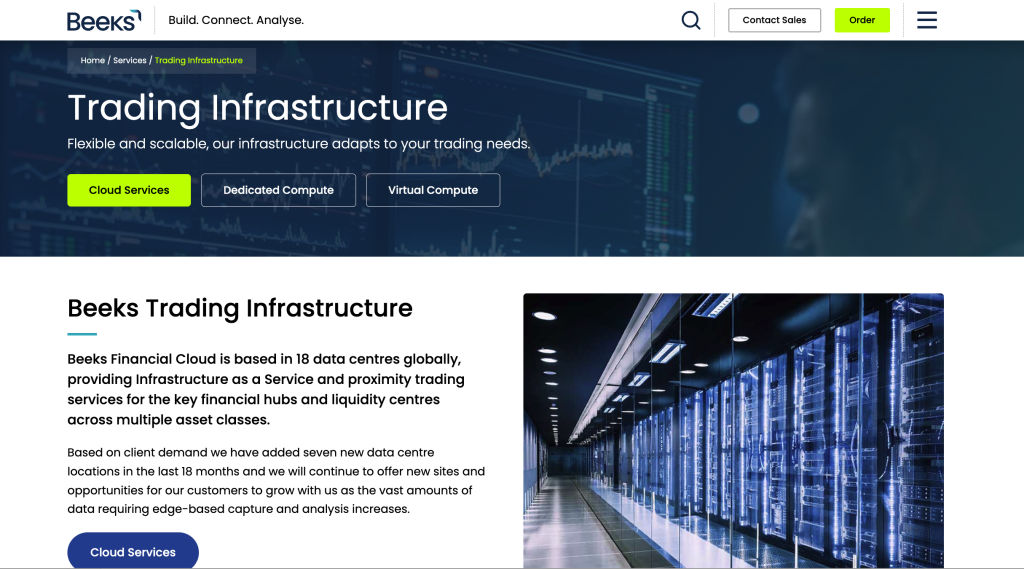
Infrastructure tier: institutional, Equinix-colocated Operator: Beeks Financial Cloud Group plc (AIM: BKS), Renfrew, Scotland, established 2011, AIM-listed 2017
BeeksFX is the institutional entry, the retail line of the only publicly listed company in this comparison, with continental infrastructure including Frankfurt as part of the Equinix financial-hub footprint that is its core business. For an EU trader operating institutional capital or under compliance obligations, its published ISO 27001 certification and listed-company governance are the features that matter, and they are ones no retail-focused provider here offers. Bronze is £25.83 on annual billing (£310 per year, about $34.87 per month) with 1 vCPU, 2,560 MB, and 30 GB on Windows Server 2022, with a managed option and cTrader support.
Its EU case rests on certification, governance, and institutional infrastructure rather than the entry specification, which at 2,560 MB is modest for the price. GBP pricing introduces sterling exchange-rate exposure for a euro-based trader, the mirror image of the advantage it gives a UK trader. For an EU trader who needs published certification and institutional backing on EU soil, BeeksFX provides what a retail plan cannot; for a retail EU trader who does not, its entry specification is modest for the money [7].
Strengths: continental-EU institutional infrastructure including Frankfurt, from a publicly listed operator with the disclosure obligations that carries; publishes ISO 27001, the only security certification in this comparison, the feature compliance-bound EU traders need; EU data residency in Frankfurt; managed option and cTrader support.
Limitations: 2,560 MB entry is modest for the price; general-purpose institutional pricing rather than a low retail entry; storage media type and RAM type not published on the retail tier; GBP pricing introduces sterling exchange-rate exposure for a euro-based trader; premium value rests on certification and pedigree rather than entry specification.
A futures-tuned Frankfurt node, for the futures or crossover EU trader: QuantVPS
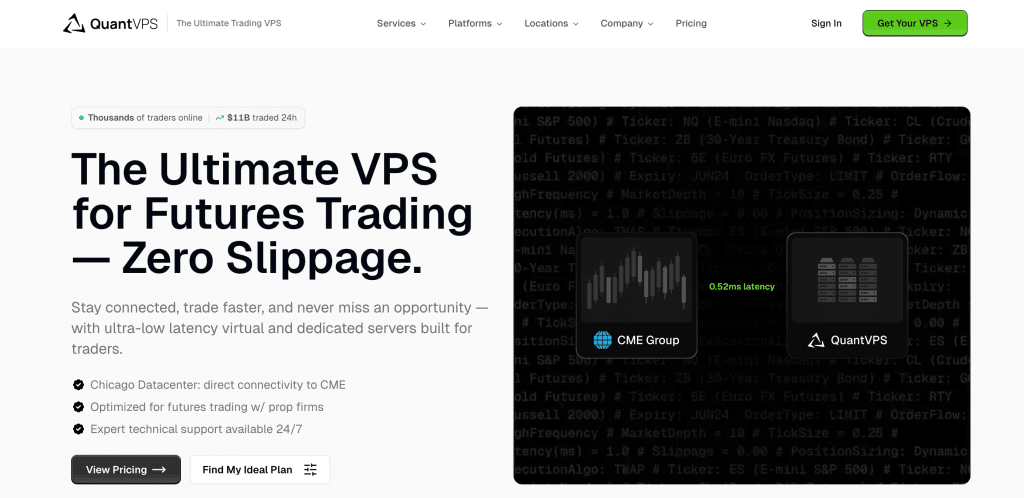
Infrastructure tier: institutional-adjacent, exchange-proximate Operator: QuantVPS, Chicago, Illinois. Publishes no legal entity name and no founding year, and is ordered accordingly.
QuantVPS operates a genuine Frankfurt node, hosted in the central European financial hub with DE-CIX peering for broad European reach, and for an EU trader whose focus is futures, or who runs futures alongside Forex, it is the better fit than a Forex-first provider, because its whole platform is tuned for futures execution. The Frankfurt location puts it near German-regulated brokers and the FR2 ecosystem, and DE-CIX peering gives it broad continental routing. Its published location network also carries Amsterdam, so its continental-EU coverage runs to two metros rather than one.
QuantVPS runs a multi-plan ladder rather than a single entry tier, and its pricing shifts with frequent promotions, so the exact figure should be read live; the plan compared here is VPS Lite, with 4 cores, 8 GB of RAM, and 70 GB of NVMe, a mid-ladder plan chosen because its memory suits heavy multi-chart work, not the cheapest rung. The product is built for futures rather than Forex, so its tuning, support, and documentation centre on futures platforms rather than MetaTrader. It runs Windows Server 2022 on its published plans. Its ECC status and refund terms are not consistently specified across its public pages and should be confirmed at checkout [5].
Strengths: a genuine Frankfurt node with DE-CIX peering and broad continental routing, near German-regulated brokers and the FR2 ecosystem; a second continental-EU metro in Amsterdam; a futures-tuned platform with a plan ladder that scales to heavy multi-chart and multi-account workloads; the VPS Lite plan carries 8 GB of RAM, real headroom for multi-chart work; NVMe storage; EU data residency in Frankfurt and Amsterdam; Windows and Linux available.
Limitations: built for futures rather than Forex, so MetaTrader is supported but not the tuning focus, and its reviews and documentation describe NinjaTrader and futures execution; ECC status and refund terms not consistently specified across its public pages, so each must be confirmed at checkout; pricing shifts with frequent promotions, so no single published rate can be relied on ahead of a live read; the compared VPS Lite plan is a mid-ladder plan, not the cheapest entry, so a like-for-like budget comparison requires reading its full ladder; no multi-monitor support on the VPS Lite plan.
Purpose-built Forex hosting with ECC, for the EU-based Forex trader: VPSForexTrader
Infrastructure tier: Forex-first retail specialist Operator: HOSTLINE, UAB, Vilnius, Lithuania, operating since 2011
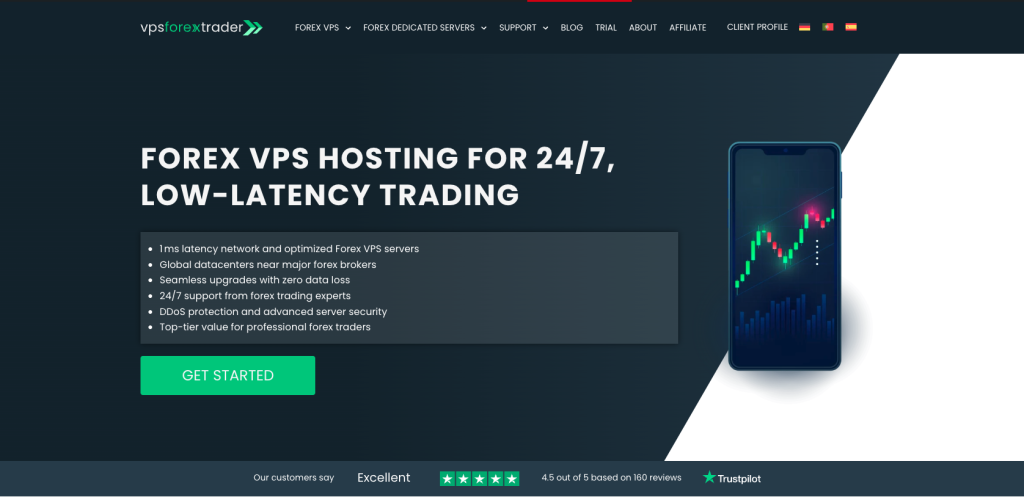
Among the providers with a genuine continental-EU server, VPSForexTrader is the one running purpose-built Forex infrastructure on the continent rather than a general-hosting or futures-first node, and for an EU-based trader running MetaTrader against an EU-regulated broker that is the combination that fits. It operates an Amsterdam node, and it pairs that location with ECC memory across every tier and Windows Server 2025 on every plan.
Smart runs $31.99 monthly or $25.59 on twelve-month billing, with three AMD EPYC vCPUs (the Amsterdam node runs on the EPYC 7702P), 4 GB of ECC RAM, and 120 GB of NVMe storage, rated for up to four terminals. The site currently displays a longer 24-month commitment as its headline rate, so the price a reader sees on click-through may be lower than the twelve-month figure used here; compare like billing terms. Boost at $41.24 annual provides six cores and 6 GB for up to seven terminals, and Max at $59.99 annual provides eight cores and 8 GB for up to ten, so an EU trader whose load grows stays within one provider and one jurisdiction. All three run Windows Server 2025, backups are included, and the Amsterdam location keeps trading data on EU soil under GDPR. Beyond Amsterdam the network covers London, New York, and Hong Kong. A $0.99 three-day trial, which requires a card at signup and continues at $31.99 monthly unless cancelled before it expires, is available in Amsterdam, New York, and London; the 14-day money-back guarantee applies to paid plans and does not cover the trial [1].
Where a competitor is the better choice, this article routes there rather than to the publisher. An EU trader whose primary platform is a futures platform, or who runs futures alongside Forex, is better served by QuantVPS in Frankfurt. An EU trader who needs a managed general-hosting environment or the lowest price is better served by AccuWeb. An EU trader operating institutional capital under compliance obligations is better served by BeeksFX. VPSForexTrader’s case is the purpose-built Forex server on EU soil with premium reliability at a mid-market price, for the common EU retail trader.
Strengths: a purpose-built Forex VPS on continental EU soil; the only qualifying provider here documenting full server ECC across all tiers; Windows Server 2025 on every tier, the longest support runway here; EU data residency keeping trading data in-jurisdiction under GDPR; a clear upgrade path from four to ten terminals within one provider and jurisdiction; a London node available for UK-regulated brokers.
Limitations: a single continental-EU metro, Amsterdam, rather than a choice of Frankfurt and Amsterdam, so a trader whose broker is specifically in Frankfurt may prefer a Frankfurt-native node; not the cheapest option, and the wrong choice for a pure budget or general-hosting need; not a futures platform host, so a futures-focused EU trader is better routed elsewhere; the EPYC model is not stated on the plan pages themselves, though the Amsterdam node is known to run the EPYC 7702P; prices subject to VAT for EU buyers, so the post-VAT figure is the real cost; the $0.99 trial auto-converts to $31.99 monthly unless cancelled; no contractual SLA, and no uptime figure appears in the Terms, so the 99.99% shown on the product pages is a marketing statement rather than a commitment; no live status page, with maintenance and incident notice delivered by email instead.
A managed continental option, for the budget or managed EU need: AccuWeb Hosting (Frankfurt, Paris, Stockholm)
Infrastructure tier: general-purpose Windows hosting with a Forex product line Operator: AccuWeb Hosting, Old Tappan, New Jersey, founded 2003
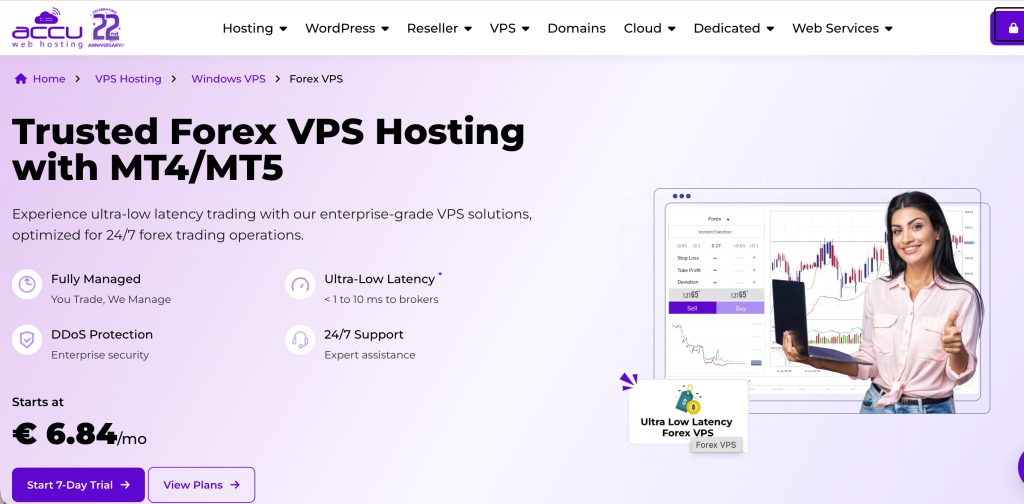
AccuWeb is the managed generalist here, and it has the broadest continental-EU footprint in this comparison: its live Forex line lists multiple continental hubs including Frankfurt, Paris, and Stockholm, so an EU trader can match the metro to the broker. It is fully managed with 24/7 support across email, ticket, live chat, and telephone, the broadest support footprint in this comparison, and its entry plan is listed at $15.00 per month, currently discounted to $7.99 on the plan card. One caveat specific to AccuWeb: its advertised and bookable Forex locations do not always match, and a tested checkout in 2026 offered a different set from the marketing pages, so confirm the exact continental metro is available at checkout before subscribing.
The trade-off is that AccuWeb is general-hosting infrastructure with a Forex product line rather than purpose-built Forex hosting, and its entry tier reflects that: Forex VPS 1 provides 1.5 GB of RAM and 1 vCPU on an older Windows Server version, with SSD rather than NVMe storage; the plan card states support for up to two terminals, though 1.5 GB is tight for two MetaTrader instances after Windows overhead. Its exact storage and bandwidth figures should be confirmed on the live plan card. Windows Server 2025 is offered only in AccuWeb’s Denver and London locations and only on plans of 3 GB or more, so its Frankfurt node does not offer the current release at any tier. It does not document ECC memory, so it does not address the unattended-runtime risk the way a server-ECC provider does. For a single terminal on a budget, or a trader who values managed support and metro choice over Forex-specific tuning, it is a strong EU option; for an unattended multi-terminal EA setup, its entry specification is a real limit [6].
Strengths: the broadest continental-EU footprint here, with Forex nodes including Frankfurt, Paris, and Stockholm, so an EU trader can match the metro to the broker; fully managed with the broadest support footprint here, 24/7 across four channels including telephone; the lowest entry price here, $15.00 per month standard and $7.99 on the current promotional rate; EU data residency in a continental hub; Windows and Linux; twenty-three years operating.
Limitations: general-hosting infrastructure with a Forex line, not purpose-built Forex hosting; advertised and bookable Forex locations do not always match, so continental-metro availability must be confirmed at checkout; 1.5 GB and one core at entry is tight for more than a single MetaTrader instance despite a vendor-stated two-terminal rating, on an older Windows Server version and SSD rather than NVMe; the current operating system is offered only in Denver and London, not on the Frankfurt node, so the continental node runs an older Windows Server version; no ECC memory documented, so unattended-runtime protection is not addressed; Forex support is one workload among many rather than the specialism.
Mistakes EU traders make choosing a European VPS
Several providers marketed to European traders resolve, on their own documentation, to London and nothing on the continent, which is a different product for a UK-regulated broker rather than an EU-regulated one. Confirm the provider operates a Frankfurt, Amsterdam, or Paris node before treating it as a continental option; in this comparison, four providers do and one popular name, despite six global locations including Dublin, has none in the continental hubs.
Choosing the VPS metro by the trader’s own location is backwards. Latency is measured from the VPS to the broker’s matching engine, not to the trader’s home, so a trader in Lisbon whose broker routes through Frankfurt should deploy to Frankfurt or Amsterdam, not to the nearest Iberian data centre. Ask the broker where its trade server sits, then match the VPS to that, because the broker’s engine is the endpoint that matters.
Assuming every European broker is still in London ignores what Brexit changed. A number of EU-regulated brokers moved or duplicated matching engines into Frankfurt and Amsterdam to keep infrastructure inside the EU, so an EU-regulated broker that was reached fastest from London three years ago may now sit on the continent. Recheck the broker’s current server location rather than relying on the pre-Brexit assumption, and retest after any broker infrastructure change.
Confusing broker regulation with VPS compliance is the last and most common error. ESMA rules, leverage caps, negative balance protection, and the rest govern the broker and the trading account, not the VPS, so no VPS makes a trader ESMA-compliant. What a VPS does contribute on the compliance side is data residency: a server on EU soil keeps trading data under GDPR in-jurisdiction, which is a real consideration for a trader handling EU client capital, but it is a separate matter from the broker-level rules and should not be conflated with them.
Three findings from this comparison
Marketing and network maps do not always agree, so “European Forex VPS” is a claim worth checking rather than trusting. Of the providers commonly recommended to European traders, applying a strict continental-EU filter leaves four with a genuine Frankfurt or Amsterdam Forex server and drops at least one popular name whose six locations, Dublin included, still miss the continental hubs. A trader comparing on the word “Europe” alone can end up on a London server routing to a continental broker, which is the specific inefficiency this filter exists to catch.
Brexit quietly redrew the map, and the continental hubs now carry weight they did not a decade ago. As EU-regulated brokers moved matching engines into Frankfurt and Amsterdam to keep infrastructure inside the EU, the fastest path to an EU-regulated broker shifted from London to the continent for a growing share of brokers, which is why a Frankfurt or Amsterdam node is now a first-class consideration for an EU trader rather than a fallback. The rule that follows, match the VPS to the broker’s server location, has not changed, but the answer it produces increasingly points to the continent.
Passing the location filter settles proximity, not quality, so the same specifications decide performance as anywhere, and they sort the four qualifiers by trader type rather than crowning one universal winner. The purpose-built Forex server with ECC suits the EU retail Forex trader; the futures-tuned Frankfurt node suits the futures trader; the managed multi-metro generalist suits the budget or general-hosting need; the certified institutional line suits the compliance-bound trader. The honest recommendation is to confirm your broker routes to the continent, then choose among the qualifying providers on the dimension that fits your workload and jurisdiction, rather than reading any single ordering as a verdict for every EU trader.
Which European VPS fits which EU trader
For an EU-based trader running MetaTrader against an EU-regulated broker who wants a purpose-built Forex server on EU soil, VPSForexTrader is the fit, with an Amsterdam node, ECC memory, current-release Windows, and EU data residency, at a mid-market price; size to Boost rather than Smart for four or more indicator-heavy terminals. This is a large group of EU retail Forex traders, and the provider built for exactly that case.
For an EU trader whose focus is futures, or futures alongside Forex, QuantVPS in Frankfurt is the better fit, with a genuine DE-CIX-peered German node, a plan ladder whose VPS Lite tier carries 8 GB for heavy multi-chart work, and a platform tuned for futures rather than MetaTrader. For an EU trader who wants managed support and the lowest price with a choice of continental metros (Frankfurt, Paris, or Stockholm among them), AccuWeb provides all of that, on the understanding that it is general-hosting infrastructure with a Forex line rather than purpose-built Forex hosting, that its continental nodes run an older Windows Server version, and that its bookable locations should be confirmed at checkout. For an EU trader operating institutional capital or under compliance obligations, BeeksFX provides ISO 27001 certification and institutional infrastructure on EU soil, with a modest entry specification as the caveat.
And for a trader whose broker’s matching engine is in London rather than on the continent, none of the continental-first logic applies: that trader wants a London server, which is a different article, and a provider whose network stops at London, such as the one excluded here, may serve them well. The continent is the right answer only when the broker lives on it.
Frequently asked questions
Which Forex VPS providers actually have continental-EU servers?
Four in this comparison do: BeeksFX operates continental infrastructure including Frankfurt as part of its institutional Equinix footprint; QuantVPS operates a DE-CIX-peered Frankfurt node built for futures, with Amsterdam also on its published network; VPSForexTrader operates an Amsterdam node; and AccuWeb operates multiple continental-EU Forex nodes including Frankfurt, Paris, and Stockholm. A commonly recommended provider, NYCServers, does not qualify: its six locations are NY4, LD4, TY3, SG1, HK1, and DUB1, and while Dublin is in the EU it is not on the continent or near Frankfurt or Amsterdam routing, so it has no presence in the continental broker hubs. Provider locations were read from each provider’s own pages; confirm the current facility before purchase, since providers add and change locations.
Does a European VPS make me ESMA-compliant?
No. ESMA rules govern the broker and the trading account, leverage limits, negative balance protection, and similar, not the VPS, so no hosting choice makes a trader ESMA-compliant; that is determined by the broker you trade with and the account you hold. What a European VPS does contribute is data residency: a server physically in the EU keeps your trading data under GDPR on EU soil, which matters if you handle EU client capital or prefer your data stay in-jurisdiction. Treat broker regulation and VPS data residency as two separate things.
Which is better for an EU trader running futures alongside Forex?
For a crossover workload where futures matter as much as Forex, QuantVPS in Frankfurt is usually the better fit than a Forex-first provider, provided you accept its trade-offs. Its platform, tuning, and documentation centre on futures execution, its VPS Lite plan carries 8 GB for heavy multi-chart work, and its DE-CIX-peered Frankfurt node keeps it on EU soil near German-regulated brokers. The conditions to weigh are that MetaTrader is supported but not its focus, its ECC status is not consistently specified, and its pricing shifts with frequent promotions, so the current rate for the plan that fits your workload should be read live. If Forex is your only concern, a purpose-built Forex provider fits better; if futures are central, QuantVPS is the crossover choice.
Frankfurt or Amsterdam, which is better for an EU trader?
It depends on where your broker routes, and the two are close enough that the broker’s location usually decides it. Frankfurt is the shortest path for a broker colocated in the Equinix FR2 campus, which includes many German-regulated brokers and ECNs near Deutsche Börse. Amsterdam, home to the AMS-IX exchange, is well connected across Western Europe and is often the best single choice for a broker distributed across the region or where you are unsure of the exact routing. If your broker’s matching engine is specifically in Frankfurt, Frankfurt wins; otherwise Amsterdam is usually comparable for aggregate Western European coverage.
Does keeping my server in the EU matter for data protection?
It can, depending on your situation. A server physically in an EU data centre keeps trading data within EU jurisdiction under GDPR, which is a meaningful consideration for a trader managing EU client capital, operating a fund, or simply preferring their data not leave the EU. For a retail trader operating their own account it is a smaller factor than latency to the broker, but it is a genuine secondary reason to prefer a Frankfurt or Amsterdam server over a non-EU one, and all four providers compared here offer EU data residency in a continental hub.
References
[1] VPSForexTrader plan, pricing, and location pages, vpsforextrader.com. Verified September 2026. Source for the Amsterdam node and the wider location list, ECC memory across all tiers, Windows Server 2025 across all tiers, per-tier terminal ratings, NVMe capacities, backup inclusion, trial and guarantee terms, VAT applicability, and the vendor-benchmark caveat applied to all latency figures.
[2] Reuters, “Brexit prompts banks and trading venues to shift operations to the EU,” reuters.com, 2021, and subsequent coverage of EU trading-infrastructure relocation. Verified September 2026. Source for the post-Brexit shift of EU-regulated broker and venue infrastructure toward Frankfurt, Amsterdam, and Paris.
[3] Equinix data-centre facility pages for the Frankfurt FR2 campus and Amsterdam metro, equinix.com, and AMS-IX exchange documentation, ams-ix.net. Verified September 2026. Source for Frankfurt hosting Deutsche Börse and German broker infrastructure, Amsterdam’s AMS-IX connectivity across Western Europe, and the GDPR data-residency relevance of an EU-hosted server.
[4] Microsoft product lifecycle documentation, learn.microsoft.com. Verified September 2026. Source for Windows Server end-of-support dates: 2016 (12 January 2027), 2019 (9 January 2029), 2022 (mainstream 13 October 2026, extended 14 October 2031), 2025 (mainstream 13 November 2029, extended 14 November 2034).
[5] QuantVPS Frankfurt VPS and pricing pages, quantvps.com/locations/frankfurt-vps and quantvps.com/pricing. Verified September 2026. Source for the DE-CIX-peered Frankfurt node, the Amsterdam node on the published location network, Windows Server 2022 on the published plans, and the VPS Lite plan specification (4 cores, 8 GB RAM, 70 GB NVMe). Pricing, ECC status, and refund terms are not consistently specified across these pages and are flagged for live confirmation.
[6] AccuWeb Hosting Forex VPS pages, accuwebhosting.com/vps-hosting/windows/vps-forex, verified September 2026, and an independent 2026 checkout test. Source for the confirmed Frankfurt Forex node, the $15.00 standard entry price and the $7.99 promotional rate displayed on the plan card, the entry specifications (1.5 GB, 35 GB SSD, 1 vCPU), the managed-support structure, the Windows Server 2025 condition on plans of 3 GB or more, and the discrepancy between advertised and bookable Forex locations (checkout offered Denver, London, New York, Frankfurt, and Hyderabad).
[7] Beeks Financial Cloud retail and investor pages, beeksfinancialcloud.com. Verified September 2026. Source for the continental-EU institutional infrastructure including Frankfurt, the 2011 founding and 2017 AIM admission, ISO 27001, the retail Bronze specifications and GBP pricing, and cTrader support.
[8] NYCServers location and network pages, newyorkcityservers.com. Verified September 2026. Source for the six-location network (NY4, LD4, TY3, SG1, HK1, DUB1) and the absence of any node in the continental-EU broker hubs of Frankfurt, Amsterdam, or Paris, the basis for its exclusion from the ranked comparison.
Editorial note
This comparison covers Forex VPS infrastructure for EU-based traders and does not constitute financial advice, trading-strategy advice, or a broker recommendation. Strategy performance depends on broker execution, market conditions, and trader skill, none of which the infrastructure controls, and no VPS makes a trader ESMA-compliant, which is a matter of broker and account rather than hosting.
This comparison is published by VPSForexTrader, operated by HOSTLINE, UAB, and VPSForexTrader is one of the providers compared, which is a conflict of interest. It is handled by evaluating the publisher’s plan on the same dimensions applied to every other provider, by ordering providers on a structural criterion (infrastructure tier) rather than a quality ranking, which places the publisher third, and by routing to competitors where they are the better fit: QuantVPS in Frankfurt for the futures or crossover trader, AccuWeb for the budget or managed general-hosting need, and BeeksFX for the institutional or compliance-bound trader, each recommended over the publisher for the trader it fits. The publisher is one option among the four, suited to the EU-based Forex trader who wants a purpose-built Forex server on EU soil; it is not presented as the best fit for every EU trader, because the article’s premise is that fit depends on the trader’s platform, budget, and compliance needs. NYCServers is named and excluded for having no node in the continental-EU broker hubs (its six locations include Dublin, which is in the EU but not on the continent), so the exclusion is transparent. A reader who wants a comparison with no publisher in the field should treat this as one input rather than an independent audit.
Specifications and locations were verified in September 2026 and go stale within six to twelve months, and providers add and change data-centre locations, so re-confirm the continental-EU presence of any provider before purchase. Pricing was verified in September 2026 and should be re-pulled from each provider’s live pages before purchase, since prices and billing states move. Latency figures published by any provider here, including the publisher, are vendor-stated and not independently replicated, and this comparison does not reproduce them as ranking inputs. This comparison does not rank providers on user-review scores.
Change log
14 September 2026. Initial publication. Four Forex VPS providers with a genuine continental-EU server compared for EU-based traders on documented data-centre location (Frankfurt or Amsterdam), whether the infrastructure is Forex-purpose or general hosting, memory type, operating system, price, and GDPR data residency. A fifth commonly recommended provider, NYCServers, is named and excluded for operating no node in the continental-EU broker hubs; its six locations (NY4, LD4, TY3, SG1, HK1, DUB1) include Dublin, which is in the EU but not on the continent. Providers are ordered by infrastructure tier, a structural criterion, which places the publisher third. The post-Brexit migration of EU-regulated broker matching engines onto the continent, and the resulting rule to match VPS location to broker server location, is sourced to Reuters coverage and Equinix and AMS-IX references. The distinction between broker-level ESMA rules and VPS-level GDPR data residency is stated explicitly. Advertised latency figures are recorded as vendor-stated and are deliberately not used as ranking inputs; documented continental-EU presence is used as the verifiable proxy for broker proximity. This comparison does not rank on user-review scores.