Best Forex VPS for Expert Advisors (EAs) (2026)
A scalping EA running on a $6 cloud instance can lose more to a single CPU throttle event than it ever loses to a 3-millisecond latency difference. The trader watches the backtest and assumes execution quality is a latency problem, so the search begins for the lowest ping. The actual failure mode is different: a burstable virtual core that runs full speed for the trial week, then gets capped by the host the first time the bot pushes sustained load through a London-open volatility spike. Orders queue, the terminal stutters, and the timing variance the EA was never designed to tolerate shows up precisely when the market is moving fastest.
Most comparisons of Forex VPS hosting for trading bots reinforce the wrong instinct. They rank the provider that publishes the article at position one without disclosing that it published the article. They evaluate “fast” almost entirely on vendor latency claims, repeating “sub-1ms” figures that describe only the small network leg between the server and the broker and ignore that broker-side processing, which no VPS can change, dominates total execution time. They treat core count as a proxy for speed, when the platforms most retail bots run on are bound by single-core clock rather than by how many cores exist. And they say nothing about CPU jitter, the unpredictable timing variance that shared cores introduce under load, which is the single most relevant execution risk for a latency-sensitive bot and the one that never appears on a spec sheet.
This guide evaluates six providers for hosting MetaTrader, cTrader, and NinjaTrader trading bots, grouped by infrastructure tier rather than ranked into a single winner. The evaluation lens is execution quality: single-core consistency, dedicated versus shared cores, error-correcting memory, storage behavior under sustained writes, and physical proximity to the broker’s matching engine. Five framework sections explain the decisions that determine bot performance before any provider is named, because the right choice depends on which platform the bot runs and where the broker is hosted, not on a headline number. VPSForexTrader is one of the six providers and is the publisher of this comparison; the ordering rationale, the conflict of interest, and the publisher’s limitations are documented in the methodology and the editorial note below.
What this comparison found
Among the providers evaluated, the strongest documented single-core hardware belongs to TradingFXVPS, which runs AMD Ryzen 9 9950X processors with a PassMark single-thread score of 4,729, one of the highest of any processor and the metric that matters most for single-threaded MetaTrader 4 execution, from $17.50 per month on annual billing. BeeksFX is the institutional execution anchor: the London Stock Exchange listed operator whose white-label infrastructure powers the retail VPS programs of FXCM, Pepperstone, Tickmill, and FxPro, with FPGA-based network cards and dedicated low-latency cross-connects available at its higher tiers, from £31 per month.

VPSForexTrader, the publisher, is the only provider here that documents dedicated AMD EPYC cores, ECC RAM, and NVMe storage together on every plan tier rather than only at the top of its range. It pairs that with a $0.99 three-day trial to validate execution against the live broker, from $25.59 per month on annual billing. ForexVPS.net offers the broadest network at 22 data centers and the largest verified review base in the field, on a 14-day refund rather than a paid trial, from $32 per month on annual billing. FXVM provides budget single-platform hosting from the same parent company as ForexVPS.net, from $12.75 per month with its standing discount code.
Vultr High Frequency is included as the general-purpose contrast for technically self-sufficient traders running custom code: 3 GHz-plus processors with NVMe storage from $6 per month, but on shared cores, with no broker tooling, no pre-installed platforms, and an acceptable use policy that reserves the right to throttle sustained CPU. It is a build-it-yourself option, not a trading-specialist one.
How this comparison was built
Pricing, plan specifications, trial terms, refund windows, and platform support were verified in June 2026 against each provider’s own pricing and product pages. Single-thread CPU figures are drawn from cpubenchmark.net’s PassMark database where a processor model is disclosed. Trustpilot ratings and review counts were read directly on trustpilot.com at the same time. MetaTrader build references reflect current releases per MetaQuotes: MT4 build 1470, released March 12, 2026, and MT5 build 5830, released April 24, 2026.
Five execution-quality dimensions carry the evaluation. Single-core consistency weighs most heavily, covering documented single-thread clock and benchmark scores and whether cores are dedicated rather than shared, because timing determinism for a live bot depends on it. Broker proximity follows, covering documented Equinix facility presence and the match between a provider’s locations and where major brokers host their matching engines. Memory and storage integrity covers ECC RAM availability and NVMe versus SATA storage, both of which affect behavior under sustained tick load. Platform fit covers documented support for MetaTrader 4 and 5, cTrader and cAlgo, and NinjaTrader 8, which have materially different CPU and memory profiles. Validation access covers paid trial availability and refund window length, since the only honest test of execution quality is a live measurement against the trader’s own broker.
Providers are grouped by infrastructure tier. Within tiers, the order reflects the lead execution criterion for this comparison, documented single-core hardware, with founding year and verified review base as secondary references. VPSForexTrader is operated by HOSTLINE UAB in Lithuania and publishes this comparison. To keep the ordering defensible rather than self-serving, the publisher sits at position three overall, behind the institutional anchor and the documented single-core leader, with its specific limitations stated alongside its strengths. Vendor latency figures and uptime percentages cited anywhere in this guide are commercially motivated and have not been independently replicated.
Latency is real, but the VPS leg is the small part of it
Latency for a trading bot means the round-trip time between the server running the bot and the broker’s matching engine, measured at the application or network level, not general internet speed. The number that matters is the total round-trip, and the network hop between a colocated VPS and the broker is only a small fraction of it. Independent measurement and broker disclosures put the VPS-to-broker network leg at roughly 2 to 5 percent of total execution time. The dominant component is broker-side processing, the time the broker’s bridge, dealing logic, and liquidity routing take to accept and confirm an order, and no VPS purchase changes that figure.
The broker-side numbers are larger than the marketing implies. Pepperstone documents average execution around 30 milliseconds from the point its bridge receives an order. IC Markets sits in a similar 35 to 40 millisecond range. Tickmill’s regulatory execution-quality filings under the European RTS 28 framework disclose average speeds in the 100 to 150 millisecond range. Against figures like these, the difference between a 0.3-millisecond and a 0.9-millisecond network hop is a rounding error. This is why upgrading from a $25 plan to a $40 plan in the same data center changes nothing measurable for execution, while moving a bot off a home connection onto any properly colocated VPS changes everything.
What the network leg does reward is colocation. A VPS in the same Equinix facility as the broker’s matching engine reaches it across a cross-connect rather than the public internet, which is what makes single-digit-millisecond round-trips possible. A VPS on the other side of the world from the broker pays a physical-distance penalty that no amount of CPU compensates for. The practical consequence runs through every provider section below: the right location is worth more than the right hardware. The only way to confirm a provider delivers it is to measure the round-trip yourself during a trial, using the MetaTrader 5 ping-to-trade-server readout or a command-line ping to the broker’s hostname, across several sessions including one volatile window.
Single-core consistency beats core count for most bots
The platform a bot runs on determines whether core count matters at all. MetaTrader 4 processes all automated trading through a single trade context. When two or more Expert Advisors, or several charts of the same EA, attempt to send, modify, or close orders at the same moment, the platform returns error 146, “trade context busy,” and an EA that does not handle that error gracefully simply skips the trade. This is a client-side serialization limit that no hardware removes. Its direct consequence is that MetaTrader 4 execution quality is governed almost entirely by single-core clock speed. The standard practice for running several EAs, confirmed across the MQL5 and broader MetaTrader community, is to split them across multiple terminals, each with its own trade context, rather than stacking them into one.

This is why a single fast, dedicated core beats a handful of slow shared ones for MetaTrader 4 work, and why the single-thread benchmark is the number to read. Among the providers here, TradingFXVPS discloses the highest single-thread hardware, the AMD Ryzen 9 9950X at a PassMark single-thread score of 4,729, which sits near the top of any consumer or server processor. VPSForexTrader, ForexVPS.net, and BeeksFX run dedicated cores but disclose AMD EPYC or unspecified server silicon without a model number. Server EPYC parts generally trade peak single-thread clock for higher core counts, so their single-thread figures cannot be independently verified and should not be assumed to match a top consumer chip.
MetaTrader 5 changes the calculus. It provides multiple trade contexts and runs one thread per Expert Advisor, so concurrent order operations rarely collide, and its Strategy Tester parallelizes optimization across cores, with each testing agent using roughly 2 gigabytes of memory and running best on a dedicated physical core. A trader who optimizes EAs heavily benefits from more cores; a trader who runs a single live EA does not. The takeaway for the provider sections that follow is specific: read the single-thread figure for MetaTrader 4 and single-EA work, and read the core count only when running many terminals or running MetaTrader 5 optimization.
CPU jitter and the noisy-neighbor problem
A virtual core is a time-slice on a shared physical core, not a dedicated core, unless the provider explicitly says otherwise. On shared and burstable instances, two effects introduce timing variance that a latency-sensitive bot cannot tolerate. The first is steal time, when the hypervisor runs another tenant’s workload while your virtual core is ready to execute, delaying your bot by an amount you cannot predict. The second is cache contention, when neighboring tenants evict your data from the shared processor cache, forcing slower memory access. Both effects are worst precisely during high-volatility windows, because that is when every tenant on the host spikes load at the same time.
Dedicated cores eliminate this by reserving a physical core for one tenant. The size of the effect is documented in cloud-provider engineering analysis: in published tick-to-trade latency benchmarking, the tail-latency advantage of dedicated bare-metal instances over shared virtual ones reached 3.3 to 10.9 microseconds, a 15 to 29 percent improvement at the 99.9th percentile, attributed directly to removing hypervisor scheduling jitter and noisy-neighbor interference. Tail latency is what matters for a bot, because the worst-case order during a fast market is the one that costs money, not the average order in a quiet hour.
This is why “dedicated cores” is the single most important specification for deterministic timing, and why it must be verified rather than assumed. Vultr’s High Frequency tier, despite its name and its genuinely high 3 GHz-plus clock, runs shared virtual cores. Its acceptable use policy states plainly that where an instance uses excessive CPU, the company reserves the right to limit the CPU available to that instance to maintain consistent performance across its nodes. For a trading bot under sustained load, that is a disqualifying behavior on the shared tiers, and reaching genuinely dedicated cores on Vultr means stepping up to its Optimized Cloud Compute or VX1 tiers. Among the trading specialists here, VPSForexTrader, TradingFXVPS, ForexVPS.net, FXVM, and BeeksFX all describe dedicated cores; the honest way to confirm any such claim is to run a sustained processor benchmark several times across a trial and check that the result holds steady rather than degrading after the first hour.
Platform-specific sizing: MT4, MT5, cTrader, and NinjaTrader differ sharply
The four platforms retail algorithmic traders run place very different demands on a server, and sizing a VPS without accounting for them is how traders end up on the wrong plan. MetaTrader 4 is the lightest: a terminal with one or two EAs typically consumes 20 to 35 megabytes per terminal, but the single trade context means the binding constraint is single-core clock, and a multi-EA portfolio is built by running several terminals rather than one large one. RAM headroom matters mainly because tick history caches grow over weeks of operation, so a 1 to 1.5 gigabyte plan that looks sufficient at setup can cross into swap during a news event.
MetaTrader 5 is heavier and structurally different. Each terminal consumes more memory, often 110 to 135 megabytes, and the multi-threaded design means a multi-EA setup can run in one terminal without the trade-context collisions of MetaTrader 4. The Strategy Tester is the workload that justifies many cores, since optimization spawns parallel agents that each want a physical core and roughly 2 gigabytes of memory. A trader optimizing across a year of tick data on eight cores finishes in a fraction of the time the same job takes on two.
cTrader and its cAlgo automation layer, now branded cTrader Automate, run on the C-sharp and dotNET stack as a 64-bit application, and each cBot and indicator spawns its own child process. Community reports show idle instances growing from 200 to 300 megabytes to over a gigabyte after extended sessions, with Renko and range charts adding around 90 megabytes each. cTrader is therefore more memory-hungry than MetaTrader 4 and benefits from a 4 gigabyte floor and at least two cores, which is also Spotware’s stated minimum for VPS cBot deployment. NinjaTrader 8 runs on dotNET as well but is genuinely multi-threaded, assigning a thread per instrument or data series up to a high ceiling, so live strategies on different instruments run concurrently; backtesting a single strategy, by contrast, is single-threaded and therefore governed by raw clock speed, while optimization parallelizes across cores. NinjaTrader leans on the GPU for chart rendering and typically wants around 4 gigabytes of memory, up to 8 for heavy order-flow tooling. The practical routing: read single-thread clock for MetaTrader 4 and for single-strategy backtests, read core count for MetaTrader 5 optimization and multi-instrument NinjaTrader, and budget memory generously for cTrader.
Broker server locations and matching your VPS
Because the network leg is the part of latency a VPS controls, the location decision reduces to one question: where does the broker host its matching engine, and can the provider place a server in or cross-connected to that facility. The major Equinix hubs are NY4 in New York, LD4 and LD5 in London, FR2 in Frankfurt, TY3 in Tokyo, and the CH2 campus in the Chicago suburb of Aurora that anchors futures markets. The table below pairs widely used brokers with their documented server locations and the providers in this comparison that can colocate. Server hostnames inside the platform, visible under Tools, Options, Server in MetaTrader, usually contain a city or facility reference and are the most authoritative per-account source.
| Broker | Documented matching-engine location | Providers here that can colocate |
|---|---|---|
| IC Markets (MT4, MT5) | Equinix NY2; London infrastructure in LD3 | TradingFXVPS, VPSForexTrader, ForexVPS.net, FXVM, BeeksFX |
| IC Markets (cTrader) | Equinix LD5 (via Spotware) | London-located plans on any provider here |
| Pepperstone | Equinix LD3 and NY2; Active Trader VPS via Beeks | VPSForexTrader, ForexVPS.net, BeeksFX |
| Tickmill | Equinix LD3 primary, NY2 backup | VPSForexTrader, ForexVPS.net, BeeksFX |
| FP Markets | Equinix New York and London | TradingFXVPS, VPSForexTrader, ForexVPS.net |
| Vantage | Equinix NY2 and LD3 | VPSForexTrader, ForexVPS.net, FXVM |
| FxPro | Equinix LD3 (London) | VPSForexTrader, ForexVPS.net, BeeksFX |
| Any cTrader broker | Spotware cServer in Equinix LD5 London, NY2 secondary | London-located plans on any provider here |
The cTrader case is the simplest to reason about. Spotware operates the cServer matching engine centrally in Equinix LD5 in the London area as primary, with a New York secondary, and essentially every cTrader broker, including IC Markets, Pepperstone, FxPro, Tickmill, FP Markets, Eightcap, and Vantage, routes through it. For a cTrader bot, a London server, ideally in LD4 cross-connected to LD5, is the closest a retail VPS gets, and adding Frankfurt, Tokyo, or Singapore locations buys no cTrader execution benefit. For MetaTrader brokers the answer varies per broker and sometimes per account server, which is why reading the hostname and confirming with the broker beats assuming the headquarters city is the server city.
Best Vps Providers For Algorithmic Trading Bots
Specifications below were verified in June 2026 and reflect entry-tier plans unless noted. Pricing shown is the annual-billing rate where a provider offers one, with the monthly rate noted in the provider sections. Single-thread scores are PassMark figures where a processor model is disclosed; where it is not, single-thread performance cannot be independently verified. Trustpilot figures are point-in-time TrustScores read directly on trustpilot.com and vary across regional domains and cached third-party widgets.
| Provider | Tier | Operator (founded) | Entry plan, annual | Single-core hardware | Ded. cores | ECC RAM | Entry storage | Key Equinix locations | Trial / refund | Trustpilot |
|---|---|---|---|---|---|---|---|---|---|---|
| BeeksFX | Institutional | Beeks Financial Cloud, LSE: BKS (2011) | £31/mo (Bronze) | Undisclosed; FPGA NIC option at high tiers | Yes | Not stated | 30 GB | LD4, NY, Chicago, TY, HK, FR | 24-hr cancel | Few reviews |
| TradingFXVPS | Trading specialist | Next Era Pte / HFT Network Pte, Singapore (2014) | $17.50/mo (Standard) | Ryzen 9 9950X, PassMark ST 4,729 | Yes (vendor) | Not stated | 30 GB NVMe | NY4, LD, FR, AM, Chicago Aurora, SG, TY, HK | $3.99/7-day + 30-day | 4.7 (365) |
| VPSForexTrader | Trading specialist | HOSTLINE UAB, Lithuania (2011) | $25.59/mo (Smart) | AMD EPYC, SKU undisclosed | Yes | Yes (all tiers) | 120 GB NVMe | NY2, LD3, Amsterdam Serverius, HK4 | $0.99/3-day + 14-day | 4.2 (164) |
| ForexVPS.net | Trading specialist | ThinkHuge Ltd, Hong Kong (2013) | $32/mo (Core) | EPYC-class, undisclosed | Yes | Not stated | 100 GB | NY4, LD4, TY3, plus 19 more | No trial / 14-day | 4.9 (6,400+) |
| FXVM | Budget specialist | ThinkHuge Ltd, Hong Kong (2013) | $12.75/mo (Virtual Desktop) | Undisclosed | Yes | Not stated | 10 GB | NY, Chicago, LD, AM, plus 11 more | $0.99/7-day + 7-day | 4.8 (~3,800) |
| Vultr High Frequency | General-purpose cloud | Vultr (2014) | $6/mo (High Freq.) | 3 GHz-plus Intel Xeon | No (shared) | No | NVMe | 32 global, no finance-hub colocation | No trading trial | Poor general / 4.3 G2 |
Institutional Execution Anchor: BeeksFX
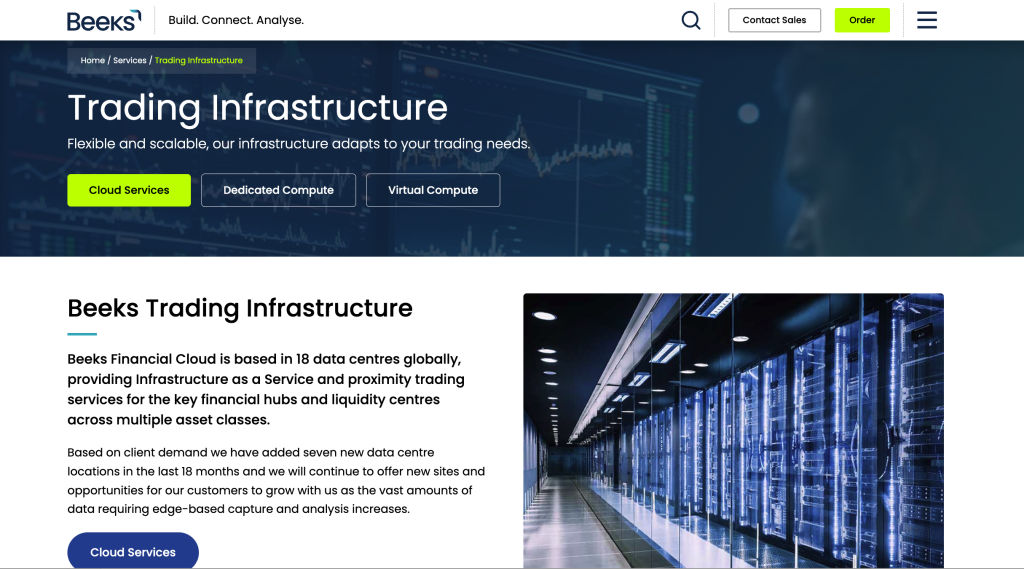
BeeksFX is the infrastructure that sits underneath much of the retail forex VPS market without most traders knowing it. Beeks Financial Cloud, the London Stock Exchange listed parent that trades under the ticker BKS, supplies the white-label VPS and connectivity that power the broker-branded VPS programs of FXCM, Pepperstone, Tickmill, and FxPro, which means a trader using one of those broker VPS offers is often already running on Beeks. Sold directly at retail, the catalogue plans give an individual trader access to that same backbone.
Infrastructure tier: Institutional execution infrastructure
Operator: Beeks Financial Cloud Group, incorporated in Scotland, London Stock Exchange listed (BKS)
The retail catalogue runs three main tiers on Windows Server, with cTrader and cAlgo explicitly supported alongside MetaTrader. Bronze provides a single virtual core, 2,560 megabytes of memory, and 30 gigabytes of storage at £31 per month or £310 annually; Silver moves to two cores and 4,096 megabytes at £55; Gold to four cores and 6,656 megabytes at roughly £97. The infrastructure is what justifies the brand: dedicated racks in Equinix London, New York, Chicago, Tokyo, Hong Kong, and Frankfurt, an Arista low-latency fiber backbone, sub-millisecond cross-connects to liquidity providers, and at the higher dedicated-server tiers, 10-gigabit SolarFlare network cards and the FPGA-based UberNic, which are genuine high-frequency-grade options absent from every retail specialist in this comparison. Beeks holds ISO 27001 and SOC 2 certification, which retail hosts generally do not. The trade-offs are real for a retail buyer. The entry Bronze specification is lean for the price, with a single core and 2.56 gigabytes barely clearing Windows Server overhead, and the cancellation window is a rigid 24 hours rather than the multi-day refunds common elsewhere. Retail reviews are sparse and mixed. The Forex Peace Army rating sits around 2.5 from only a handful of reviews, and the Trustpilot listing carries very few reviews, reflecting the gap between Beeks’ institutional focus and its smaller retail operation even as the institutional backbone remains among the strongest in the market.
Strengths: the only provider here with FPGA network card and dedicated low-latency cross-connect options, available at higher tiers; London Stock Exchange listed operator with ISO 27001 and SOC 2 certification; dedicated racks in six major Equinix facilities including Chicago for futures; the underlying white-label infrastructure for several major brokers’ own VPS programs; cTrader and cAlgo support documented alongside MetaTrader.
Limitations: entry Bronze tier is lean for the price, with one core and 2,560 megabytes of memory, so multi-EA or cTrader workloads need Silver or Gold; the 24-hour cancellation window is the most rigid in this comparison and leaves little room to validate execution; RAM is not publicly specified as ECC; retail reviews are sparse and mixed, with a low Forex Peace Army rating from few reviews reflecting value complaints from individual buyers; the genuine high-frequency hardware lives at dedicated-server pricing well above the catalogue VPS tiers, so the retail plans deliver the network but not the FPGA hardware.
Single-Core Performance Leader: TradingFXVPS
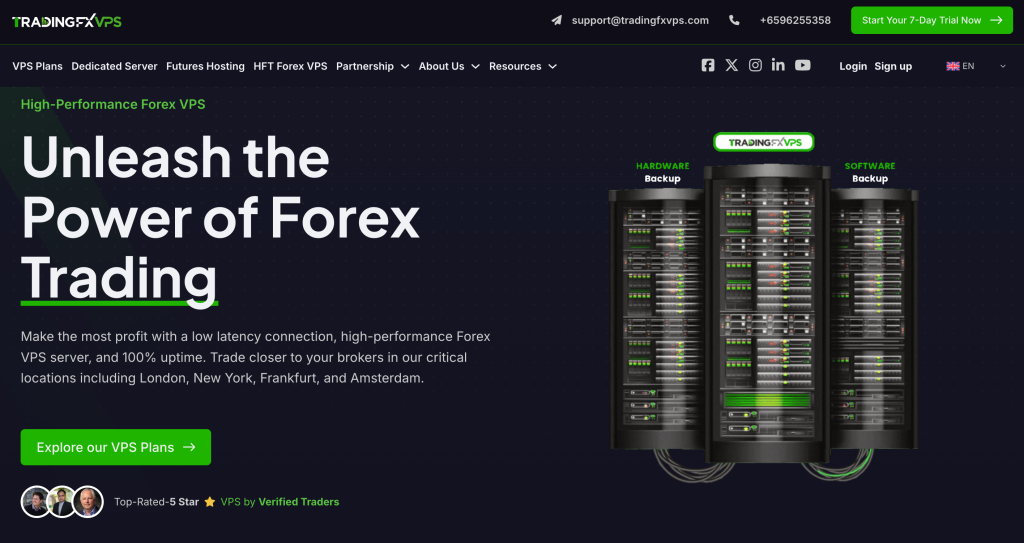
TradingFXVPS competes on the one number that matters most for single-threaded MetaTrader 4 execution, and it is the only provider here that names the processor behind the claim. Operated from Singapore and active since 2014, it positions itself around colocation in financial data centers and around helping traders match a server location to a broker, and it is the only retail specialist in this comparison with a documented presence in the Chicago Aurora facility that anchors CME futures.
Infrastructure tier: Trading-focused retail specialist
Operator: Next Era Pte Ltd / High Frequency Trading Network Pte Ltd, Singapore, founded 2014
The hardware claim is specific: AMD Ryzen 9 9950X processors, a 16-core part with a 4.3 gigahertz base and 5.7 gigahertz boost, whose PassMark single-thread score of 4,729 ranks among the highest of any processor and well above typical server EPYC silicon on single-thread work. That figure is the reason to consider TradingFXVPS for a single-core-bound scalping EA, with the caveat that the model number appears more often in the provider’s blog and comparison content than on individual plan spec sheets, so it should be read as vendor-stated. Plans run from a Standard tier at $25 monthly or $17.50 annually, providing one core, 2 gigabytes of DDR5 memory, and 30 gigabytes of NVMe, up through Standard-plus, Advanced, and Expert tiers that add cores and memory, with dedicated futures and high-frequency plans above those. The network is marketed with SolarFlare 10-gigabit cards and NVMe in RAID 1 across eight locations including New York, London, Frankfurt, Amsterdam, Chicago Aurora, Singapore, Tokyo, and Hong Kong. Validation is straightforward through a $3.99 seven-day trial and a 30-day refund, though that refund window excludes discounted and promotional plans, so taking the annual rate voids it. The Standard tier’s single core and 2 gigabytes are tight for a multi-terminal MetaTrader 5 setup under load, and the provider’s published cross-connect latency figures, such as 0.28 milliseconds to IC Markets, measure only the small network leg and are vendor-stated.
Strengths: the highest documented single-thread hardware in this comparison, the Ryzen 9 9950X at a PassMark single-thread score of 4,729, which is the metric that governs MetaTrader 4 execution; the only retail specialist here with a documented Chicago Aurora location for CME futures proximity; NVMe storage and SolarFlare 10-gigabit networking marketed across eight locations; a low-cost $3.99 seven-day paid trial plus a 30-day refund for validation; DDR5 memory and dedicated cores on the trading tiers.
Limitations: the Standard entry tier provides one core and 2 gigabytes of memory, tight for multi-terminal MetaTrader 5 or heavy cTrader use; memory is not documented as ECC; the 30-day refund excludes discounted and promotional plans, so the annual rate voids the safety net; the disclosed processor model appears mainly in marketing rather than on plan spec sheets and is vendor-stated; the broker latency checker the provider publishes covers MetaTrader 4 only and is not consistently current.
VPSForexTrader, Dedicated Cores and ECC RAM on Every Tier
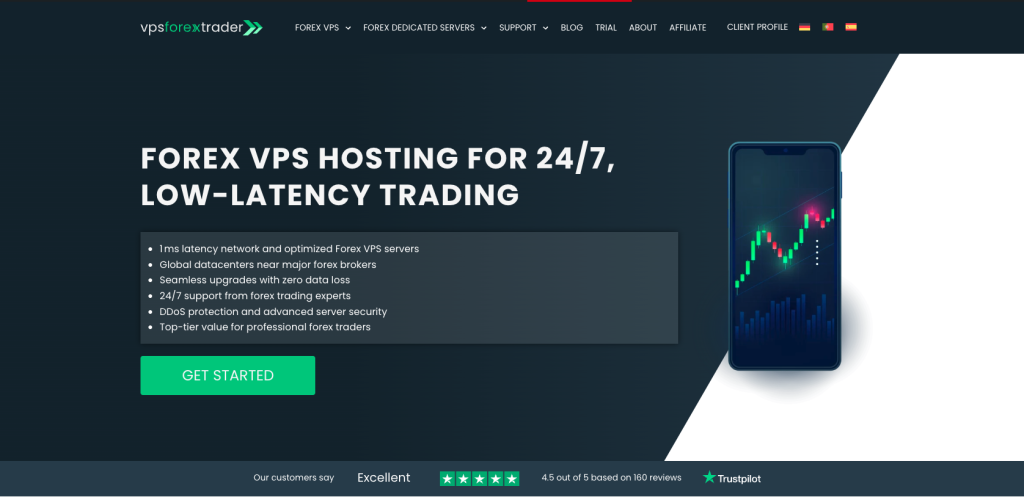
VPSForexTrader is the forex VPS specialist that documents dedicated AMD EPYC cores, ECC RAM, and NVMe storage on every plan tier rather than reserving any of the three for the top of its range. The Smart plan provides three dedicated EPYC cores, 4 gigabytes of ECC RAM, and 120 gigabytes of NVMe storage on Windows Server Standard at $25.59 per month on annual billing or $31.99 monthly; Boost moves to six cores, 6 gigabytes of ECC, and 180 gigabytes of NVMe; Max to eight cores, 8 gigabytes of ECC, and 250 gigabytes of NVMe. Among the providers evaluated here, it is the only one that pairs dedicated cores, error-correcting memory, and NVMe storage together at the entry tier, which is the combination that holds tick-processing timing steady when several EAs run at once, since ECC prevents the bit-level memory errors that cause micro-stalls and NVMe absorbs the log and history writes that bog down SATA storage during volatility. For a trader running two to four MetaTrader 4 or 5 terminals against a broker hosted in Equinix NY2 or LD3, the Smart and Boost tiers cover that workload, and the $0.99 three-day trial allows the round-trip to the live broker to be measured before any commitment.
Infrastructure tier: Trading-focused retail specialist
Operator: HOSTLINE UAB, Lithuania, operating since 2011
The footprint is four locations: Equinix NY2 and LD3 at the two busiest forex hubs, Amsterdam Serverius, and HK4, with Vilnius available on dedicated servers. The published per-tier terminal guidance, up to four terminals on Smart, seven on Boost, and ten on Max, maps plan selection directly to portfolio size because the cores are dedicated rather than shared. MetaTrader 4 and 5 are the optimized platforms, with cTrader and NinjaTrader also compatible in the Windows environment, and platforms are installed manually over a remote desktop session rather than pre-imaged. The honest limitations are geographic and disclosed: four locations is far narrower than ForexVPS.net’s 22, the specific EPYC model and memory generation are not published so the single-thread clock cannot be independently verified against a part like the Ryzen 9 9950X, there is no Linux option for native Python bot stacks, and no service-level percentage appears on the official site, though third-party aggregators cite 99.99 percent. The trial price is stated as $31.99 post-trial on the plan cards and $29.99 in the trial-page FAQ, a discrepancy worth confirming at checkout, and the Trustpilot TrustScore stands at 4.2 from 164 reviews as of June 2026, lower than several competitors because most of the reviews predate 2025 and Trustpilot’s score is time-weighted, even though the underlying distribution is 93 percent five-star.
Strengths: the only provider here documenting dedicated cores, ECC RAM, and NVMe storage together on every tier, the combination that stabilizes multi-EA timing; documented Equinix NY2 and LD3 presence at the two busiest forex hubs; per-tier terminal guidance, four on Smart through ten on Max, that maps plan to portfolio size on dedicated cores; a $0.99 three-day paid trial that allows live execution measurement before commitment; MetaTrader 4 and 5 optimized, with cTrader and NinjaTrader also compatible, on Windows Server Standard.
Limitations: four locations is the narrowest network among the trading specialists here, well short of ForexVPS.net’s 22; the specific EPYC model and memory generation are undisclosed, so single-thread performance cannot be verified against named parts; no Linux option, which rules out native Python or custom bot stacks; no published service-level percentage on the official site; the post-trial price differs between the plan cards and the trial FAQ; the Trustpilot TrustScore of 4.2 trails competitors, a function of low recent review volume against an older five-star base.
Broadest Broker Network: ForexVPS.net

ForexVPS.net is the network and reputation leader of the retail field, the provider to reach for when a broker is hosted somewhere the trading specialists do not commonly cover. Operated by ThinkHuge Ltd from Hong Kong since 2013, it has built the largest verified review base in the segment and the widest geographic footprint, and it supports the broadest platform list here, spanning MetaTrader 4 and 5, cTrader, NinjaTrader, and TradingView.
Infrastructure tier: Trading-focused retail specialist
Operator: ThinkHuge Ltd, Hong Kong, founded 2013
The Core plan runs at $40 monthly or $32 on annual billing, providing two cores, 4 gigabytes of memory, and 100 gigabytes of storage, with Edge and Prime tiers adding cores and memory above it. The defining asset is reach: 22 data centers including Equinix NY4, LD4, and TY3 plus Hong Kong, Singapore, Sydney, Amsterdam, Frankfurt, and Zurich, which is the broadest in this comparison and the reason a trader whose broker sits outside the usual New York and London hubs starts here. A Resource Spike Protection feature auto-allocates additional CPU and memory during volatility events at no extra cost, which directly addresses the tick-storm degradation that undersized plans suffer during news. Validation is by a 14-day money-back guarantee rather than a paid trial, and free VPS access is available through partner brokers such as Admirals and IC Markets at volume thresholds. The trade-offs against the execution lens of this guide are specific: storage type is not documented as NVMe, unlike the providers here that specify it, memory is not specified as ECC, the processor is server-class but undisclosed so single-thread clock cannot be confirmed, and because ForexVPS.net and FXVM share the same parent and infrastructure, the two cannot serve as independent redundancy for each other, a point the common-mistakes section returns to.
Strengths: the broadest network in this comparison at 22 data centers including Equinix NY4, LD4, and TY3, the reason to choose it when a broker sits outside the common hubs; the largest verified review base in the field, a Trustpilot TrustScore of 4.9 from over 6,400 reviews; the widest platform support here, covering MetaTrader 4 and 5, cTrader, NinjaTrader, and TradingView; a Resource Spike Protection feature that auto-allocates resources during volatility; free VPS access available through partner brokers at volume thresholds.
Limitations: storage type is not documented as NVMe, unlike VPSForexTrader and TradingFXVPS which specify it, which matters for sustained tick and history writes; memory is not specified as ECC; the processor is undisclosed server-class silicon, so single-thread performance cannot be verified; no paid trial, only a 14-day refund, so live validation requires a purchase first; sharing a parent and infrastructure with FXVM means the two brands provide no genuine redundancy against a shared outage.
Budget Single-Platform Hosting: FXVM

FXVM is the budget entry point from the same parent as ForexVPS.net, aimed at traders running one or two light bots who want a low monthly cost and a cheap way to test. Operated by ThinkHuge Ltd from Hong Kong since 2013, it carries a strong retail reputation and a wide location list, and it is best understood as the price-led sibling to ForexVPS.net rather than an independent alternative to it.
Infrastructure tier: Budget retail specialist
Operator: ThinkHuge Ltd, Hong Kong, founded 2013 (same parent as ForexVPS.net)
The lineup runs from a Virtual Desktop tier at $15 monthly, or $12.75 with the standing FXVM4LIFE discount code, providing two cores, 3 gigabytes of memory, and 10 gigabytes of storage on a terminal limited to a single platform, up through Lite, Basic, and Advanced VPS tiers on full Windows. The Lite VPS at $25 monthly provides two cores but only 1.5 gigabytes of memory, which is below the practical floor for a multi-EA setup once Windows Server overhead is accounted for, so a bot trader running more than one EA should size to Basic or Advanced. The location list is wide on the Lite tier and above, 15 to 16 data centers including New York, Chicago, London, Amsterdam, Frankfurt, Singapore, Tokyo, and Sydney, while the Virtual Desktop is limited to four. Platform support spans MetaTrader 4 and 5, cTrader, NinjaTrader, and TradingView, though the Virtual Desktop tier runs a single platform and does not support DLL-dependent EAs. A $0.99 seven-day trial and a 7-day refund cover validation. The central caveat is structural and shared with ForexVPS.net: a fiber-related outage on August 11, 2025 took both brands’ New York servers offline simultaneously for roughly 24 hours during active trading hours, which is the clearest possible demonstration that the two cannot back each other up.
Strengths: the lowest entry pricing among the trading specialists here, a Virtual Desktop tier at $12.75 monthly with the standing discount code, providing 3 gigabytes of memory; a wide location list on Lite and above, 15 to 16 data centers including New York, Chicago, and London; broad platform support across MetaTrader 4 and 5, cTrader, NinjaTrader, and TradingView; a $0.99 seven-day paid trial for cheap validation; a strong retail Trustpilot TrustScore of 4.8 from around 3,800 reviews.
Limitations: the Lite VPS provides only 1.5 gigabytes of memory, below the practical multi-EA floor after Windows overhead, so bot traders need Basic or Advanced; the Virtual Desktop tier is limited to one platform and does not support DLL-dependent EAs; the processor model and ECC status are undisclosed; the 7-day refund is the shortest among the specialists here; sharing a parent and infrastructure with ForexVPS.net means the two provide no independent redundancy, as the simultaneous August 2025 outage demonstrated.
General-Purpose Cloud Contrast: Vultr High Frequency
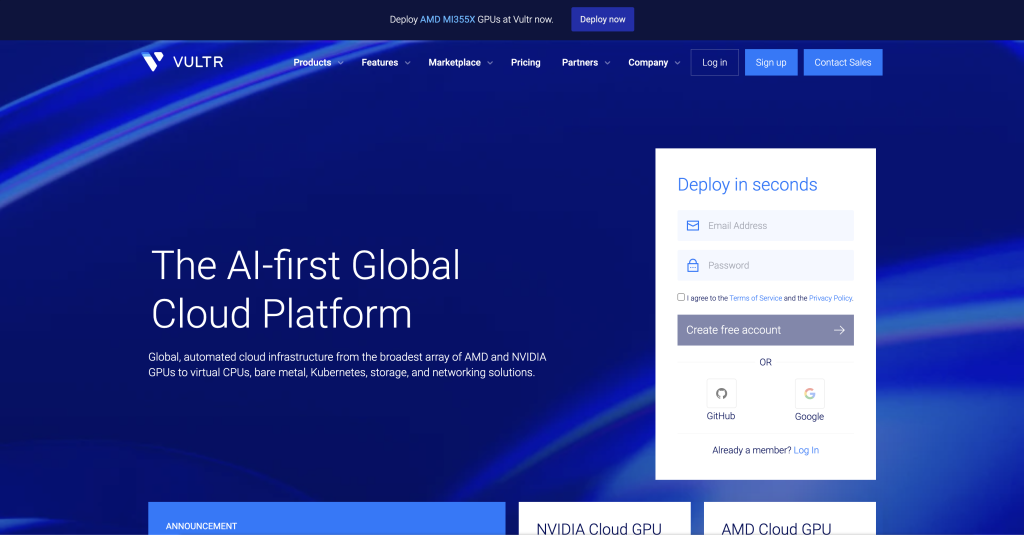
Vultr is included as the contrast that proves the rule, the general-purpose cloud option for a trader whose bot is a real application in Python, C-sharp, or another language and who is prepared to manage the server themselves. Active since 2014 and US-headquartered, Vultr is a capable cloud host, but it is not a trading specialist, and the difference matters more for execution than its high clock speed suggests.
Infrastructure tier: General-purpose cloud, do-it-yourself
Operator: Vultr (The Constant Company), United States, founded 2014
The High Frequency tier runs 3 gigahertz-plus Intel processors with NVMe storage from $6 monthly at the 1-gigabyte entry, and the High Performance line adds AMD EPYC and Intel Xeon options, also on NVMe; both run shared virtual cores, with Windows and Linux available across 32 data centers in 19 countries. The disqualifying issues for a trading bot are not about raw speed but about everything around it. The High Frequency and High Performance tiers run shared virtual cores, and Vultr’s acceptable use policy reserves the right to limit the CPU available to an instance that draws sustained load, which is exactly the profile of a live bot; reaching genuinely dedicated cores means stepping up to the Optimized Cloud Compute tier from $28 monthly or the newer VX1 dedicated-EPYC tier from roughly $44. There is no trading-specific trial, no pre-installed MetaTrader or cTrader, and no finance-hub colocation guarantee, so matching a broker’s Equinix facility and isolating cores is the trader’s own responsibility. Windows licensing adds roughly $16 monthly at the entry tiers, and a stopped instance keeps billing. Its general Trustpilot rating is poor, though the technically self-selected audience on G2 rates it markedly higher, around 4.3, a split that captures exactly who Vultr suits: builders, not buyers.
Strengths: genuinely high clock speed, 3 gigahertz-plus, with NVMe storage from $6 monthly on the High Performance line; both Windows and Linux available, the only option here that natively supports Linux Python and custom bot stacks; 32 data centers across 19 countries; dedicated cores reachable on the Optimized Cloud Compute and VX1 tiers for traders who need them; full root or administrator control for custom execution engines.
Limitations: the High Frequency and High Performance tiers run shared virtual cores, and the acceptable use policy permits CPU throttling under sustained load, the exact profile of a trading bot; no trading-specific trial, no pre-installed platforms, and no finance-hub colocation guarantee, so colocation and core isolation are the trader’s responsibility; Windows licensing adds roughly $16 monthly at entry tiers and stopped instances keep billing; reaching dedicated cores requires the higher Optimized or VX1 tiers; the poor general Trustpilot rating reflects a host built for technical self-service rather than for trading support.
Common mistakes that cost algorithmic traders execution quality
Buying many weak cores instead of a few fast dedicated ones is the most expensive mistake on a single-threaded platform. A MetaTrader 4 EA serializes through one trade context, so a plan advertising six shared cores at a modest clock executes worse than a plan with three dedicated cores at a high clock. Read the single-thread figure, not the core count, for MetaTrader 4 and single-strategy work, and treat a provider that will not disclose its processor with appropriate caution, since an undisclosed server EPYC part is unlikely to match a named consumer chip like the Ryzen 9 9950X on single-thread.
Trusting a sub-1ms latency claim without measuring it is the second. Every provider markets some variant of ultra-low latency, and every such figure describes only the small network leg while the broker-side processing that dominates total execution, 30 milliseconds at Pepperstone, 100 to 150 at Tickmill per its regulatory filings, is identical regardless of which VPS is bought. The only honest validation is a live ping from the server to the broker’s own server hostname during a trial, including one volatile session.
Ignoring broker colocation, and buying a fast server in the wrong city, is the third. A high-clock VPS in Frankfurt routing to an IC Markets matching engine in Equinix NY4 pays a physical-distance penalty no processor compensates for, while a modest VPS in NY4 reaches it across a cross-connect. Identify the broker’s facility first, then choose hardware, never the reverse.
Stacking several EAs into one MetaTrader 4 terminal, then meeting error 146, “trade context busy,” during a tick burst, is the fourth. The fix is structural, not hardware: run each EA in its own terminal so each has its own trade context, which is why the per-terminal guidance VPSForexTrader publishes, and the core headroom on Boost and Max, map to real multi-EA capacity.
Testing only at idle, never under sustained load, is the fifth, and it matters because sustained load is precisely when burstable cores get throttled. A plan that runs cleanly for a quiet trial hour can be capped by the host the first time the bot pushes sustained CPU, the behavior Vultr’s acceptable use policy describes for its shared tiers. Validate by running a sustained processor benchmark several times across the trial and confirming the result holds rather than degrading.
Treating two brands from the same parent as redundancy is the sixth and last. Running ForexVPS.net in NY4 alongside FXVM in NY4 looks like a backup plan, but both are ThinkHuge infrastructure, and the August 11, 2025 fiber outage took both offline simultaneously for roughly 24 hours. Genuine redundancy requires two providers under different parent infrastructure, such as VPSForexTrader paired with ForexVPS.net, or either paired with BeeksFX.
Use case routing
For a single-core-bound MetaTrader 4 scalping or news EA, the priority is the highest dedicated single-thread clock, which points to TradingFXVPS and its Ryzen 9 9950X at a PassMark single-thread score of 4,729, with the Standard tier at $17.50 annually as the entry and a step up in tier for more memory; the alternative for a trader who values error-correcting memory and weeks-long stability is VPSForexTrader Smart or Boost, whose ECC RAM and dedicated EPYC cores hold timing steady across long uptimes, particularly when the broker sits in Equinix NY2 or LD3. In both cases the EAs should be split across terminals to avoid the single trade context colliding.
For a multi-terminal MetaTrader 5 portfolio or heavy Strategy Tester optimization, the priority shifts to core count and memory, which favors VPSForexTrader Boost or Max at six to eight dedicated EPYC cores with 6 to 8 gigabytes of ECC, or ForexVPS.net’s Edge and Prime tiers where the broader location network also matters; each optimization agent wants a physical core and roughly 2 gigabytes, so the higher core counts pay for themselves on long backtests. A cTrader or cAlgo bot, by contrast, is memory-led and London-led: any London-located plan with at least 4 gigabytes and two cores serves it, whether VPSForexTrader in LD3, ForexVPS.net in LD4, or BeeksFX in London, because Spotware’s matching engine sits in Equinix LD5 and a London server is the closest a retail VPS reaches.
For an automated NinjaTrader 8 strategy or CME futures bot, processor clock and at least 4 gigabytes of memory matter most, and proximity to the Chicago Aurora campus favors TradingFXVPS in Chicago Aurora or BeeksFX in Chicago. A trader who wants institutional-grade execution and is prepared to pay for it goes to BeeksFX directly, accepting the lean retail specs and the 24-hour cancellation window in exchange for the FPGA-capable backbone that powers several brokers’ own VPS programs. And a trader whose bot is native Python or a custom execution engine, who will manage colocation and core isolation personally, takes Vultr, but only its Optimized Cloud Compute or VX1 dedicated tiers rather than the shared High Frequency tier, since a live bot under sustained load is exactly the workload the shared tiers throttle.
Three findings from this comparison
The first finding is that the network latency every provider advertises is the smallest controllable part of execution, 2 to 5 percent of the round-trip, while broker-side processing that no VPS changes, from 30 milliseconds at Pepperstone to over 100 at some brokers, dominates. This reframes the entire category: the VPS decision is not about shaving microseconds off a network hop but about being in the right Equinix facility on dedicated cores, and a buyer who internalizes that will ignore most of the latency marketing and choose on colocation and core isolation instead.
A second finding is that single-thread performance, not core count, governs execution for the platforms most retail bots run, and disclosure of it is uneven. TradingFXVPS is the only provider here that names its processor, the Ryzen 9 9950X at a PassMark single-thread score of 4,729, while VPSForexTrader is the only one that documents dedicated cores, ECC RAM, and NVMe storage together on every tier, the combination that stabilizes timing under load. ForexVPS.net leads on network breadth at 22 locations and on review base at a 4.9 TrustScore from over 6,400 reviews, and BeeksFX leads on institutional hardware with FPGA options, but none of those advantages is the single-thread number, which a MetaTrader 4 trader must read separately.
A third finding concerns shared infrastructure, which hides where redundancy appears to exist. ForexVPS.net and FXVM are both ThinkHuge brands on shared infrastructure, and the August 11, 2025 outage took both offline at once, so a trader who split a strategy across the two for safety had no safety at all. Genuine redundancy in this field means two providers under different parents, and the cleanest decision a bot trader can make is to choose a primary on execution fit and, if redundancy matters, a secondary under entirely separate infrastructure rather than a sibling brand. The right starting point is not a provider but the broker’s server location and the platform the bot runs, which together determine everything above.
Frequently asked questions
What is the best VPS for running MetaTrader 4 Expert Advisors?
The execution-relevant answer is a VPS with the highest dedicated single-thread clock in the same Equinix facility as the broker, because MetaTrader 4 processes all automated trading through one trade context and is therefore bound by single-core speed rather than core count. Among the providers compared, TradingFXVPS documents the highest single-thread hardware, the AMD Ryzen 9 9950X at a PassMark single-thread score of 4,729, while VPSForexTrader pairs dedicated EPYC cores with ECC RAM and NVMe on every tier for stability across long uptimes. The deciding factor between them is usually which one colocates with the specific broker and whether error-correcting memory matters for the strategy.
Does VPS location or VPS hardware matter more for algorithmic trading?
Location matters more, by a wide margin, because the network leg between a colocated VPS and the broker is only 2 to 5 percent of total execution time while broker-side processing dominates, and a fast server in the wrong city pays a physical-distance penalty no hardware compensates for. A modest VPS in Equinix NY4 reaching an NY4-hosted broker across a cross-connect outperforms a powerful VPS in another region every time. Identify the broker’s matching-engine facility first by reading the server hostname under Tools, Options, Server, then choose hardware within that location.
How many CPU cores do I need for a trading bot?
It depends entirely on the platform. A single MetaTrader 4 EA needs one fast dedicated core, since the platform serializes order operations through one trade context, and additional EAs are best run in separate terminals rather than added cores. MetaTrader 5 optimization and multi-instrument NinjaTrader genuinely use multiple cores, so a heavy Strategy Tester job benefits from six or eight, with each optimization agent wanting a physical core and roughly 2 gigabytes of memory, while cTrader is memory-led and runs comfortably on two cores with at least 4 gigabytes.
Can I run Python or custom bots on a forex VPS?
Native Python and custom execution engines run most cleanly on Linux, which the trading specialists in this comparison generally do not offer, since they are Windows-first for MetaTrader and cTrader; VPSForexTrader, for example, is Windows Server only. The general-purpose option for custom code is Vultr, which offers both Windows and Linux, but only its Optimized Cloud Compute or VX1 dedicated-core tiers are suitable for a live bot under sustained load, because the shared High Frequency tier can be throttled. A trader running both MetaTrader EAs and Python bots typically runs two separate servers, a Windows trading VPS and a Linux instance.
How do I measure my VPS latency to my broker?
Use the platform’s own readout and a direct network ping rather than a generic speed test. In MetaTrader 5, the ping to the trade server appears in the connection status, and in MetaTrader 4 the bottom-right connection indicator shows round-trip time to the server. For a network-level figure, run a command-line ping to the broker’s server hostname, which is visible inside the platform under Tools, Options, Server. Measure across several sessions including at least one high-volatility window such as the London open or a scheduled news release, because the meaningful number is the worst-case round-trip under load, not the best case in a quiet hour.
Is a sub-1ms latency claim real?
It is real only in a narrow sense and misleading as a buying signal. A sub-millisecond figure describes the network round-trip between a VPS and a broker when both sit in the same Equinix facility connected by a cross-connect, which is achievable, but it is only the small network leg of execution. The broker-side processing that dominates total execution time, documented in the 30-millisecond range at Pepperstone and the 100 to 150 millisecond range at Tickmill per its regulatory filings, is unaffected by which VPS is purchased, so two providers advertising different sub-millisecond figures will deliver effectively identical real-world execution if both colocate with the broker. Treat the claim as a colocation indicator, not a speed ranking, and verify it with a live measurement.
References
- MetaQuotes Software. MetaTrader 4 Release Notes (metatrader4.com). Verified June 2026. Source for MT4 build 1470, released March 12, 2026, and the minimum supported build 1440.
- MetaQuotes Software. MetaTrader 5 Release Notes (metatrader5.com). Verified June 2026. Source for MT5 build 5830, released April 24, 2026.
- MQL5 community documentation and MetaTrader trade-context behavior, including error 146, “trade context busy,” and the single trade context in MetaTrader 4 (mql5.com). Verified June 2026. Source for the single-core serialization constraint and the multiple trade contexts in MetaTrader 5.
- Amazon Web Services. “Optimize tick-to-trade latency for digital assets exchanges and trading platforms on AWS: Part 2” (aws.amazon.com/blogs). Verified June 2026. Source for the dedicated bare-metal tail-latency advantage of 3.3 to 10.9 microseconds, a 15 to 29 percent improvement at the 99.9th percentile, attributed to removing hypervisor jitter and noisy-neighbor interference.
- PassMark Software. CPU Benchmarks single-thread chart (cpubenchmark.net). Verified June 2026. Source for the AMD Ryzen 9 9950X single-thread score of 4,729.
- Spotware Systems. cTrader infrastructure and cServer documentation (spotware.com / ctrader.com). Verified June 2026. Source for the central cServer matching engine in Equinix LD5 London as primary with a New York secondary, and the cAlgo and cTrader Automate execution model.
- Vultr (The Constant Company). Acceptable Use Policy and High Frequency Compute product pages (vultr.com). Verified June 2026. Source for the reserved right to limit CPU on instances under sustained load, the shared-core High Frequency tier, and the dedicated Optimized Cloud Compute and VX1 tiers.
- Tickmill regulatory best-execution disclosures under the European RTS 28 framework, and broker server-location documentation from IC Markets and Pepperstone (icmarkets.com, pepperstone.com, tickmill.com). Verified June 2026. Source for broker-side execution speeds and Equinix matching-engine locations.
- Beeks Financial Cloud Group. Catalogue VPS product pages and London Stock Exchange company information under ticker BKS (beeksgroup.com). Verified June 2026. Source for the white-label relationships, Equinix racks, FPGA UberNic and SolarFlare options, ISO 27001 and SOC 2 certification, and catalogue pricing.
- Provider pricing and product pages, verified June 2026: VPSForexTrader (vpsforextrader.com), TradingFXVPS (tradingfxvps.com), ForexVPS.net (forexvps.net), FXVM (fxvm.net). Source for plan specifications, pricing, trial and refund terms, locations, and platform support.
- ThinkHuge Ltd status and incident records for the August 11, 2025 fiber-related outage affecting ForexVPS.net and FXVM New York servers. Verified June 2026. Source for the shared-infrastructure redundancy finding.
- Trustpilot listings read directly on trustpilot.com, verified June 2026: VPSForexTrader (TrustScore 4.2 from 164 reviews), ForexVPS.net (4.9 from over 6,400), FXVM (4.8 from approximately 3,800), TradingFXVPS (4.7 from 365), BeeksFX (sparse Trustpilot reviews and a low Forex Peace Army rating), and Vultr (poor general rating). TrustScores are time-weighted and vary across regional Trustpilot domains and cached third-party widgets.
Editorial note
This comparison is published by VPSForexTrader, one of the six providers evaluated, operated by HOSTLINE UAB in Lithuania, which creates an inherent conflict of interest. To address it, the providers are grouped by infrastructure tier with a documented ordering rationale, and the publisher is placed at position three overall rather than at the top. Competitors are credited where they lead: TradingFXVPS documents stronger single-thread hardware, the Ryzen 9 9950X at a PassMark single-thread score of 4,729, than VPSForexTrader publishes for its undisclosed EPYC parts; ForexVPS.net offers a far broader network at 22 locations and a higher Trustpilot TrustScore of 4.9 from over 6,400 reviews; BeeksFX provides institutional FPGA and dedicated cross-connect hardware that VPSForexTrader does not; FXVM undercuts it on entry price; and Vultr offers Linux and custom-stack flexibility that the Windows-only publisher cannot. In the publisher’s own section, the limitations stated outnumber the strengths, including its four-location network, undisclosed processor model, absence of a Linux option, and a Trustpilot TrustScore of 4.2 that trails its peers.
Pricing, specifications, trial terms, and platform support were verified against each provider’s own pages in June 2026, and all vendor latency and uptime figures cited anywhere here are commercially motivated and have not been independently replicated. This article covers VPS infrastructure for algorithmic trading and does not constitute financial, trading, or procurement advice; the performance of any bot depends on its own logic, the broker’s execution, and market conditions, none of which a VPS controls. Prices and Trustpilot scores change frequently; confirm all figures at the source before purchasing.
Written by: Nedas Miliunas
Reviewed by: VPS performance reviewer
Detailed review of VPS providers for MT4, MT5, and algorithmic trading bots. Learn what actually matters for latency, stability, and execution.