Scalping breaks the moment latency spikes or your terminal disconnects. You’re not looking for a “powerful” VPS, you’re looking for the shortest, most stable path between your trading platform and your broker’s servers, ideally inside the same data center.
This list focuses on VPS providers that actually make sense for scalping in 2026. These are services where execution stability, location accuracy, and uptime discipline matter more than marketing specs. Instead of a generic “best VPS,” this guide ranks providers by what actually impacts scalping execution: proximity to broker servers, latency stability, and uptime discipline. If you want the shortest path to stable execution, start with the comparison table, then use the evaluation notes to choose the provider and location that match your broker.
How this list was evaluated (2026)
This ranking is based on scalping-relevant infrastructure factors, not generic “hosting specs.” We prioritized:
- Broker proximity options (NY4/LD4 and other liquidity hubs)
- Latency consistency (stability/jitter matters more than best-case ping)
- Uptime behavior (maintenance practices, forced reboots, account holds)
- Single-core stability for MT4/MT5 under load (no throttling surprises)
- Operator confidence (trial/refund, clear plan sizing, transparent limitations)
Where providers publish only generic infrastructure details, we treat claims as “capability” rather than guaranteed performance.
Quick comparison table
| Provider | Best use case | Primary server locations | NY4 / LD4 proximity | Typical latency (matched broker) | Uptime focus | Hardware type | MT4 / MT5 capacity (typical) | Starting price (USD) |
| VPSForexTrader | Best overall scalping VPS | US, UK, EU, Asia | Yes (location-dependent) | ~1–2 ms best-case | 99.99% (trading-focused) | NVMe + ECC RAM | 3–5 terminals (entry tier) | $31.99/mo (≈ $25.59/mo annual) |
| BeeksFX | Institutional-grade latency | NY, London, major hubs | Yes (Equinix) | <1 ms best-case | Finance-grade SLA | Enterprise SSD / NVMe | 2–4 terminals (entry) | ~$42/mo |
| Liquidity Connect | Low-latency specialist | NY, London, Asia | Yes | ~1–2 ms best-case | Trading SLA | SSD / NVMe | 3–4 terminals | $30/mo |
| ForexVPS.net | Broad global coverage | 20+ locations | Yes | ~1–3 ms best-case | 99.99% | SSD | 3–5 terminals | $35/mo (≈ $28 annual) |
| TradingFXVPS | Budget + hub proximity | NY, London, EU | Yes | ~1–2 ms best-case | Trading-focused | NVMe | 1–3 terminals | $17.50/mo |
| FXVM | Cheap entry testing | Multiple | Sometimes | Variable | Standard VPS | SSD | 1 terminal | $11.90/mo |
| Cloudzy | Lowest cost option | Multiple | No guarantee | Variable | Standard VPS | SSD / NVMe | 1–2 terminals | $7.96/mo |
Important note on latency numbers
Latency depends on where your broker’s trading server actually is and where you place your VPS. Numbers like “1–2 ms” are only realistic when your VPS is in the same city – or the same data center – as the broker’s server.
For scalping, you should validate:
- broker server location (city / DC where possible)
- VPS location choice
- stability over time (watch for spikes, not just a single ping result)
If you want a faster, safer way to validate placement, use a broker latency checker or run repeated pings at different times of day rather than relying on one-off tests.
1) VPSForexTrader – best overall for scalping
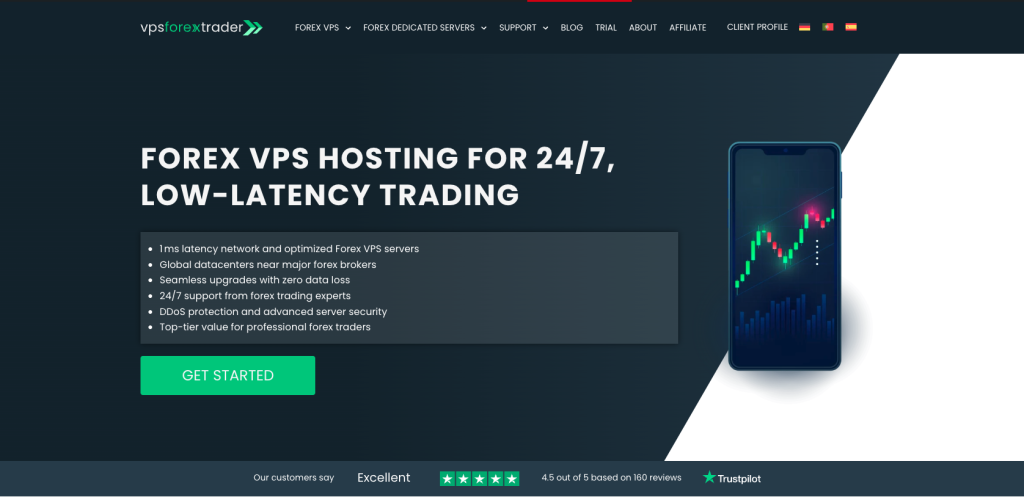
VPSForexTrader is built specifically for Forex trading, not generic cloud workloads. That distinction matters for scalping, where consistent latency, predictable CPU behavior, and stable uptime are more important than raw headline specs.
The entry-level Smart VPS plan provides 3 vCPU, 4GB ECC RAM, and 120GB NVMe storage, which is enough for most scalping setups running multiple MT4 or MT5 terminals simultaneously. The use of ECC memory and NVMe storage helps reduce random freezes and micro-stutters that can disrupt execution during high-frequency trading.
Location coverage includes the US, UK, EU, and Asia, allowing traders to place their VPS close to their broker’s actual trading servers instead of guessing. When matched correctly, latency in the 1–2 ms range is realistic, but only if the broker is nearby, which is exactly how it should be framed.
A key advantage for scalpers is risk control. The $0.99 / 3-day trial plus a money-back window makes it possible to test real execution quality, slippage behavior, and platform stability before committing long-term. That’s critical for scalping, where assumptions can be expensive.
Source: VPSForexTrader.com
Pros
- Trader-first plans designed around MT4/MT5 usage
- Strong balance of CPU consistency and fast NVMe storage
- Trial + refund makes real latency testing possible
- Clear plan sizing (no vague “unlimited” promises)
Cons
- Not the cheapest option on the list
- Best results still depend on choosing the correct location for your broker
Best for: Scalpers who want a reliable, low-friction VPS that “just works” once placed near the broker.
2) BeeksFX – institutional-grade Equinix infrastructure
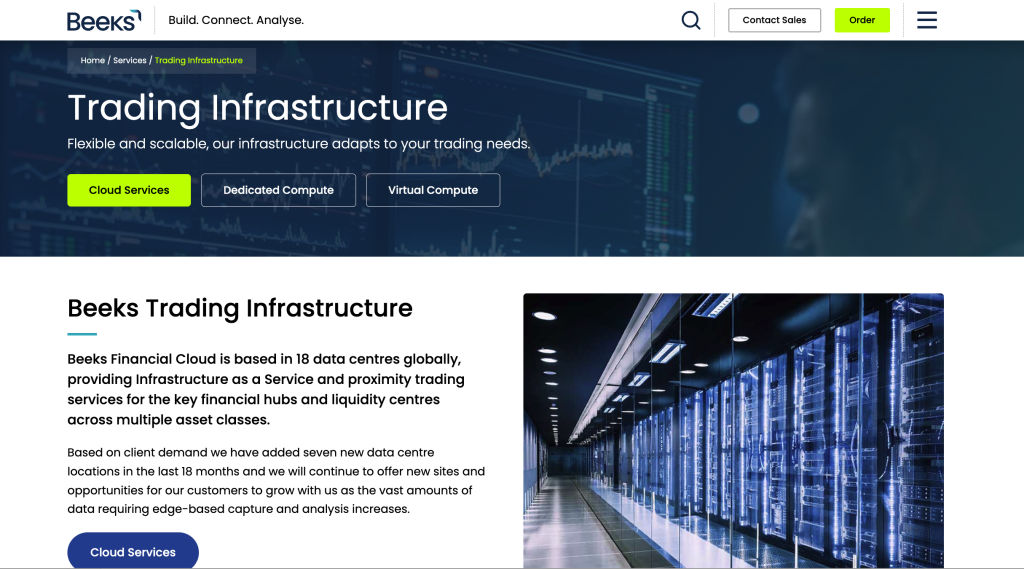
BeeksFX sits at the premium end of the Forex VPS market. Its infrastructure is deployed inside Equinix data centers such as NY4 and LD4, which are the same facilities used by many tier-one brokers and liquidity providers.
When your broker is hosted in the same facility, latency can be extremely low, making Beeks attractive for serious scalpers and execution-sensitive strategies. However, entry plans are relatively small for the price, and the cost reflects infrastructure quality rather than raw resources.
This is not a retail-optimized VPS, it’s infrastructure-grade hosting adapted for trading.
Source: Beeksgroup.com
Pros
- Equinix colocation in major financial hubs
- Extremely low latency when broker is colocated
- Enterprise-grade reliability and reputation
Cons
- Higher monthly cost
- Entry plans offer limited resources for the price
- Best value often comes via broker programs
Best for: Professional or high-volume scalpers who prioritize infrastructure quality over cost.
3) Liquidity Connect – low-latency specialist with Asia strength
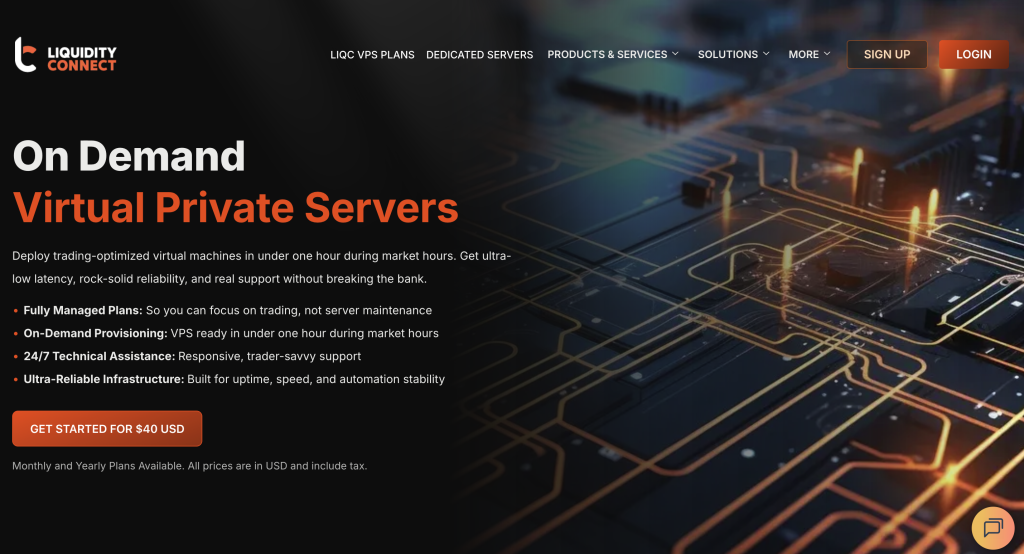
Liquidity Connect focuses heavily on low-latency trading infrastructure, with strong coverage in New York, London, and Asia. It is also used by brokers themselves to provide VPS access to clients, which is generally a good signal for execution reliability.
Both Windows and Linux options are available, which is uncommon in the Forex VPS space. Pricing is straightforward at around $30/month, positioning it between retail and institutional offerings.
Source: Liqc.com
Pros
- Designed specifically for low-latency trading
- Strong NY, London, and Asia connectivity
- Used by brokers as underlying VPS infrastructure
Cons
- Less consumer-friendly branding and onboarding
- Best experience often tied to broker partnerships
Best for: Scalpers trading across US, UK, and Asia sessions who care about infrastructure-level latency.
4) ForexVPS.net – best for global broker matching
ForexVPS.net’s main strength is location coverage. With more than 20 global locations, it’s often easier to match a VPS city to a broker’s server, especially when the broker is not in NY4 or LD4.
The Core plan offers sufficient resources for most scalping setups, though monthly pricing is higher unless you commit annually. It’s a mature, stable provider rather than a scalping-specialist.

Source: ForexVPS.net
Pros
- Very wide global location selection
- Well-known and established Forex VPS provider
- Solid baseline resources for MT4/MT5
Cons
- More expensive month-to-month
- Not as tightly optimized for scalping-specific use cases
Best for: Scalpers using brokers in less common locations or running multi-region setups.
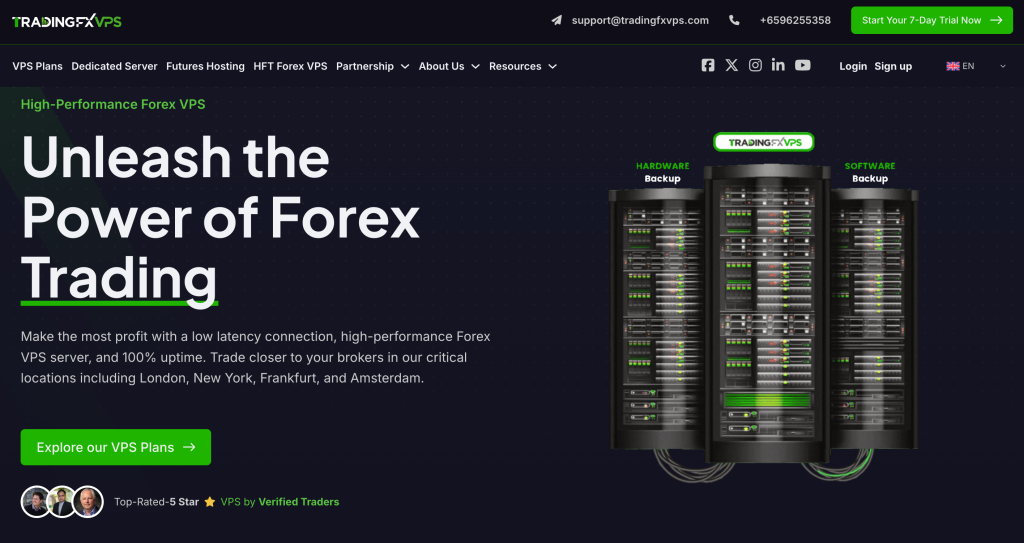
5) TradingFXVPS – value pick with major hub options
TradingFXVPS targets traders who want NY and London proximity at a lower price point. Entry plans are affordable and include NVMe storage, but resources are limited, so careful sizing is important.
A low-cost trial makes it possible to test execution quality before committing.
Source: TradingFXVPS.com
Pros
- Competitive pricing
- Access to major trading hubs
- Trial option for testing latency
Cons
- Lower tiers are resource-constrained
- Not ideal for multi-terminal or indicator-heavy setups
Best for: Budget-conscious scalpers who still want access to major data centers.
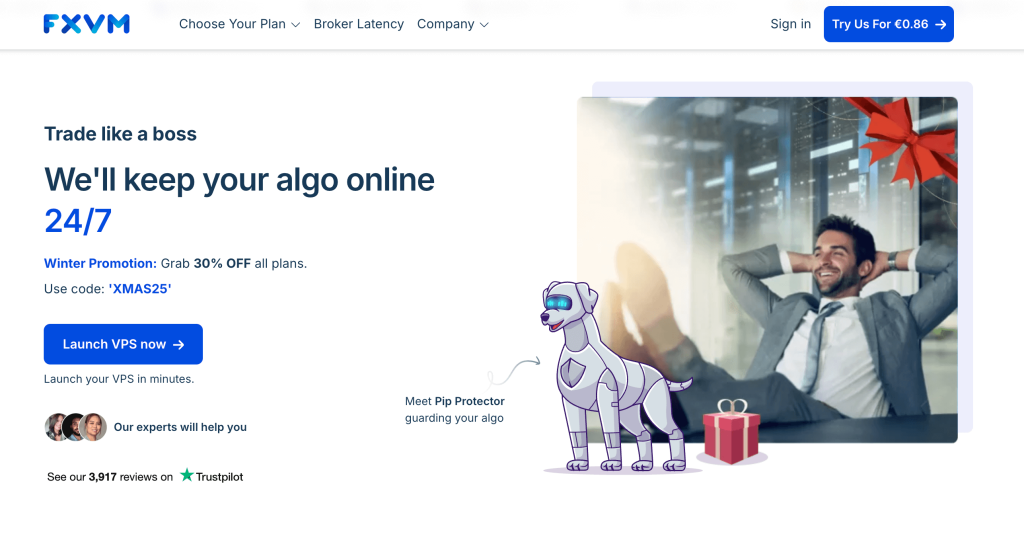
6) FXVM – cheap entry-level VPS
FXVM is often chosen for its low price and simplicity. However, it is not designed specifically for scalping, and resource limitations can become a bottleneck quickly.
Source: FXVM.net
Pros
- Low monthly cost
- Simple way to keep one terminal online
Cons
- Limited resources
- Latency optimization is not the focus
Best for: Testing or very light manual scalping, not latency-sensitive strategies.
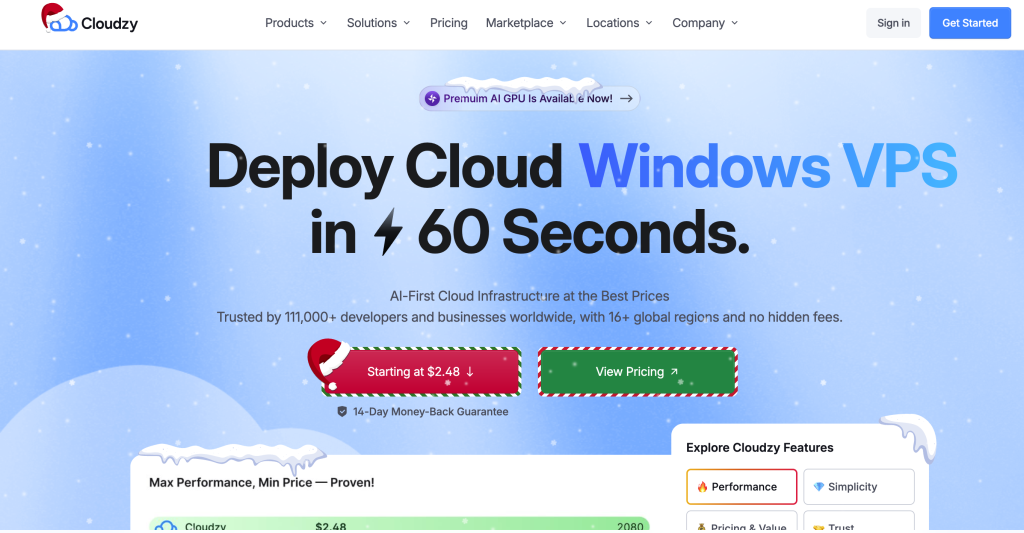
7) Cloudzy – lowest-cost option
Cloudzy is the cheapest option on the list and offers Forex-oriented VPS plans with MT4 support. However, it remains a general-purpose VPS provider, not a trading infrastructure specialist.
Pros
- Very low starting price
- Money-back guarantee
- Multiple plan sizes
Cons
- No strong broker colocation positioning
- Latency varies widely by location
Best for: Beginners or experimental setups where cost matters more than execution quality.
How to validate a scalping VPS in 15 minutes
Before committing long-term, test three things:
- Repeated ping tests (10–20 pings repeated a few times) – you’re watching for spikes, not the lowest number
- Platform stability – run your terminal + indicators and confirm CPU doesn’t peg and the UI doesn’t stutter
- Session behavior – repeat the ping once during a busier session (London open / NY open) to catch routing variability
A VPS that’s slightly slower but stable is usually better for scalping than one with occasional spikes.
What actually matters when choosing a VPS for scalping
Location beats everything
For scalping, physical proximity to your broker’s trading servers is the single most important factor. If your VPS is not in the same city or liquidity hub as the broker, faster CPUs or more RAM won’t compensate. Every extra network hop adds delay and variability. A modest VPS in the right location will consistently outperform a high-spec server across the ocean. This is why confirming where your broker is actually hosted matters more than choosing the “fastest” VPS on paper.
Stable latency > best-case latency
Scalping strategies are sensitive not just to latency, but to latency consistency. A VPS that occasionally spikes or jitters is more damaging than one that is slightly slower but stable. Chasing theoretical sub-millisecond numbers is pointless if execution fluctuates under load or during volatile sessions. What you want is predictable, repeatable execution timing, especially during news releases or high-volume market opens.
Single-core performance matters most
MT4 is heavily single-threaded, and MT5 still benefits strongly from high single-core performance for many trading workloads. Additional CPU cores help mainly when you run multiple terminals or parallel strategies. For most scalpers, one strong, stable core delivers better real-world performance than many weaker cores. Clock stability and CPU throttling behavior matter more than raw core count.
Uptime and no surprise reboots
Scalping leaves no room for downtime. A VPS reboot during an active session can miss exits, interrupt EA logic, or leave positions unmanaged. This is worse than running at slightly higher latency. Providers that schedule maintenance carefully, avoid forced restarts during market hours, and handle billing issues without suspensions are far better suited for scalping than generic VPS hosts.
The broker still controls execution
A VPS removes your local connection as a bottleneck, but it does not override broker-side execution logic. Slippage, spreads, order queues, and liquidity availability are still determined by the broker. A good VPS ensures your orders reach the broker as quickly and consistently as possible, but it cannot fix poor broker execution. Scalpers should treat VPS selection as one part of a larger execution chain, not a magic solution.
Bottom line
For most scalpers in 2026, VPSForexTrader remains the best overall choice: trader-focused plans, sensible pricing, and a real way to test latency before committing.
If you want institutional-grade infrastructure, BeeksFX or Liquidity Connect make sense.
If location flexibility is your priority, ForexVPS.net is hard to beat.