Best Forex VPS for Expert Advisors (EAs) (2026)
A Forex VPS costs anywhere from about $8 to about $60 a month for what looks, on a spec sheet, like a similar product: a Windows server in a data centre running a MetaTrader terminal. That price range matters because plans can differ in capacity, support, backups, operating-system support runway, network location, and published infrastructure controls. Problems can originate in the EA or terminal, Windows updates, broker connectivity, host contention, network incidents, or hardware faults. ECC memory can mitigate some memory errors, but this comparison does not establish how often DRAM errors affect MetaTrader orders or rank ECC above those other failure sources. The honest answer to “budget or premium” therefore depends on the workload, the cost of downtime, and which risks the plan demonstrably addresses.
This is not a ranking of best to worst. It is a decision framework: what a budget Forex VPS genuinely does well, where it stops being enough, what premium actually buys, and which category a given trader belongs in. It uses six real providers as worked examples across the price range, from AccuWeb at a $7.99 promotional entry rate to QuantVPS, whose 8 GB plan is $59.99 on monthly billing above its own $29.99 entry tier, and it is honest about the cases where the cheap plan is the correct choice, because for a large group of traders it is. Scope is infrastructure. Nothing here is trading advice, and no VPS makes a losing strategy profitable.
The short version
For most active traders, the plan that resolves the budget-versus-premium question best is VPSForexTrader Smart at $25.59 per month on annual billing. Within this framework, its case rests on a combination of provider-documented ECC memory, Windows Server 2025, published terminal ratings, NVMe storage, and included backups at a mid-market price. ECC is one reliability control, not a technical guarantee that unattended EAs require this plan or that memory faults are the main cause of MetaTrader failures.

But not every trader should buy it, and the framework is explicit about who should not. A trader running a single MetaTrader terminal manually, testing a strategy, or working on a genuinely tight budget can start with a budget plan such as AccuWeb at its $7.99 promotional entry rate or TradingFXVPS at a $17.50 annual-billing monthly equivalent, provided the exact workload is tested. A funded or institutional trader with formal compliance requirements may evaluate BeeksFX, but must verify the certificate’s validity, scope, covered service, and contractual commitments. A trader needing more memory than the plans here offer may consider QuantVPS, whose 8 GB plan is $59.99 on monthly billing above its own $29.99 entry tier. The right tier depends on the trading setup and the evidence available for each plan.
How this comparison was built
Forex VPS provider specifications, pricing, memory type, and operating-system versions were checked against provider pages, with the corrections in this edition rechecked on 28 August 2026. Promotional, month-to-month, and annual-billing monthly-equivalent prices are kept separate; the order page remains the final check where a provider publishes conflicting figures.
The framework sorts plans into three bands by price: budget (under $20 per month), mid-market ($20 to $45 per month), and premium (above $45 per month, or institutional pricing). The bands describe plans rather than providers, because several span more than one: TradingFXVPS and NYCServers both sit in the budget band on annual billing and the mid-market band at their $25 monthly rate, QuantVPS starts at $29.99 but charges $59.99 for its 8 GB plan, and BeeksFX prices in GBP with an institutional profile its entry specification alone would not suggest. On entry pricing alone, no provider here exceeds $45.
Within that structure the article evaluates each plan on memory type, capacity, storage, Windows support runway, network location, backups, monitoring, and support. ECC can be relevant to memory integrity, but it is one control among several and is not an unattended-runtime threshold. A newer Windows release offers a longer runway. Windows Server 2019 and 2022 remain in support to 9 January 2029 and 14 October 2031, but those are extended-support dates: Server 2019 has been in extended support since January 2024, and Server 2022 leaves mainstream support on 13 October 2026. Server 2025 runs to 13 November 2029 in mainstream support and 14 November 2034 in extended support. The organising question is which combination fits the workload, not which provider wins on one specification.
Latency, uptime, and throughput figures quoted anywhere here are published by the providers themselves and are not independently replicated.
What a budget Forex VPS actually does well
A budget Forex VPS, roughly $8 to $18 a month, is not automatically a compromised product. It can provide an always-on data-centre environment so a MetaTrader VPS terminal is not dependent on the trader’s home computer or connection. Whether an entry plan is adequate for one chart, one EA, or a manual strategy depends on the Windows image, terminal build, symbols, history, indicators, and MQL programs in use. The plans in this comparison were not benchmarked, so AccuWeb’s $7.99 promotional entry rate should be treated as a low-cost candidate to test, not as a universally proven single-terminal baseline.
A budget plan can also be a sensible place to test or learn. A trader evaluating a new EA, using a demo account, or learning to operate a VPS may place greater weight on cost and support than on ECC or the newest Windows release. AccuWeb advertises a $7.99 promotional entry rate, while TradingFXVPS lists $17.50 per month equivalent on annual billing and publishes an AMD Ryzen 9 processor family and 4.3 GHz clock rate. Neither provider was performance-tested for this article, so buyers should validate their exact terminal, charts, and EA load before relying on either plan for live trading.
The honest budget case is therefore specific: light or test workloads on a defined budget, with resource use monitored and the configuration validated. A trader in that description may gain little from paying for unused capacity or controls, but that conclusion cannot be made from price or RAM alone. Budget stops being enough when measured headroom, support, recovery, connectivity, or other requirements fall short of the trader’s actual risk.
Where a budget VPS stops being enough
A budget VPS stops being the right choice when the cost of a plausible failure exceeds the price difference to a plan that demonstrably reduces that risk. Unattended runtime raises the consequence of faults and reduces the chance of a quick human response, but it is not a physical threshold at which memory errors suddenly become likely. DRAM error probability depends on hardware, memory capacity, time, and operating conditions, and a watching trader might not notice a corrupted value. ECC can detect and correct certain errors, but the article has no evidence that these errors are a common MetaTrader order-failure mechanism. EA defects, terminal hangs, updates, host contention, broker disconnections, and network failures also belong in the decision.

The second consideration is load. Entry plans in this comparison offer about 1.5 to 2 GB of RAM and one or two cores, but available headroom cannot be inferred reliably from those figures alone. MetaTrader resource use varies with the terminal version, charts, symbols, history, indicators, and MQL programs. Paging can materially increase storage access latency, but this article did not test a universal slowdown ratio or observe execution becoming unpredictable. Microsoft lists 2 GB as the minimum for Windows Server with Desktop Experience and recommends 4 GB, so a 1.5 GB plan deserves particular validation before live use.
The third consideration is consequence. A funded or prop-firm trader may reasonably pay for more headroom, monitoring, backups, support, or redundancy when one outage could be costly. Latency also needs precise language: a VPS cannot change the broker’s internal execution quality, but a server located closer to the broker can shorten the client-to-broker network path and may reduce network delay. Any benefit depends on the specific broker route and should be measured rather than inferred from a vendor’s headline latency claim.
What premium actually buys, and what it does not
Premium in a Forex VPS is not simply a faster version of the same thing; it can buy specific controls and headroom. These may include more RAM and cores, storage and network capacity, monitoring, backups, support commitments, a longer Windows support runway, redundancy, or published security controls. ECC memory is one hardware reliability feature that can correct certain memory errors, but it is not a direct or complete answer to unattended operation. At the institutional end, a certification may be relevant only after its scope and application to the purchased service are verified.
What premium does not buy is worth stating plainly. A premium VPS does not improve a broker’s internal execution logic and does not make a losing strategy profitable. It may, however, reduce the network distance between the trading terminal and broker when the location and route are favourable. Advertised sub-millisecond figures are vendor-stated and broker-specific, so traders should measure latency to their own broker. The case for paying more should rest on tested capacity, route, monitoring, recovery, support, and other requirements, rather than on a single feature or marketing number.
The six providers by tier
Table 1 of 2: tier, price, and the specs that separate budget from premium.
| Provider | Tier | Entry price | RAM (entry) | RAM type | Operating system |
| AccuWeb | Budget | $7.99/mo promotional; $15/mo renewal | 1.5 GB | Not published | Server 2019 |
| TradingFXVPS | Budget / mid boundary | $17.50/mo equiv. ($210 yearly); $25 monthly | 2 GB DDR5 | DDR5 (server ECC not stated) | Server 2019 |
| NYCServers | Budget / mid boundary | $25/mo monthly; $16.67/mo equiv. ($200 yearly, current 20% promo) | 2 GB DDR5 | Server ECC not stated | Server 2022 |
| VPSForexTrader | Mid-market | $25.59/mo equiv. (12-month); $31.99 monthly | 4 GB | ECC documented | Server 2025, all tiers |
| BeeksFX | Premium (institutional) | £25.83/mo equiv. (£310 yearly) | 2,560 MB | Not published | Server 2022 |
| QuantVPS | Mid-market entry; premium at 8 GB | $29.99/mo (Starter); $59.99/mo (Lite, 8 GB) | 4 GB (Starter); 8 GB on Lite | DDR4; server ECC not published | Server 2022 |
Table 2 of 2: capacity and what each tier is for.
| Provider | Terminals / capacity (published) | Best-fit trader |
| AccuWeb | Up to 2 (up to 8 on 4 GB tier) | Managed, low-cost; test workload |
| TradingFXVPS | Not published | Published CPU family and PassMark scores; test workload |
| NYCServers | 1–2 accounts (Basic); 3–6 on Standard | Broker-configured; test workload |
| VPSForexTrader | Up to 4 (up to 10 on Max) | EA/multi-terminal candidate; validate workload |
| BeeksFX | 2 to 4 | Institutional needs; verify certification scope |
| QuantVPS | 1–2 charts/strategies (Lite); 3–4 on Pro | Most memory per plan; futures-first, vendor-rated 1–2 charts |
Selected specifications were rechecked on 28 August 2026. At the article’s reference rate of £1 = $1.35, the BeeksFX annual-billing equivalent of £25.83 is about $34.87 per month; the £31 month-to-month price is about $41.85. BeeksFX remains in the institutional-premium category because of its market positioning rather than because its entry price exceeds $45. Band boundaries are a framing device, not a quality judgement. Terminal and chart ratings are vendor statements and actual capacity depends on the workload.
The mid-market pick for most traders: VPSForexTrader
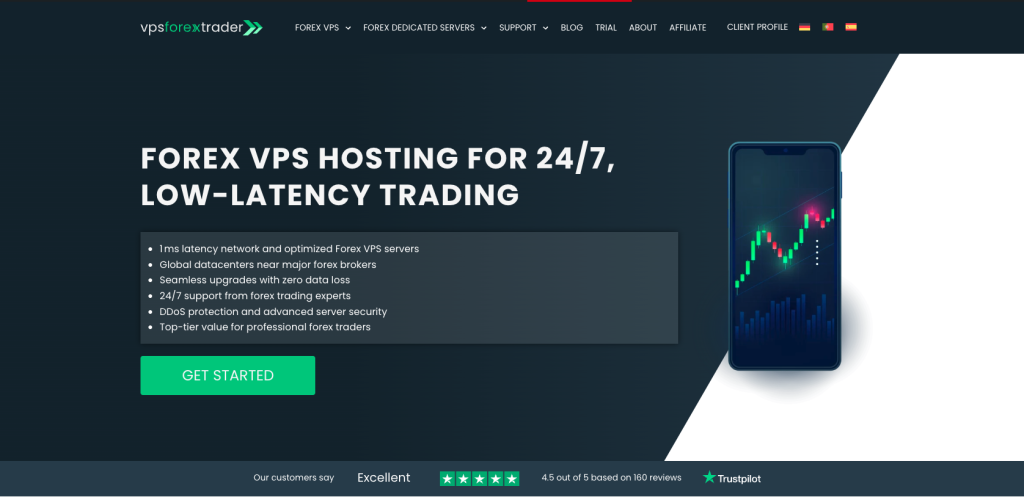
Infrastructure tier: Forex-first retail specialist. Operator: HOSTLINE, UAB, Vilnius, Lithuania, operating since April 2011
For the broad middle of active traders, VPSForexTrader Smart remains the plan this framework points to because it combines provider-documented ECC RAM, Windows Server 2025, published terminal ratings, NVMe storage, and included backups at $25.59 per month on annual billing. ECC is one reliability control rather than an unattended-runtime threshold, and the plan page does not provide enough detail to establish full end-to-end memory protection. Its Windows version offers a longer support runway, not proof that supported 2019 or 2022 plans are unsafe.
Smart provides three AMD EPYC vCPUs, 4 GB of ECC RAM, and 120 GB of NVMe storage, rated for up to four terminals. Boost at $41.24 per month equivalent on 12-month billing provides six cores and 6 GB for up to seven terminals, and Max at $59.99 per month equivalent on 12-month billing provides eight cores and 8 GB for up to ten, so a trader whose load grows stays within one provider. All three run Windows Server 2025, and backups are included, weekly on Smart and daily above it. A $0.99 three-day trial converts to the standard $31.99 monthly subscription unless cancelled before it expires. The 14-day money-back guarantee applies to paid VPS plans; confirm whether it extends to the trial before relying on it.
Where a competitor may be the better choice, this article says so rather than routing everyone here. A trader on a tight budget can test AccuWeb at its $7.99 promotional entry rate or TradingFXVPS at a $17.50 annual-billing monthly equivalent against the intended workload; TradingFXVPS also offers a $3.99 seven-day trial. A trader with formal institutional or compliance requirements should verify the scope of BeeksFX’s published certification and the contractual service before choosing it. A trader needing more memory can consider QuantVPS’s 8 GB VPS Lite plan.
Strengths: provider-documented ECC across every tier at a mid-market price; Windows Server 2025 on every tier, the longest support runway here; per-tier terminal ratings; NVMe storage; included backups; an upgrade path from four to ten vendor-rated terminals; 14-day guarantee on paid plans.
Limitations: not the cheapest plan, and the wrong choice for a single manual terminal on a tight budget, where a budget provider is better; not the most memory, which QuantVPS’s 8 GB Lite plan provides; EPYC model not published, only the family; prices subject to VAT for EU buyers; the $0.99 trial auto-converts unless cancelled, and the 14-day guarantee is documented for paid VPS plans rather than the trial.
Budget example, managed and cheapest: AccuWeb Hosting
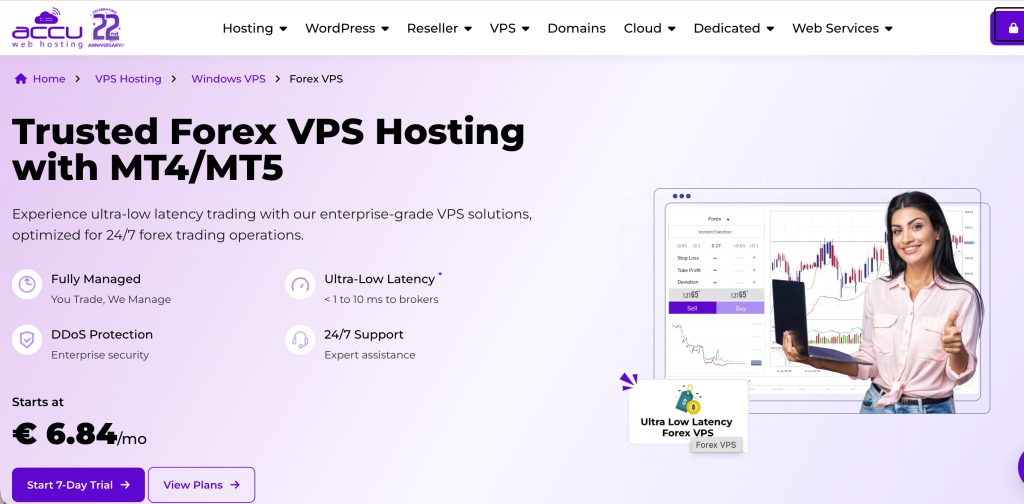
Infrastructure tier: general-purpose Windows hosting with a Forex product line. Operator: AccuWeb Hosting, Old Tappan, New Jersey, founded 2003
AccuWeb is the lowest-priced managed example in this comparison. Its $7.99 figure is a promotional entry rate, not an annual-billing monthly equivalent; the provider’s comparison page shows a $15 monthly renewal price and $180 yearly renewal total. The plan includes 24/7 support across email, ticket, live chat, and telephone, plus complimentary weekly backups in selected locations rather than every data centre. It lists 1.5 GB of RAM, 1 vCPU, and 250 GB of bandwidth. AccuWeb’s comparison material has listed 35 GB for the entry configuration, but the live pages mix plan-level SSD wording with a general NVMe SSD feature claim, so the exact storage allocation and type should be confirmed in the order flow.
The entry tier uses Windows Server 2019. AccuWeb states that Windows Server 2025 is available only in Denver and London and requires at least 3 GB of RAM, so the 1.5 GB entry plan does not qualify. Server 2019 remains in extended support until 9 January 2029, although mainstream support ended in January 2024. The more important capacity caveat is memory: 1.5 GB is below Microsoft’s 2 GB minimum for Windows Server with Desktop Experience and its 4 GB recommendation. A pre-installed virtual machine may operate with less depending on its configuration, but suitability for MetaTrader, charts, and EAs should be demonstrated with the actual image and workload.
Strengths: lowest advertised entry here at a $7.99 promotional rate; fully managed support across four channels including telephone; complimentary weekly backups in selected locations; a no-overselling statement; Windows and Linux; a low-cost plan that can be evaluated for testing or light use.
Limitations: $7.99 is promotional, with $15 monthly and $180 yearly renewal pricing shown; 1.5 GB and one core at entry require workload testing and fall below Microsoft’s 2 GB minimum for Windows Server with Desktop Experience; no memory type is documented, so ECC support cannot be confirmed or denied; plan pages are inconsistent on SSD versus NVMe wording; complimentary weekly backups are location-restricted; Windows Server 2025 requires at least 3 GB and is limited to Denver and London; the 7-day money-back period is the shortest here.
Budget example, value with a published processor family: TradingFXVPS
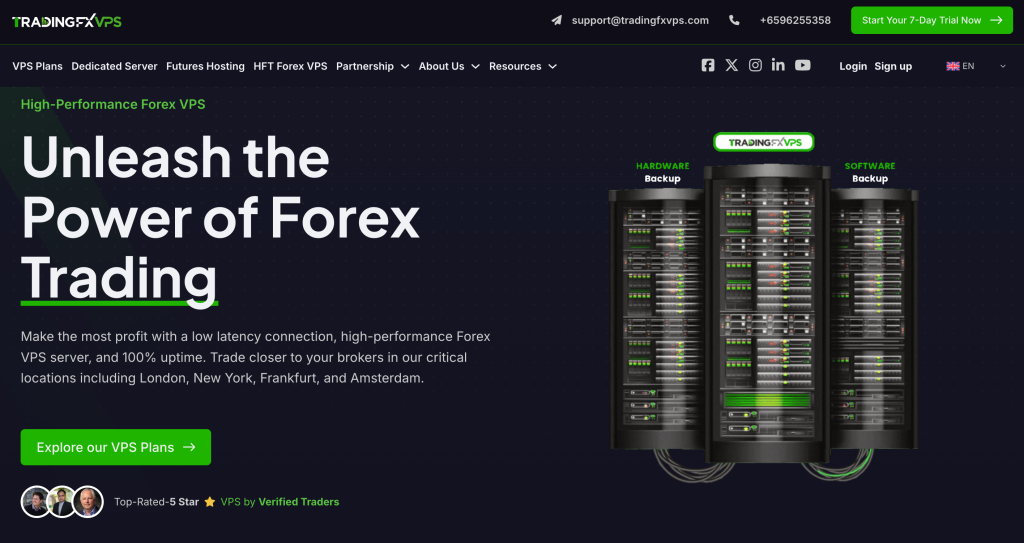
Infrastructure tier: Forex-first retail specialist. Operator: Next Era Pte. Ltd. (also known as High Frequency Trading Network Pte Ltd), Singapore, founded 2014
TradingFXVPS is the budget tier’s value example. Its Standard plan is $17.50 per month equivalent when billed $210 yearly, compared with a $25 month-to-month rate. The live plan page lists one AMD Ryzen 9 core at 4.3 GHz, 2 GB of DDR5 RAM, 30 GB of NVMe storage, and Windows Server 2019. The purchasable plan identifies the processor family and clock rate but not the model, and publishes PassMark benchmark scores directly on the plan card: a multi-thread score of 2,066 and a single-thread score of 4,739. Separate provider blog content cites a Ryzen 9 9950X. Because the model is not stated on the plan itself, this article treats the family, clock rate and published PassMark scores as the purchasable specification.
The published specification may suit a light workload, but this article did not test how many terminals, charts, or EAs it can support. DDR5 includes on-die error correction inside each DRAM chip; that mechanism is distinct from server ECC across the memory path, and the plan page does not document the latter. The provider publishes no terminal rating, so although the PassMark scores give an unusually direct CPU reference point, buyers should still measure memory headroom on their own workload. A $3.99 seven-day trial is available for traders who want to validate the configuration before committing. Its 30-day guarantee excludes discounted plans, including the annual rate, and is limited to first-time customers.
Strengths: lowest-cost Forex specialist here at a $17.50 annual-billing monthly equivalent; publishes the AMD Ryzen 9 family and 4.3 GHz clock rate; publishes PassMark multi-thread and single-thread scores on the plan card itself, the only provider here to do so; 2 GB DDR5 and 30 GB NVMe, with RAID claimed in the provider’s FAQ and blog material but not on the plan card; a $3.99 seven-day trial; primary broker data-centre location; four weekly off-site backups included.
Limitations: one core and 2 GB at entry require workload testing; DDR5 is listed but server-grade end-to-end ECC is not documented; no terminal rating published; the purchasable Standard plan does not identify the Ryzen 9 model; Standard lists Windows Server 2019 rather than a choice at checkout; the 30-day guarantee excludes discounted plans and returning customers.
Mid-market example, broker-configured onboarding: NYCServers
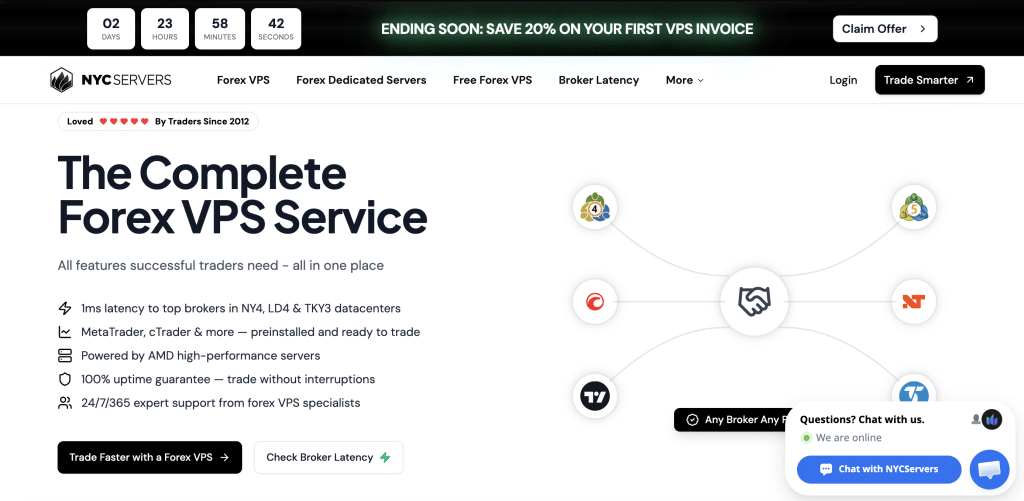
Infrastructure tier: Forex-first retail specialist. Operator: GreenHill Technologies Inc., trading as NYCServers, with a stated mailing address in North Haven, Connecticut and infrastructure in Equinix NY4, LD4, TY3, SG1, HK1 and DUB1. Providing Forex VPS since 2012. Third-party listings describe the company as Manhattan-based; the corporate address on its own site is in Connecticut.
NYCServers sits at the budget-to-mid boundary and earns its place for a trader who wants the setup done for them. The Basic plan is priced at $25 on monthly billing according to NYCServers’ own comparison material. Annual billing is $200 for the year, equivalent to $16.67 per month, but that rate reflects a 20 per cent first-invoice promotion running at the time of writing; the plan card shows $20.83 per month as the undiscounted annual equivalent. Provider pages are not consistent on the monthly figure, so the order page is the final check. The plan pre-installs the selected platform and broker, with monitoring enabled by default, and lists 2 CPU cores, 2 GB of DDR5 RAM, 60 GB of NVMe storage, Windows Server 2022 with Ubuntu 24.04 also offered, and a published rating of one to two trading accounts.
For a first-time VPS user the onboarding is a real advantage. DDR5 is published, but server-grade end-to-end ECC is not stated and cannot be inferred. The 2 GB allocation is Microsoft’s minimum for Windows Server with Desktop Experience, so actual MetaTrader capacity should be tested rather than assumed from the vendor’s one-to-two-account rating. Backups are a paid, non-refundable add-on.
Strengths: platform pre-installed and configured against the trader’s specific broker at checkout, unique here and valuable for first-timers; monitoring with alerting included; published per-plan account ratings; NVMe storage; 14-day guarantee; VNC alongside RDP; six Equinix locations.
Limitations: the $16.67 annual equivalent depends on a promotional discount, the undiscounted annual equivalent shown on the plan card is $20.83, and provider pages disagree on the monthly rate ($20.83 versus $25); 2 GB DDR5 is published but server ECC is not; Windows Server 2022 remains supported until 2031, though mainstream support ends in October 2026; actual terminal capacity requires workload testing; backups are a paid, non-refundable add-on.
Premium example, institutional at retail: BeeksFX

Infrastructure tier: institutional, Equinix-colocated. Operator: Beeks Financial Cloud Group plc (AIM: BKS), registered office Riverside Building, 2 Kings Inch Way, Renfrew, Renfrewshire, Scotland (SC521839), established 2011, AIM-listed 2017
BeeksFX is the premium tier defined by institutional pedigree rather than raw specification. It is the retail line of the only publicly listed company here, supplies infrastructure that brokers resell, and publishes ISO 27001. That certification can be relevant to a formal compliance review, but it does not by itself prove that the Bronze retail plan satisfies a trader’s requirements; buyers must verify certificate validity, scope, the covered service, and contractual commitments. Bronze is £25.83 per month equivalent on annual billing (£310 per year, about $34.87 at £1 = $1.35); the £31 month-to-month price is about $41.85. It includes 1 vCPU, 2,560 MB, 30 GB, Windows Server 2022, a managed option, and cTrader support.
Its premium case is the listed-company governance and institutional infrastructure, not the modest 2,560 MB entry specification. GBP pricing removes exchange-rate exposure for a UK trader. BeeksFX may warrant evaluation where its certification and contracts match a buyer’s documented requirements; without that verification, ISO 27001 is not a stand-alone buying rule.
Strengths: the only publicly listed operator here, with the disclosure obligations that carries; published ISO 27001 status that can support a compliance review after scope is verified; institutional infrastructure; GBP pricing for UK buyers; managed option and cTrader support; published terminal ratings.
Limitations: 2,560 MB entry is modest for the price; storage type and RAM type are not published; no retail SLA percentage published; certificate scope and applicability to the selected retail service must be verified rather than assumed.
Highest-capacity example, futures-first: QuantVPS
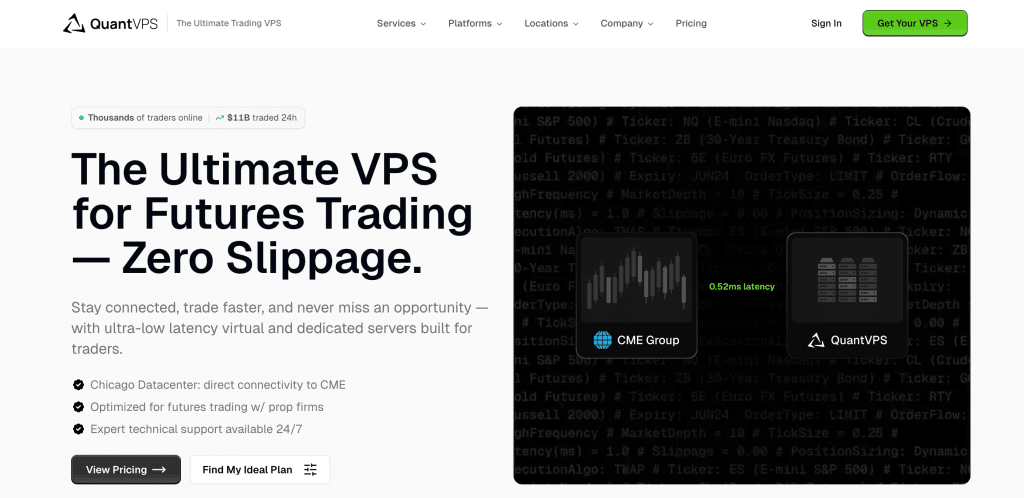
Infrastructure tier: institutional-adjacent, exchange-proximate. Operator: QuantVPS. The site publishes no legal entity name; it states a Delaware headquarters with a Chicago mailing and support address, and claims more than 10 years in operation without giving a founding year.
QuantVPS is the highest-capacity example here, but its tier placement needs care. Its published entry plan is VPS Starter at $29.99 on monthly billing, listing 2 AMD EPYC cores, 4 GB of DDR4 and 50 GB of NVMe storage. The 8 GB plan this article references is VPS Lite, the second tier, at $59.99 on monthly billing with 4 AMD EPYC cores, 8 GB of DDR4, 75 GB of NVMe storage and Windows Server 2022, with Linux also available. VPS Lite carries the most memory of any plan named in this comparison, but it is not QuantVPS’s entry price: on entry pricing the provider sits in the mid-market band rather than above it. The pricing page displays monthly rates only, with a hero line stating $39.99 and a page title stating $29.99, so the applicable rate and any annual option should be confirmed in the order flow.
Two things qualify the capacity case for a Forex trader specifically. The product is built for futures rather than Forex, so its positioning, latency benchmarks, and prop-firm material centre on NinjaTrader and CME execution even though MetaTrader is documented and supported. Its current VPS Lite page lists DDR4 and does not publish server ECC, so no memory-integrity comparison with VPSForexTrader can be made from the available specifications. It publishes a 14-day refund for new customers, first payment only.
Strengths: 8 GB on VPS Lite, the most memory of any plan here; four AMD EPYC cores on Lite; NVMe and DDR4; a parallel Ryzen/DDR5 “+” line with automatic backups; seven locations (Chicago, New York, London, Dublin, Amsterdam, Frankfurt and Tokyo); Windows and Linux; no minimum term. These are published specifications, not a tested terminal-capacity result.
Limitations: the 8 GB Lite plan at $59.99 is the highest-priced plan named here, though the provider’s own entry tier is $29.99 with 4 GB; the pricing page displays monthly rates only and its hero and page title disagree ($39.99 versus $29.99); backups are not included on VPS Lite; built for futures rather than Forex; the current Lite plan lists DDR4 and does not publish server ECC; QuantVPS rates Lite for only one to two charts or strategies.
Four mistakes in the budget-versus-premium decision
Overpaying for an unmeasured light workload is the first mistake. A trader running one manual MetaTrader terminal may place less value on ECC, extra cores, or institutional certification, but “manual” does not prove that ECC is unnecessary and a small RAM figure does not prove the workload will fit. AccuWeb’s $7.99 promotional entry rate or TradingFXVPS’s $17.50 annual-billing monthly equivalent can be economical starting points if the exact Windows image, charts, indicators, and EAs are tested and monitored.
Underpaying for an unmonitored, untested EA workload is the second mistake. Unattended operation increases the value of monitoring, restart procedures, backups, support, network stability, and capacity headroom because faults may persist longer before a person intervenes. ECC can reduce some hardware memory errors, but the probability of a bit error is not determined by whether a trader is watching, and this comparison does not establish DRAM faults as the dominant MetaTrader risk.
Reading total RAM instead of measured usable headroom is the third mistake. Windows, terminals, charts, history, symbols, indicators, and EAs all consume resources, and the amount varies by configuration. Microsoft lists 2 GB as the minimum for Windows Server with Desktop Experience and recommends 4 GB, but even those figures do not establish a universal terminal count. QuantVPS illustrates the point from the other direction: its 8 GB Lite plan carries the most memory here yet is vendor-rated for only one to two charts. Use the provider’s rating only as a starting point and verify CPU, memory, paging, and stability under realistic load.
Paying a premium price for features that do not match the requirement is the fourth mistake. Price and specification do not always move together: one plan may prioritize RAM, another onboarding, backups, support, network location, a longer OS support runway, or published institutional controls. Headline prices also need reading carefully, since promotional rates, annual monthly-equivalents, and undiscounted equivalents can all appear on the same page. If a memory type is not published, record it as unconfirmed rather than non-ECC. If certification matters, verify its scope. Match evidence to the workload instead of assuming one feature or a higher price delivers reliability in every dimension.
Which tier fits which trader
For a trader running one MetaTrader terminal manually, testing a strategy, or working on a tight budget, the budget tier may be the most economical place to start. AccuWeb’s $7.99 promotional entry rate includes managed support and telephone help; TradingFXVPS at a $17.50 annual-billing monthly equivalent publishes a Ryzen 9 processor family with on-card PassMark scores and offers a $3.99 seven-day trial. Neither plan was performance-tested for this article, and AccuWeb’s 1.5 GB entry is below Microsoft’s 2 GB Desktop Experience minimum, so the exact workload must be validated.
For an active trader running Expert Advisors or several terminals who wants more documented controls without the premium tier’s cost, the mid-market tier is this framework’s choice. VPSForexTrader Smart at $25.59 per month equivalent on 12-month billing combines provider-labeled ECC, Windows Server 2025, published terminal ratings, NVMe storage, and backups. That combination, rather than an unattended-runtime rule, is the basis for the recommendation; actual workload capacity and the extent of ECC protection still need to be confirmed.
For a trader whose workload or situation is specialised, the requirement should determine the shortlist. A funded, prop-firm, or compliance-bound trader can evaluate BeeksFX only after confirming that the certificate scope and contract cover the required service. A trader wanting more memory than the other plans here offer can consider QuantVPS’s 8 GB VPS Lite plan, noting two things: the product is futures-first, and QuantVPS itself rates Lite for only one to two charts or strategies, directing heavier multi-chart use to VPS Pro at $99.99. More RAM on the spec sheet is not a higher vendor-rated capacity. A trader who wants a broker-configured terminal can look at NYCServers. Premium is not a universal upgrade; it is a set of specific features whose relevance must be verified.
Three findings from this comparison
The first finding is that price and specification are only loosely coupled, and that headline prices need careful reading. NYCServers shows $16.67 per month on annual billing only under a current 20 per cent promotion, against a $20.83 undiscounted annual equivalent and inconsistent monthly figures of $20.83 and $25; QuantVPS’s $59.99 is a month-to-month rate for its second tier, above a $29.99 entry plan, while VPSForexTrader Max’s $59.99 is a monthly equivalent on 12-month billing; and VPSForexTrader advertises ECC at a mid-market price without publishing enough detail to prove end-to-end server ECC. Compare the specification, billing basis, and evidence that matter for the workload rather than assuming the price band supplies them.
The second finding is that unattended runtime is an operational condition, not a clear ECC threshold. It raises the value of monitoring, automated recovery, stable connectivity, backups, support, and adequate headroom because nobody may intervene quickly. ECC can address certain memory errors, but watching the terminal does not change their physical probability and may not reveal a corrupted value. The budget-versus-premium decision should therefore consider the full failure model rather than one line.
The third finding is that a useful mid-market plan can combine several higher-tier features without resolving every reliability risk. Documented ECC and a newer Windows release may be advantages, but supported older Windows versions, network quality, host contention, monitoring, backups, EA quality, broker connectivity, and support still matter. The practical recommendation is to define the workload and failure consequences, test the shortlisted plan, and buy the least expensive option that meets those measured requirements.
Frequently asked questions
Is a cheap Forex VPS good enough?
For the right workload, potentially. A budget Forex VPS around $8 to $18 a month can provide an always-on environment, but this comparison did not test either AccuWeb or TradingFXVPS with a defined set of terminals, charts, or EAs. Resource use varies by configuration, AccuWeb’s $7.99 is a promotional rate rather than the renewal price, and its 1.5 GB entry is below Microsoft’s 2 GB minimum for Windows Server with Desktop Experience. Use a trial or test period — TradingFXVPS offers seven days for $3.99 and VPSForexTrader three days for $0.99 — monitor CPU, RAM, paging, terminal health, and broker connectivity, and upgrade when measured headroom or operational controls are insufficient.
When is it worth paying for a premium Forex VPS?
When the higher-priced plan addresses a measured requirement: more capacity, a better network route to the trader’s broker, monitoring and recovery, stronger support commitments, backups, a longer OS support runway, or verified institutional controls. ECC can be relevant to memory integrity, but unattended operation alone does not prove it is required or that DRAM faults are the main risk. A certification is relevant only if its scope covers the purchased service and the buyer’s compliance obligations. Test the actual workload and route before paying for a headline feature.
What does ECC memory actually do, and do I need it?
ECC memory can detect and correct certain bit errors. Conventional server ECC is designed to protect data across more of the memory path, while DDR5 on-die ECC corrects errors inside the DRAM chip and is not a partial version of the same end-to-end mechanism. VPSForexTrader advertises ECC across its plans, but its public page does not specify the DIMM type, controller, ECC mode, or end-to-end coverage. TradingFXVPS lists DDR5 without documenting server ECC, and QuantVPS currently lists DDR4 on its base plans. Whether ECC should affect a buying decision depends on the workload and broader reliability design; manual versus unattended use is not a technical dividing line.
Why do Forex VPS prices range from $8 to $60 for similar-looking plans?
Because plans can differ in RAM and CPU capacity, storage, network location, support, monitoring, backups, redundancy, operating-system support runway, and published institutional controls even when their summaries look similar. Billing basis matters too: a promotional rate, an undiscounted annual monthly-equivalent, and a month-to-month price can all appear for the same plan. Price alone does not prove performance or reliability, and this article did not benchmark the six providers. A trader should compare the exact workload and broker route, confirm undocumented items rather than assume them, and test whether the selected plan meets measured capacity and recovery needs.
Can I start on a budget plan and upgrade later?
Usually yes, and it is often the sensible path, but check the upgrade route before committing. A trader learning to use a VPS or testing a strategy can reasonably start on a budget plan and move up when their workload crosses a threshold, but moving between providers means reconfiguring the server, while moving up tiers within one provider is simpler. VPSForexTrader, for instance, scales from four terminals on Smart to ten on Max within one account, so a trader who expects to grow can start mid-tier and upgrade in place. If you start budget, confirm whether your provider offers a clean upgrade path or whether growth means migrating to a new host.
References
[1] VPSForexTrader plan and pricing pages, vpsforextrader.com. Rechecked August 2026. Source for the provider’s ECC label across all tiers, Windows Server 2025, per-tier terminal ratings, NVMe capacities, backup frequency, trial terms, monthly prices, and 12-month monthly-equivalent prices. The public page does not establish the ECC mode or end-to-end memory-path coverage. The trial page does not state that the 14-day money-back guarantee extends to the $0.99 trial.
[2] AccuWeb Hosting Forex VPS pricing and comparison pages, accuwebhosting.com. Rechecked 28 August 2026. Source for the $7.99 promotional entry rate, $15 monthly and $180 yearly renewal figures, 1.5 GB RAM, 1 vCPU, 250 GB bandwidth, selected-location complimentary backups, the 7-day guarantee, and the Windows Server 2025 location and 3 GB minimum. The live pages mix plan-level SSD wording with a general NVMe SSD feature claim, so storage type should be confirmed at checkout.
[3] TradingFXVPS plan pages, technical content, and terms, tradingfxvps.com. Rechecked 28 August 2026. Source for the $17.50 annual-billing monthly equivalent, $25 monthly rate, AMD Ryzen 9 family at 4.3 GHz, on-card PassMark MTR 2,066 and STR 4,739, 2 GB DDR5, 30 GB NVMe (RAID stated only in FAQ and blog material, not on the plan card), four weekly off-site backups, Windows Server 2019 on Standard, the $3.99 seven-day trial, and the 30-day guarantee exclusions. Separate provider blog content identifies a Ryzen 9 9950X, but the purchasable plan does not state the processor model.
[4] NYCServers plan and terms pages, newyorkcityservers.com. Rechecked 28 August 2026. Source for broker and platform pre-installation, 2 GB DDR5, 60 GB NVMe, Windows Server 2022, the published one-to-two-account rating on Basic, six Equinix locations, refund terms, and the GreenHill Technologies Inc. corporate identity and North Haven, Connecticut mailing address shown in the site footer. The main Forex VPS plan page shows $20.83 as a struck-through undiscounted annual monthly-equivalent against a promotional $16.67 ($200 billed yearly, Save 20%); provider comparison pages state a $25 monthly rate.
[5] Beeks Financial Cloud retail catalogue and investor pages, beeksfinancialcloud.com and beeksgroup.com, with the registered office and company number confirmed against Companies House record SC521839. Rechecked August 2026. Source for the retail tiers, the 2011 founding and 2017 AIM admission, published ISO 27001 status, GBP pricing, cTrader support, and the Riverside Building, 2 Kings Inch Way, Renfrew registered office. Certification scope must be verified against the selected service and buyer requirements.
[6] QuantVPS pricing, plan, legal, and refund pages, quantvps.com. Rechecked 28 August 2026. Source for the $29.99 monthly VPS Starter rate with 4 GB DDR4 and 50 GB NVMe, the $59.99 monthly VPS Lite rate with 8 GB DDR4, 75 GB NVMe and four AMD EPYC cores, the parallel Starter+/Lite+ line at $39.99 and $79.99, VPS Pro at $99.99, the per-plan chart ratings, Windows Server 2022, backups not included on VPS Lite, refund terms, futures-first positioning, Delaware headquarters statement, Chicago mailing address, and the claim of more than 10 years in operation. The pricing page hero states $39.99 while the page title states $29.99. No legal entity name, founding year, or server ECC is published, and the pricing page displays no annual rate; provider blog material has previously cited annual pricing, so the order flow is the final check.
[7] Microsoft Windows Server release information, lifecycle documentation, and hardware requirements, learn.microsoft.com. Rechecked August 2026. Source for support dates: Server 2019 entered extended support in January 2024 and runs to 9 January 2029; Server 2022 mainstream support ends 13 October 2026 and extended support ends 14 October 2031; Server 2025 mainstream support ends 13 November 2029 and extended support ends 14 November 2034. Also source for the 2 GB Desktop Experience minimum and 4 GB recommendation.
[8] MetaQuotes MetaTrader 5 resource-monitoring documentation, metatrader5.com, and Kingston’s DDR5 technical overview, kingston.com. Rechecked August 2026. Sources for workload-dependent chart, EA, CPU, and memory usage, and for the distinction between DDR5 on-die ECC inside a DRAM chip and server-module ECC.
Editorial note
This comparison covers Forex VPS infrastructure and does not constitute financial advice, trading-strategy advice, or a broker recommendation. Strategy performance depends on broker execution, market conditions, and trader skill, none of which the infrastructure controls.
Selected plan specifications and technical references were rechecked on 28 August 2026 and can change without notice. Promotional rates in particular are time-limited and were current on that date. Provider terminal ratings, chart ratings, latency, uptime, and throughput figures are vendor-stated and were not independently replicated.