An automated Forex VPS strategy lives or dies on two things its code cannot control: how far its server sits from the broker’s matching engine, and whether the network between them stays up. A dedicated server in the same Equinix hall as the broker, Secaucus NY4 for much of the United States-facing market or Slough LD4 for London, reaches the matching engine in well under a millisecond over a cross-connect. The same strategy on a general “New York” cloud region can sit several milliseconds further away, and the gap widens the moment the link is congested. Uptime is the other half of the problem: a plan advertising 99.99 percent availability still budgets about 52.6 minutes of downtime a year [9], and a distributed denial-of-service attack or a saturated uplink can stall a bot with a position open. For automation, the data-center address and the network behind it are infrastructure decisions, not marketing ones.
Most comparisons of dedicated trading servers do not help with either question. They run one section per provider with a loose mix of specifications, publish no standardized table, and rarely name the actual facilities a broker uses, so a reader cannot line two providers up on the dimension that matters. Network capacity and DDoS protection, when they appear at all, are stated inconsistently from one provider to the next. This comparison fixes the axes and holds every provider to them. The scope is infrastructure: where each provider’s dedicated servers sit relative to the major broker and exchange hubs, how much network capacity and redundancy they document, and what DDoS protection they offer, all read against one goal, keeping an automated strategy running without interruption.
Nothing here is trading advice. The seven providers are grouped by infrastructure tier, institutional first, then purpose-built Forex and trading hosts, then general hosting, and within each tier by length of operation, a non-quality ordering set out in the methodology.
The short version
Beeks (Beeks Financial Cloud) is the institutional reference point, colocated in the exchange halls themselves, Aurora and 350 Cermak in Chicago, Secaucus NY4 and NY5, Slough LD4 and LD5, Tokyo TY3, Frankfurt FR2, Hong Kong (HKEX), and London LSE, with dedicated fiber between its sites [8]. Among the purpose-built Forex hosts, VPSForexTrader, the longest-established of them, names Equinix facility codes LD3, NY2, and HK4 with Amsterdam, though its London and New York halls are adjacent to rather than the same as the primary LD4 and NY4 aggregation points [10]; ForexVPS.net lists 22 locations by its own count, marketed as Equinix-powered and near the major exchanges, with 1 Gb/s on its VPS plans [2]; NYCServers, operated by GreenHill Technologies Inc., offers dedicated servers in six named facility codes, New York NY4, London LD4, Tokyo TY3, Singapore SG1, Hong Kong HK1, and Dublin DUB1 [3]; and TradingFXVPS lists eight locations including a CME-connected Chicago (Aurora) site sold as a futures VPS product, on what it describes as Equinix data centres for its dedicated line [4]. The general hosts cast a wider geographic net without the Forex-specific colocation: AccuWeb lists more than 20 global data centers with anti-DDoS on most dedicated servers [5], and Cloudzy offers 13 cloud regions with 40 Gb/s uplinks and network-edge DDoS filtering stated for its dedicated servers, its dedicated bare metal quoted from $99 per month [6].

How these providers were compared
Specifications were verified on 26 October 2026 from each provider’s own pages, with data-center locations cross-referenced against Equinix facility naming [7] and Beeks’s footprint and network checked against its own entry in CME Group’s vendor directory [8]; the Cloudzy, NYCServers,
TradingFXVPS, AccuWeb, ForexVPS.net, and CME pages were re-checked on 27 October 2026. The comparison turns on three dimensions that decide whether an automated strategy runs well and keeps running: data-center location relative to the broker and exchange hubs, network capacity and redundancy, and DDoS protection. Providers are listed by infrastructure tier, institutional first, then purpose-built Forex and trading hosts, then general hosting, and within each tier by years in operation, longest-established first (VPSForexTrader operating since 2011, ForexVPS.net since 2012, and NYCServers founded in 2012 with its Forex service from 2013); that ordering reflects tier and track record, not a quality ranking. Network-capacity figures, DDoS-protection claims, latency numbers, and uptime percentages published by any provider are commercially motivated and are not independently replicated here; they are treated as vendor-stated throughout.
Why data-center location decides automated-trading latency
For an automated strategy, the single largest latency lever is physical distance to the broker’s matching engine, and that distance is set the moment you choose a data center. Forex brokers and their liquidity providers are widely documented to cluster in a handful of Equinix facilities; Equinix names these halls NY4 and NY5 in Secaucus, LD4 and LD5 in Slough, TY3 in Tokyo, FR2 in Frankfurt, HK1 and HK2 in Hong Kong, and SG1 in Singapore [7]. Futures are a separate map, with CME Globex in Aurora, Illinois [8]. Knowing which building your broker uses is the starting point, because proximity comes in three very different grades.
The closest is a cross-connect inside the same hall: a server in NY4 patched to a broker in NY4 reaches the matching engine in well under a millisecond. The next grade is metro fiber to a nearby building, which adds microseconds, imperceptible for retail automation but not a true in-hall cross-connect. The furthest, and the trap, is a general cloud region labeled “New York” or “London” that may sit miles from the exchange hall and several milliseconds away, a gap that widens under load. A city name on a plan page is not the same as the facility code. Against that map, the providers split clearly. Beeks is inside the halls themselves, with footprints in Aurora, Chicago, Secaucus NY4 and NY5, Slough LD4 and LD5, Tokyo, Frankfurt, Hong Kong, and London [8]. NYCServers names six facility codes, NY4, LD4, TY3, SG1, HK1, and DUB1, the first five Equinix halls and DUB1 a Dublin facility outside Equinix’s DB-series naming [3]. TradingFXVPS lists eight locations including a CME-connected Chicago (Aurora) site, sold as a futures VPS product, and describes its dedicated line as on Equinix data centres, though without facility codes [4]. AccuWeb and Cloudzy name cities such as New York and London without confirming which hall, which is the distinction that matters for a latency-sensitive bot [5][6].
The takeaway for the sections and the table below is one question to carry into each provider’s location row: not whether it has a server in your region, but whether it is in the specific hall your broker uses. That is what separates a sub-millisecond cross-connect from a merely regional server.
Network capacity and what automation actually needs
Headline bandwidth is the most over-weighted number on a trading-server page. An automated strategy sends small messages, order instructions and market-data subscriptions, so raw throughput is rarely the bottleneck; what degrades execution is jitter and packet loss when a link congests, and what causes an outage is a single uplink with no failover.
A 1 Gbps port with redundant upstreams and low jitter serves a bot better than a 10 Gbps port that saturates or drops. The published figures vary widely in both size and candor. Cloudzy cites 40 Gb/s uplinks on every plan with a monthly transfer allowance of 1 to 5 terabytes on its listed plans [6]; ForexVPS.net states 1 Gb/s on its VPS plans and publishes no port figure for its dedicated line [2]; and TradingFXVPS states 10 Gbps on its VPS plans, without a separate figure for the dedicated line [4]. AccuWeb lists a 250 Mbps to 1 Gbps port with 10 Gbps available on request, though its page gives three different figures in different places, “up to 10 Gbps,” “up to 100 Gbps,” and a “minimum public bandwidth of 500 Mbit/s,” so the real figure needs confirming [5].
Beeks frames capacity as a managed network rather than a port number, offering 100 Mbps to 100 Gbps over dedicated fiber between its sites [8], with Arista low-latency switches [1]. NYCServers publishes no port speed at all [3]. Redundancy is the number that actually protects an unattended bot, and it is the one most pages omit. AccuWeb states redundant networking and premium bandwidth, though it does not name the upstream carriers on the dedicated-servers page [5], and Beeks runs dedicated fiber between data centers with a 24/7 network operations center [8]; a lone Gbps figure tells you nothing about what happens when a carrier drops.
The takeaway is to read a port speed as a ceiling rather than a promise, weight documented redundancy and sustained low jitter above a big headline number, and remember that a large uplink figure is not the same as sustained per-server speed. The table records the port figure where a provider publishes one and marks the rest as not stated.
DDoS protection and uninterrupted trading
For a strategy you leave running, a distributed denial-of-service attack is an uptime problem dressed up as a security one. A volumetric flood saturates the uplink, your bot can no longer reach the broker, and any position it was managing sits unattended until the link clears, which is the same failure as a server crash from the strategy’s point of view. That makes DDoS protection part of the uptime story for automation, not an optional extra.
The protection that matters is always-on filtering at the network edge, which inspects and drops attack traffic before it reaches your server, as opposed to on-demand scrubbing that engages only after an attack is detected and so carries a delay. No provider here documents the always-on kind with a stated capacity.
AccuWeb, Cloudzy and ForexVPS.net are the most specific: AccuWeb includes anti-DDoS against volumetric and application-layer attacks on most of its dedicated servers [5], and ForexVPS.net states real-time monitoring with mitigation of volumetric and L4 protocol-based attacks on both its VPS and dedicated lines [2]; none of the three names a capacity. Cloudzy is the only one of the six to state where mitigation sits: network-edge filtering included on every dedicated server, with volumetric attacks dropped upstream of the hardware, though with no capacity figure [6]. TradingFXVPS lists DDoS protection as included on its own site, with no capacity or method [4].
Two providers document no DDoS protection on their dedicated pages. Beeks and NYCServers are both colocation-oriented, where protection is often handled at the facility or by the client’s own appliances rather than advertised as a plan feature [1][3]; a third-party listing does show DDoS protection on a NYCServers Basic VPS plan, so the gap may be specific to the dedicated product, as checked on 23 October 2026 [3].
None of the six publishes a mitigation capacity in gigabits or terabits per second, so every “DDoS protected” claim here is directional rather than measured. The takeaway is to value always-on edge filtering over an unquantified badge, and to ask any provider for the specifics, always-on or on-demand, the attack types covered, and the mitigation capacity, before trusting it to keep a bot online through an attack.
The seven providers at a glance
Specifications were verified on 26 October 2026 from each provider’s own pages. Read the Less ideal if column as a buyer-requirement filter, not a verdict, and treat every network, DDoS, and uptime figure as vendor-stated.
| Provider | Data centers (Forex halls) | In a broker hub? | Network capacity (port) | DDoS protection | Uptime | Less ideal if |
| Beeks (Beeks Financial Cloud) | Aurora, Chicago 350 Cermak, Secaucus NY4/NY5, Slough LD4/LD5, Tokyo TY3, Frankfurt FR2, Hong Kong HKEX, London LSE | Yes, inside the halls | Dedicated fiber, 100 Mbps to 100 Gbps | Not documented | Not stated | You want a published plan and price rather than a quoted configuration |
| VPSForexTrader | Equinix LD3 (London), NY2 (New York), HK4 (Hong Kong); Amsterdam (Serverius) | Named Equinix codes, but not the primary LD4/NY4 halls | 1 Gbps dedicated line; no traffic cap; redundant routers (vendor-stated) | Not documented | 99.99% displayed on product pages; no uptime guarantee in the Terms | You need documented DDoS, an uptime guarantee, or the primary LD4/NY4 halls |
| ForexVPS.net | 22 by its own count, Equinix-powered: New York, Chicago, London, Frankfurt, Tokyo, Singapore, Hong Kong, Mumbai and others | Near exchanges (no codes given) | 1 Gb/s (VPS plans); dedicated not stated | Volumetric and L4 protocol-based; no capacity | 100% marketed; SLA credit below 99.99% | You need named facility codes |
| NYCServers | Dedicated in NY4, LD4, TY3, SG1, HK1, DUB1 | Yes, six named codes (five Equinix) | Not published | Not documented on dedicated page (Basic VPS lists it) | 100% guarantee | You need a published port speed or documented dedicated DDoS |
| TradingFXVPS | New York, London, Amsterdam, Frankfurt, Chicago (Aurora, CME, futures VPS), Hong Kong, Singapore, Tokyo; Equinix data centres for dedicated | Equinix stated; no codes | 10 Gbps (VPS plans) | Included (own site); no capacity | 99.99% SLA (footer), 100% (hero) | You need named facility codes or one uptime figure |
| AccuWeb | 20+ global incl New York, Chicago, London, Frankfurt, Amsterdam, Tokyo, Singapore | Cities present; Forex hall unconfirmed | 250 Mbps to 1 Gbps (10 Gbps on request) | Most servers; volumetric and application-layer | 99.99%; separate 100% network-and-power SLA | You need a confirmed Forex-hall location |
| Cloudzy | Dedicated in most of its 13 cloud regions (FAQ says 12); deepest stock Utah, Dallas, Amsterdam, Frankfurt | General regions, not Forex colos | 40 Gb/s uplinks | Network-edge, upstream volumetric filtering; no capacity | 99.95% SLA | You need Forex-specific colocation near a broker |
1. Colocated in the exchange halls: Beeks (Beeks Financial Cloud)
Infrastructure tier: institutional, colocation and bare metal
Operator: Beeks Financial Cloud Group plc
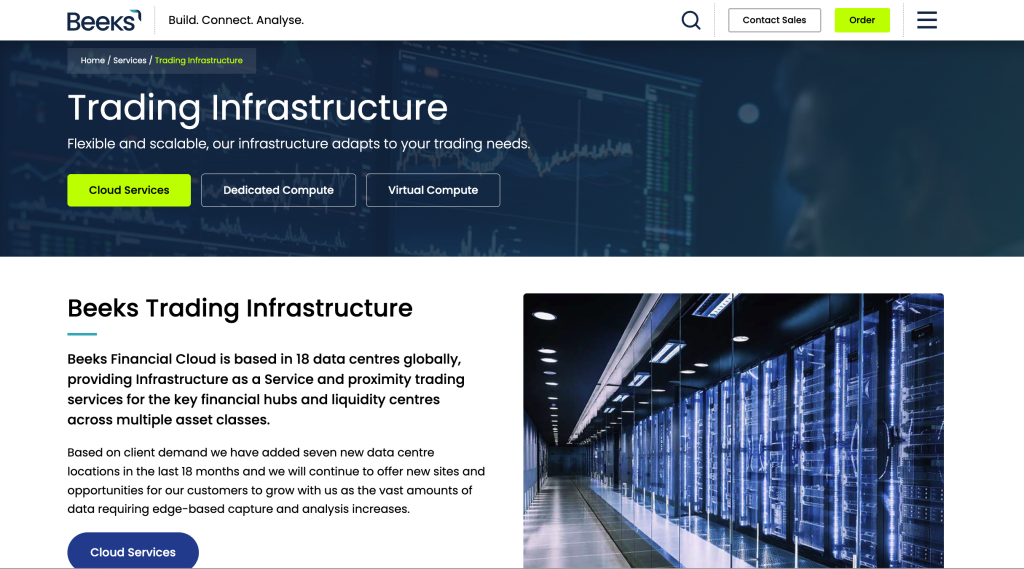
Beeks, which trades as Beeks Financial Cloud, is the institutional end of Forex hosting, and its distinguishing feature is that its servers sit inside the exchange facilities rather than near them. Beeks’s entry in CME Group’s vendor directory lists Aurora and 350 Cermak in Chicago, Secaucus NY4 and NY5, Slough LD4 and LD5, Tokyo TY3, Frankfurt FR2, Hong Kong at HKEX rather than an Equinix hall, and London LSE [8], while the wider business cites 18 data centers globally in its page body, and 17 in its meta description [1]. For an automated strategy that cross-connects to a broker or liquidity provider in one of those halls, that is as close as hosting gets. The network is built as a managed fabric rather than a port on a plan: dedicated fiber between sites and bandwidth from 100 Mbps to 100 Gbps, with cross-connects to liquidity providers, exchanges, and trading platforms [8], over Arista low-latency switches [1]. Beeks offers bare metal and virtual machines in a private caged environment [1], with a UK network operations center and 24/7 support [8].
Strengths: colocation inside the exchange facilities, NY4/NY5, LD4/LD5, TY3, FR2, Hong Kong, London LSE, and Aurora, the closest proximity to broker matching engines in this set [8]; a managed low-latency fabric with dedicated inter-site fiber and 100 Mbps to 100 Gbps of bandwidth [8], over Arista low-latency switches [1]; direct cross-connects to liquidity providers and exchanges [8]; bare metal and private caged environments suited to institutional automation [1].
Limitations: dedicated and colocation pricing is not published on the pages checked, though an order store at beeksfinancialcloud.com may carry it, so check there before assuming a quote is required [1]; DDoS protection is not documented as a plan feature, so a retail buyer must confirm how attacks are handled at the facility or supply their own [1]; the directory entry lists retail traders among its customer segments, but with no published plan or price the fit for a single retail bot cannot be assessed from the pages checked [8]; the public pages give the data-center count inconsistently, nine in the CME directory entry and 18, or 17, on the Beeks site, so confirm the footprint for your region [1][8].
2. Named Equinix codes with European coverage: VPSForexTrader
Infrastructure tier: purpose-built Forex VPS and dedicated
Operator: HOSTLINE UAB
VPSForexTrader is the longest-established of the purpose-built Forex hosts here, operating since 2011, and among this set it is one of the clearest on exactly which buildings it uses: it names Equinix facility codes LD3 in London, NY2 in New York, and HK4 in Hong Kong, alongside an Amsterdam site at Serverius [10][7]. That makes the facility identifiable rather than just the city, which is the distinction this comparison keeps returning to. The nuance is that LD3 and NY2 are not the primary broker-aggregation halls, LD4 and NY4, where most brokers and liquidity providers cluster, so being in Equinix London is not the same as being in the specific hall your broker uses; whether VPSForexTrader puts you next to your broker depends on which hall that broker is in [10][7]. On the network side it is, on its own figures, the most fully documented in this set: it states 1 Gbps on the dedicated line with no traffic cap, redundant routers at every location including dedicated MPLS routers, a nine-point-of-presence MPLS backbone, and connectivity through Tier-1 providers, which makes it the only provider here to document router-level redundancy, all vendor-stated [10].
The dedicated range is two published plans. FX Pro runs 8 cores and 16 threads, 16 GB of ECC RAM, two 250 GB SSDs in RAID 1, and supports up to 25 terminals; FX Premier runs 16 cores and 32 threads, 48 GB of ECC RAM, two 400 GB SSDs in RAID 1, and supports up to 150 terminals [10]. Both ship on Windows Server 2025 Standard with daily backups and the 1 Gbps line [10]. The ECC memory on both tiers detects and corrects memory errors on a box left running for weeks, and base pricing was $165.00 per month for FX Pro and $400.00 for FX Premier at last capture; pull the live figure on the product page and date it at publication [10].
Strengths: names specific Equinix facility codes, LD3 (London), NY2 (New York), and HK4 (Hong Kong), plus an Amsterdam site at Serverius, so the building is identifiable [10][7]; two published dedicated plans, FX Pro (8 cores, 16 GB ECC, up to 25 terminals) and FX Premier (16 cores, 48 GB ECC, up to 150 terminals), on Windows Server 2025 Standard with daily backups [10]; documented network redundancy, vendor-stated, with 1 Gbps on the dedicated line, no traffic cap, redundant routers including dedicated MPLS routers, a nine-point-of-presence MPLS backbone, and connectivity through Tier-1 providers, the only provider here to document router-level redundancy [10]; the longest-established Forex specialist here, operating since 2011, with ECC RAM on both dedicated tiers [10].
Limitations: its named Equinix halls are LD3 and NY2, not the primary broker-aggregation halls LD4 and NY4, so whether it sits in your broker’s hall depends on the broker [10][7]; the network and redundancy figures are vendor-stated and not independently replicated, and dedicated pricing should be confirmed live, as it changes [10].
3. Equinix-powered, near the exchanges: ForexVPS.net
Infrastructure tier: purpose-built Forex VPS and dedicated
Operator: Think Huge Ltd (Hong Kong), which also owns FXVM
ForexVPS.net is a long-running Forex host that markets proximity as its core promise, describing its locations as powered by Equinix and situated near the major exchanges [2]. Its own site counts 22 locations, including New York, Chicago, London, Frankfurt, Tokyo, Singapore, Hong Kong and Mumbai, but gives no Equinix facility codes, so the exact hall is unconfirmed [2]. Bandwidth is stated as 1 Gb/s on every VPS plan, with no separate figure published for the dedicated line, and the site advertises a marketed 100 percent uptime guarantee whose SLA credit threshold is 99.99 percent [2]. DDoS protection is stated as real-time monitoring with mitigation of volumetric and L4 protocol-based attacks, on both the VPS and dedicated lines; no capacity is published [2]. Its dedicated servers start at $270 per month on Intel Xeon or AMD EPYC/Ryzen with 16 to 128 GB of RAM, 2x 500 GB to 2x 2 TB SSD storage, and Windows Server 2025, 2022, or 2019, and the 14-day money-back guarantee excludes dedicated servers [2]. One structural fact belongs on the record: ForexVPS.net shares its parent, ThinkHuge, with FXVM, and ThinkHuge’s own site confirms the two brands run on the same infrastructure, so they are not independent of each other, which matters when you plan failover [2].
Strengths: 22 Equinix-powered locations by its own count, marketed as near the major exchanges, spanning New York, Chicago, London, Frankfurt, Tokyo, Singapore, Hong Kong, and more [2]; DDoS protection stated for the dedicated line as volumetric and L4 protocol-based with real-time monitoring [2]; a marketed 100 percent uptime guarantee with SLA credits below 99.99 percent [2]; a long operating history in Forex hosting [2].
Limitations: bandwidth is published as 1 Gb/s for the VPS plans only, with no port figure for the dedicated line [2]; no Equinix facility codes are published, so proximity to a specific broker hall cannot be confirmed [2]; no DDoS mitigation capacity is stated, and the 14-day money-back guarantee does not cover dedicated servers [2]; it shares infrastructure with its sister brand FXVM, so the two are a single point of failure rather than a failover pair [2].
4. Dedicated servers in six named facility codes: NYCServers
Infrastructure tier: purpose-built Forex VPS and dedicated
Operator: GreenHill Technologies Inc.
NYCServers, operated by GreenHill Technologies Inc., is built around the Forex facilities directly. Its dedicated-server page lists all three plans in six named facility codes, New York (NY4), London (LD4), Tokyo (TY3), Singapore (SG1), Hong Kong (HK1), and Dublin (DUB1), checked 26 October 2026 [3]. The first five are Equinix halls; DUB1 falls outside Equinix’s DB-series Dublin naming, so the page names codes without naming the operator. The codes appear in the features block and footer while the plan details list cities, so read the code as the facility rather than assuming the city alone. For a trader whose broker is in any of those halls, that places a dedicated box in the same building rather than merely the same city. Its servers arrive with MetaTrader pre-installed and configured per broker, and it claims roughly one millisecond or less to most brokers with a 100 percent uptime guarantee [3]. The network and security detail is thinner than the location clarity: the dedicated-server page states no port speed, and it does not document DDoS protection on the dedicated product, though a third-party listing shows DDoS on its Basic VPS plan, as checked on 23 October 2026 [3].
Strengths: dedicated servers in six named facility codes, NY4, LD4, TY3, SG1, HK1, and DUB1, so the building is identifiable rather than just the city [3]; MetaTrader pre-installed and configured per broker [3]; a footprint that covers the United States, United Kingdom, and Asian Forex halls where brokers aggregate [3]; a 100 percent uptime guarantee [3].
Limitations: no network port speed or bandwidth is published, so capacity and redundancy cannot be assessed from the page [3]; DDoS protection is not documented on the dedicated product, though the Basic VPS plan lists it per a third-party source [3]; the page names facility codes but not their operators, and DUB1 is not an Equinix code, so confirm the Dublin facility if that is your hall [3]; the latency claims are vendor-stated and not independently replicated [3]; the money-back guarantee applies to VPS only, and dedicated orders are non-refundable [3].
5. Eight locations with a CME-connected Chicago site: TradingFXVPS
Infrastructure tier: purpose-built Forex VPS and dedicated
Operator: Next Era Pte. Ltd. (also known as High Frequency Trading Network Pte Ltd)
TradingFXVPS lists eight locations on its own site: New York, London, Amsterdam, Frankfurt, Chicago, Hong Kong, Singapore, and Tokyo, with its dedicated line described as on Equinix data centres [4]. The Chicago (Aurora) site is sold as a futures VPS product with CME cross-connection; whether the dedicated line is offered there is not stated [4]. It states 10 Gbps network speed on its VPS plans [4]. DDoS protection is listed as included on its own site, though with no capacity or method; a third-party review table recorded it as not available, which is the reviewer’s summary rather than the provider’s statement [4]. Uptime is stated inconsistently, a 99.99 percent SLA in the footer alongside a 100 percent claim in the hero, and the operating entity appears as High Frequency Trading Network Pte Ltd in the footer and as Next Era Pte Ltd in press releases [4].
Strengths: eight locations including a CME-connected Chicago site, with the dedicated line described as on Equinix data centres [4]; a stated 10 Gbps network speed on its VPS plans [4]; DDoS protection listed as included [4]; a Forex-specialist focus with per-broker setup [4].
Limitations: the dedicated line’s facilities are described as Equinix but no facility codes are given, so the specific hall is unconfirmed [4]; uptime is stated as both a 99.99 percent SLA and a 100 percent claim, so the real figure needs confirming [4]; the 10 Gbps figure is quoted for the VPS plans, not separately for the dedicated line [4]; DDoS protection is listed as included but with no capacity or method [4]; the 30-day money-back guarantee applies to VPS only, and dedicated orders are excluded [4].
6. The widest footprint, general-purpose: AccuWeb
Infrastructure tier: general hosting with a Forex option
Operator: AccuWeb Hosting
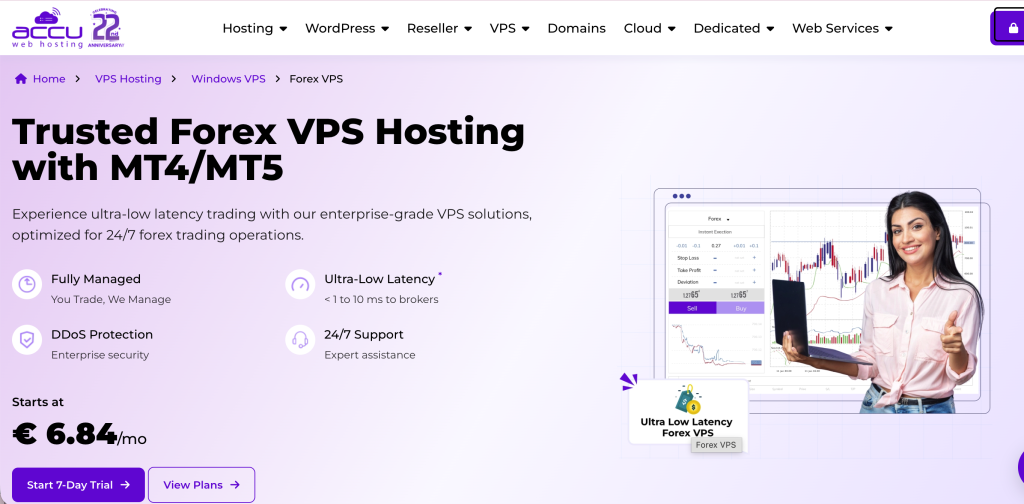
AccuWeb is a general web host with a Forex line rather than a Forex specialist, and its advantage on this comparison is reach: more than 20 data centers worldwide, including New York, Chicago, London, Frankfurt, Amsterdam, Tokyo, Singapore, Mumbai, and Sydney [5]. The catch for a latency-sensitive bot is that the pages name cities, not Forex halls, so whether the New York site is in or near NY4 is not confirmed [5]. Its dedicated servers run a 250 Mbps to 1 Gbps port, with 10 Gbps available on request, and the dedicated-servers page states redundant networking and premium bandwidth, though it does not name the upstream carriers [5]. Anti-DDoS covering volumetric and application-layer attacks is included on most dedicated servers [5]. Several numbers need confirming before you rely on them: connectivity appears as both “up to 10 Gbps” and “up to 100 Gbps,” the port as both 250 Mbps to 1 Gbps and a “minimum public bandwidth of 500 Mbit/s,” and uptime as a 99.99 percent guarantee alongside a separate 100 percent network-and-power uptime SLA [5].
Strengths: more than 20 global data centers, among the widest geographic choices in this set [5]; redundant networking and premium bandwidth stated on the dedicated-servers page [5]; anti-DDoS against volumetric and application-layer attacks on most dedicated servers [5]; 10 Gbps connectivity available on request [5].
Limitations: locations are named by city, not by Forex hall, so proximity to a broker’s matching engine is unconfirmed [5]; the page gives three inconsistent figures, connectivity at 10 and 100 Gbps, the port at 250 Mbps to 1 Gbps and a 500 Mbit/s minimum, and uptime as a 99.99 percent guarantee beside a separate 100 percent network-and-power SLA, so each needs confirming [5]; the standard port is 250 Mbps to 1 Gbps unless you request more [5]; it is general hosting with a Forex option rather than purpose-built Forex infrastructure [5]; no money-back guarantee or trial applies to dedicated servers [5].
7. General-cloud regions, dedicated from $99: Cloudzy
Infrastructure tier: general cloud with dedicated bare metal
Operator: Cloudzy AI Information Technology L.L.C. (Dubai)
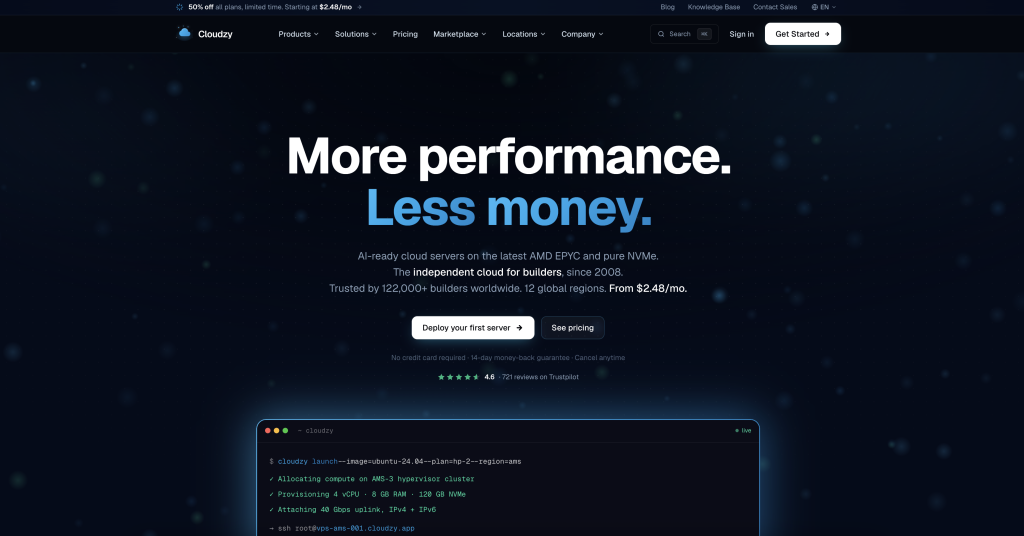
Cloudzy is a general cloud provider rather than a Forex host, offering 13 regions across eight countries, including New York, London, Frankfurt, Amsterdam, Singapore, and Dubai, with dedicated bare metal quoted on request from a $99 per month homepage starting price and a 99.95 percent uptime SLA; its dedicated FAQ counts 12 regions and says stock is deepest in Utah, Dallas, Amsterdam, and Frankfurt [6]. For Forex automation the location story is the weak point: these are general-cloud regions, not Forex colocations, so a server labeled New York is not a cross-connect to NY4 [6]. Where Cloudzy is strong is raw network and inclusives: it advertises 40 Gb/s uplinks on every plan, NVMe storage, and network-edge DDoS filtering on every dedicated server, with volumetric attacks dropped upstream of the hardware, with a monthly transfer allowance of 1 to 5 terabytes on the listed plans alongside a no-egress-fees claim [6]. That makes it a reasonable home for a headless bot that talks to a broker API and does not need in-hall proximity, but a poor match for a latency-sensitive strategy that must sit next to a specific matching engine.
Strengths: 40 Gb/s uplinks on every plan, among the highest headline network figures here [6]; network-edge DDoS filtering stated for every dedicated server [6]; dedicated bare metal in most of its 13 general-cloud regions, including New York, London, Frankfurt, Amsterdam, Singapore, and Dubai, with the deepest stock in Utah, Dallas, Amsterdam, and Frankfurt [6]; dedicated bare metal quoted from $99 per month, with a 99.95 percent uptime SLA and a 14-day money-back guarantee that applies to dedicated servers, the only such term in this set [6].
Limitations: its regions are general cloud, not Forex colocations, so it cannot offer an in-hall cross-connect to a broker [6]; the transfer allowance, 1 to 5 terabytes on the listed plans, sits beside a no-egress-fees claim, so confirm the real limit [6]; dedicated servers are quoted on request above a $99 homepage starting price; the page publishes a hardware menu (EPYC or Xeon Scalable, DDR5 ECC, NVMe, 40 Gbps NICs, IPMI) but no per-configuration prices, and its FAQ gives the region count as 12 rather than the 13 stated elsewhere, with deeper stock in Utah, Dallas, Amsterdam and Frankfurt [6]; the site advertises both 40 Gb/s uplinks and a separate 10 Gbps bandwidth feature, so confirm the per-server figure before relying on it [6].
Five mistakes that interrupt an automated strategy
The first mistake is buying on the city name instead of the facility. A plan that lists a New York location can mean a cross-connect inside NY4, as NYCServers names on its dedicated line [3], or a general-cloud region somewhere in the New York area, as Cloudzy offers [6], and those two are milliseconds apart. Before you buy, ask which building, not which city.
The second is over-weighting headline bandwidth. Cloudzy’s 40 Gb/s uplinks [6] and AccuWeb’s “up to 100 Gbps” claim [5] are large numbers, but an automated strategy sends small order and market-data messages, so a redundant 1 Gbps link with low jitter protects it better than a big pipe that saturates. Weight the redundancy, not the headline figure.
The third is trusting a “DDoS protected” label without asking what it means. No provider here documents always-on edge filtering with a stated capacity; AccuWeb, Cloudzy and ForexVPS.net are the most specific, AccuWeb naming volumetric and application-layer coverage on most dedicated servers [5], Cloudzy stating network-edge filtering upstream of the hardware on every dedicated server [6], and ForexVPS.net naming volumetric and L4 protocol-based coverage on its dedicated line [2], while TradingFXVPS lists protection as included on its own site but a third-party review table recorded it as not available [4]. Ask whether protection is always-on or on-demand, and what it can absorb, before you rely on it.
The fourth is assuming a colocation provider bundles DDoS mitigation. Beeks and NYCServers are built around colocation and neither documents DDoS on its dedicated product [1][3], though NYCServers does list it on a Basic VPS plan; in that model protection is often handled at the facility or by the client’s own appliance. If you need it included on a dedicated box, confirm it rather than assume it.
The fifth is running automation with no failover while trusting a 100 percent uptime guarantee to cover you. A guarantee is a service credit, not a second site, and two brands that run on one parent’s infrastructure, as ForexVPS.net and FXVM do, fail together rather than backing each other up [2]. For a strategy that holds positions, a second location or a documented failover path with an independent provider matters more than the number printed on the guarantee.
Which provider fits which automated setup
A trader whose broker sits in a specific Forex hall, and who wants the nearest possible cross-connect, is matched by NYCServers, which offers dedicated servers in six named facility codes including NY4 and LD4 and arrives with MetaTrader configured per broker [3].
A trader operating at institutional scale, cross-connecting to multiple liquidity providers and exchanges from inside the halls, is matched by Beeks, whose colocation in Aurora, Secaucus, Slough, Tokyo, Frankfurt, Hong Kong, and London and managed inter-site fiber are built for exactly that [1][8].
A trader who wants a named Equinix facility in London, New York, or Hong Kong with two published dedicated plans, ECC memory, and documented router-level redundancy is matched by VPSForexTrader, provided its LD3 and NY2 halls are close enough to the specific broker and its undocumented DDoS is confirmed directly [10][7].
A trader who wants the network and security dimensions documented rather than implied, a stated port range, redundant networking, and anti-DDoS on most servers, is matched by AccuWeb and its more than 20 global data centers, accepting that its locations are named by city rather than by Forex hall and that several of its figures need confirming [5].
A trader who wants eight metros, a CME-connected Chicago site, and a stated 10 Gbps network on the VPS plans, and can accept Equinix named without codes, is matched by TradingFXVPS [4].
A trader running a headless bot against a broker API, with no need to sit in a specific hall, can use Cloudzy, whose 40 Gb/s uplinks and included DDoS suit a general-region deployment [6].
And a trader drawn to a Forex specialist near the major metros can consider ForexVPS.net, keeping in mind that it and its sister brand FXVM share infrastructure, so pair it with an independent failover host [2].
Three things the comparison makes clear
First, naming a city and naming a facility are different claims. Beeks colocates inside the exchange facilities [8] and NYCServers names six facility codes, NY4, LD4, TY3, SG1, HK1, and DUB1 [3]; TradingFXVPS says its dedicated line is on Equinix data centres but gives no codes [4]; and the general hosts name only cities [5][6]. For a strategy that depends on a cross-connect, the facility code, not the city, is what decides latency.
Second, the providers closest to the Forex halls publish the least about network capacity and DDoS, while the general hosts publish the most. Beeks and NYCServers, the two in named halls, state no port speed and little DDoS detail on their dedicated products [1][3], whereas AccuWeb and Cloudzy, in general facilities, give port figures and name their DDoS coverage [5][6]. Proximity and documentation pull in opposite directions in this set, so you choose which to prioritize.
Third, for automation, uptime is a network-and-failover question, not a guarantee line. Three providers advertise a 100 percent figure [2][3][4], two of them beside an SLA whose credit threshold is 99.99 percent [2][4], but a guarantee is a service credit, and two brands that share one parent’s infrastructure, as ForexVPS.net and FXVM do, are a single point of failure rather than a failover pair [2].
The resilient setup is the right hall, documented redundancy, and an independent failover plan, in that order, rather than the largest uptime number on the page.
Frequently asked questions
Which Forex dedicated server is closest to broker servers in NY4 or LD4?
For a cross-connect inside the hall, Beeks colocates in Secaucus NY4 and NY5 and in Slough LD4 and LD5 [8], and NYCServers names dedicated servers in New York (NY4) and London (LD4) among its six facility codes [3]; both put you in the same facility as many brokers rather than merely in the same city. VPSForexTrader names Equinix LD3 and NY2, which are Equinix London and New York but not the LD4 and NY4 halls, so it helps only if your broker happens to share LD3 or NY2 [10][7]. The deciding step is to confirm which hall your specific broker uses, because being in NY4 helps only if your broker is in NY4 and not, say, NY5 or LD5.
What network speed does a dedicated server need for automated trading?
Less than most pages imply: order and market-data messages are small, so a 1 Gbps port is ample for a single strategy, and redundancy and low jitter matter more than raw speed. AccuWeb lists a 250 Mbps to 1 Gbps port with 10 Gbps on request [5], which is already beyond what a typical bot consumes, so treat higher figures such as Cloudzy’s 40 Gb/s uplinks [6] as headroom rather than a requirement. VPSForexTrader states 1 Gbps on its dedicated line with redundant routers, which is likewise ample for a single strategy [10].
Does DDoS protection matter for automated Forex trading?
Yes, because a denial-of-service attack is an outage, and an outage leaves your positions unmanaged. Prefer always-on filtering at the network edge, but note that no provider here publishes a mitigation capacity; AccuWeb, Cloudzy and ForexVPS.net are the most specific, AccuWeb covering volumetric and application-layer attacks on most dedicated servers [5], Cloudzy filtering volumetric attacks at the network edge on every dedicated server [6], and ForexVPS.net covering volumetric and L4 protocol-based attacks [2], while Beeks, NYCServers, and VPSForexTrader do not document DDoS on their dedicated products [1][3][10].
Dedicated server or VPS for running EAs and bots?
A dedicated server gives you the whole machine, with no neighbors contending for CPU or network and more consistent latency, which suits a heavy multi-strategy or latency-sensitive setup; a VPS is cheaper and enough for one or a few EAs. For automation the deciding factor is usually consistency rather than peak power, so a dedicated server earns its cost once contention or jitter on a shared box starts hurting fills.
Which provider has servers in the most broker hubs?
Beeks has the widest Forex-hub presence, colocated across Aurora, Chicago, Secaucus, Slough, Tokyo, Frankfurt, Hong Kong, and London [8]; NYCServers names six facility codes, NY4, LD4, TY3, SG1, HK1, and DUB1 [3]; VPSForexTrader names Equinix LD3, NY2, and HK4 with Amsterdam [10]; and ForexVPS.net and AccuWeb offer the most locations overall, 22 and more than 20 respectively, though as cities rather than named Forex halls [2][5].
How do I keep an automated strategy running during a network attack or outage?
Combine three things: a provider that documents its DDoS mitigation, such as AccuWeb’s volumetric and application-layer coverage [5], a network with documented redundancy rather than a single carrier [5] (VPSForexTrader documents router-level redundancy and a nine-point-of-presence MPLS backbone [10]), and your own failover plan, meaning a second server in another location or with another, independent provider. Two brands on one parent’s infrastructure, as ForexVPS.net and FXVM are, do not count as failover for each other [2], so keep critical stop orders server-side with the broker, where they survive your server dropping [9].
References
[1] Beeks (Beeks Financial Cloud), the 18-data-centre global footprint (17 in the page meta description), Arista low-latency switches, a private caged colocation environment, and an order store at beeksfinancialcloud.com, https://beeksgroup.com/services/trading-infrastructure/, retrieved 26 October 2026.
[2] ForexVPS.net, own site: 22 locations marketed as Equinix-powered, 1 Gb/s bandwidth on the VPS plans, a marketed 100 percent uptime guarantee with SLA credits below 99.99 percent, anti-DDoS covering volumetric and L4 protocol-based attacks on the VPS and dedicated lines, dedicated servers from $270 per month (Intel Xeon or AMD EPYC/Ryzen, 16 to 128 GB RAM, 2x 500 GB to 2x 2 TB SSD), the 14-day money-back guarantee excluding dedicated servers, and the operator shown as Think Huge Ltd dba ForexVPS.net (Hong Kong), https://www.forexvps.net/, retrieved 26 October 2026; shared ownership with the sister brand FXVM per https://thinkhuge.net, checked 26 October 2026.
[3] NYCServers (GreenHill Technologies Inc.), dedicated-server plans listed in six named facility codes (New York NY4, London LD4, Tokyo TY3, Singapore SG1, Hong Kong HK1, and Dublin DUB1; the first five Equinix halls, DUB1 outside Equinix’s DB-series naming), MetaTrader pre-installation, a 100 percent uptime guarantee, no published port speed, DDoS not documented on the dedicated page, and no refunds on dedicated orders, https://newyorkcityservers.com/forex-dedicated-servers, checked 26 October 2026.
[4] TradingFXVPS, own site: eight locations (New York, London, Amsterdam, Frankfurt, Chicago for the CME, Hong Kong, Singapore, Tokyo), the dedicated line described as on Equinix data centres, 10 Gbps network speed on VPS plans, DDoS protection listed as included, a 30-day money-back guarantee on VPS only with dedicated servers excluded, and uptime stated as both a 99.99 percent SLA (footer) and 100 percent (hero); operating entity shown as High Frequency Trading Network Pte Ltd (footer) and Next Era Pte Ltd (press releases), https://tradingfxvps.com/, retrieved 26 October 2026; a third-party review table at https://offbeatforex.com/tradingfxvps-review/ recorded DDoS as not available.
[5] AccuWeb Hosting, more than 20 global data centers, a 250 Mbps to 1 Gbps port (10 Gbps on request), redundant networking and premium bandwidth, anti-DDoS on most dedicated servers, and no money-back guarantee or trial on dedicated servers, with connectivity, port, and uptime figures stated inconsistently on the page (10 and 100 Gbps; 250 Mbps to 1 Gbps and a 500 Mbit/s minimum; a 99.99 percent guarantee beside a 100 percent network-and-power SLA), https://accuwebhosting.com/dedicated-servers, retrieved 26 October 2026.
[6] Cloudzy, own site: 13 cloud regions, 40 Gb/s uplinks on every plan, network-edge DDoS filtering stated for every dedicated server (volumetric attacks filtered upstream), a 99.95 percent uptime SLA, dedicated bare metal quoted on request from a $99 per month homepage starting price with a published hardware menu but no per-configuration prices, a dedicated FAQ that counts 12 regions, a 14-day money-back guarantee covering dedicated servers, transfer allowances of 1 to 5 terabytes on the listed plans beside a no-egress-fees claim, and the operator shown as Cloudzy AI Information Technology L.L.C. (Dubai), https://cloudzy.com/, retrieved 26 October 2026.
[7] Equinix, data-center facility naming for the Forex and exchange halls referenced throughout (NY4, NY5, LD4, LD5, TY3, FR2, HK1, HK2, SG1), https://www.equinix.com/data-centers.
[8] CME Group vendor directory, Beeks Financial Cloud entry (vendor-supplied text): the colocation sites (Aurora, 350 Cermak, NY4/NY5, LD4/LD5, TY3, Hong Kong HKEX, FR2, and London LSE), dedicated fiber between sites, 100 Mbps to 100 Gbps bandwidth, a UK network operations center, 24/7 support, and the CME Globex location in Aurora, Illinois, https://www.cmegroup.com/solutions/market-tech-and-data-services/technology-vendor-services/beeks-financial-cloud.html, retrieved 23 October 2026.
[9] Uptime arithmetic (99.99 percent is about 52.6 minutes a year, a direct calculation) and the distinction between server-side orders, which the broker holds through a disconnection, and client-side logic, which stops when the server stops, per MetaQuotes platform documentation, https://www.mql5.com/en/docs.
[10] VPSForexTrader, Equinix facility codes LD3 (London), NY2 (New York), and HK4 (Hong Kong) and an Amsterdam site at Serverius; two dedicated plans, FX Pro (8 cores, 16 GB ECC RAM, 2x 250 GB SSD RAID 1, up to 25 terminals) and FX Premier (16 cores, 48 GB
[11] ECC RAM, 2x 400 GB SSD RAID 1, up to 150 terminals), on Windows Server 2025 Standard with daily backups and a 1 Gbps line; a nine-point-of-presence MPLS backbone with redundant routers and connectivity through Tier-1 providers; 99.99 percent uptime displayed on the product pages with no guarantee in the Terms; base pricing $165.00 and $400.00 per month at last capture, to be pulled live and dated at publication; all per the provider, https://vpsforextrader.com, checked 28 October 2026.
Editorial note
Specifications were verified on 26 October 2026 from each provider’s own pages, with locations cross-referenced to Equinix facility naming and Beeks’s entry in CME Group’s vendor directory. Several providers publish inconsistent connectivity, port, or uptime figures, each flagged in the text. Broker and liquidity-provider colocation in specific halls is widely documented but not asserted here from any broker’s own records; confirm your own broker’s facility before relying on proximity. Network-capacity, DDoS-protection, latency, and uptime claims published by any provider are commercially motivated and are not independently replicated here, and no provider publishes a DDoS mitigation capacity, so those claims are directional. This article covers infrastructure only. It is not financial, investment, or trading advice, and it makes no claim about trading outcomes; execution quality depends on your broker, your strategy, and market conditions, none of which a server location fully controls.
Change log
23 October 2026: first publication, seven providers, with locations cross-referenced to Equinix facility naming and CME Group’s Beeks listing.
26 October 2026, revision 2: reframed the Equinix-hall and sub-millisecond claims as widely documented; added live source URLs and renumbered the references.
26 October 2026, revision 3: corrected NYCServers to six dedicated-server facilities and set its operator to GreenHill Technologies Inc.; renamed BeeksFX to Beeks (Beeks Financial Cloud); re-pointed the dedicated-fiber, bandwidth, network-operations-center, and support claims to the CME Group listing; narrowed the Beeks pricing limitation.
26 October 2026, revision 4: corrected the TradingFXVPS DDoS description (the provider lists it as included; changed NYCServers from “Equinix halls” to “named facility codes” and noted that DUB1 is not an Equinix code; updated the Beeks reference URL and added London LSE so the CME count reconciles.
27 October 2026, revision 5: corrected the Cloudzy DDoS description (network-edge filtering stated on every dedicated server) and narrowed its dedicated region and specification claims to what the dedicated page publishes; added the dedicated refund terms for NYCServers, TradingFXVPS, AccuWeb, and Cloudzy alongside ForexVPS.net; reattributed the CME Group source as Beeks’s own vendor-directory entry, noted Hong Kong as HKEX, and reworded the Beeks retail filter.